The right way to get internet in China depends on your phone, trip length, need for a Chinese number, data usage and tolerance for in-person setup. This guide compares travel eSIM, local SIM, international roaming, public Wi-Fi and pocket Wi-Fi.
Quick answer: A travel eSIM is usually the simplest fit for a short trip when your phone is unlocked and eSIM-compatible. Choose a local SIM when you need a mainland Chinese number, choose roaming when keeping your normal number matters most, and use public Wi-Fi only as a backup.
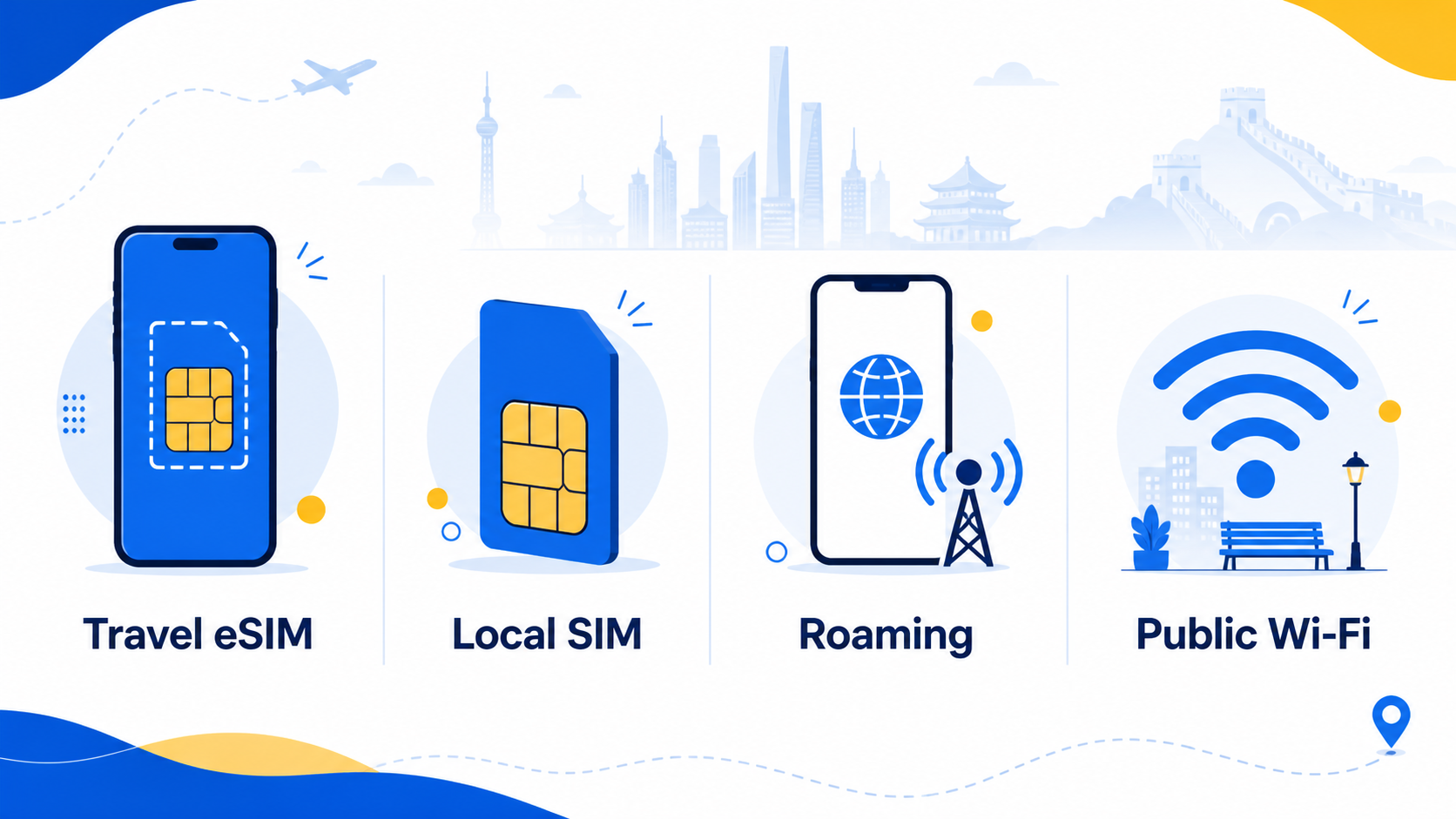
How to get internet in China as a tourist: options at a glance
There is no universal winner. The table below separates convenience, number access, setup and the main limitation of each option.
| Option | Best for | Setup | Local number | Main trade-off |
|---|---|---|---|---|
| Travel eSIM | Short-term visitors who want data before arrival | Online; install over Wi-Fi | Usually no | Requires an unlocked, compatible phone |
| Local SIM | Longer stays or domestic calls and SMS | In person at an operator service hall | Yes, depending on plan | Passport registration and possible cancellation work |
| International roaming | Keeping your normal number | Activate with your home carrier | Your usual number | Price and allowance can be limited or high |
| Public Wi-Fi | Backup access in hotels and venues | Connect at each location | No | Venue-dependent, sometimes slow or verified |
| Pocket Wi-Fi | Groups and multiple devices | Rent, collect and charge a hotspot | No | Extra device, battery and return logistics |
What to check before choosing China internet
- Check that your phone is unlocked. A carrier-locked phone may reject another SIM or eSIM profile.
- Check the exact model and region. eSIM support can vary by model, country of origin and regional variant. Do not rely only on the phone family name.
- Decide whether you need a Chinese number. Data-only travel plans do not replace a local number for domestic calls, SMS or services that require one.
- Estimate your data. Maps, messages and translation are lighter than video, cloud photo backup, video calls or hotspot use. Use the China travel data guide for planning.
- Identify the services you cannot lose access to. Routing, app availability, device settings and local conditions can affect the result. No provider should promise that every app works in every situation.
Option 1: use a travel eSIM in China
A travel eSIM is a digital SIM profile purchased online and installed on a compatible phone. You normally receive a QR code or activation details by email, install the profile over Wi-Fi, and select it for mobile data after arrival.
Why tourists choose it
You can arrange the connection before departure, keep your physical SIM in the phone and avoid finding a telecom store immediately after landing. It is useful when you mainly need mobile data and do not need a local number.
The current Ezigo China eSIM plan page lists mainland China data-only plans with instant QR delivery, 4G/LTE/5G where available and hotspot support on applicable plans.
What can vary
Check the coverage boundary, validity start, QR installation rule, network, fair-use terms and tethering policy. Confirm whether the plan covers mainland China only or also Hong Kong and Macau.
Read Can You Use an eSIM in China? for device, installation and profile considerations.
Option 2: buy a local SIM card in China
A local SIM can provide a domestic mobile connection and, depending on the plan, a mainland Chinese number for calls and SMS. It is most useful for longer stays, local communications or services that require a Chinese number.
What foreign visitors need to know
China uses real-name registration for mobile services. Official guidance says foreign nationals can generally apply with an original passport or an eligible foreign permanent resident ID at a telecom operator’s directly operated service hall. The application is handled in person rather than by another person on the visitor’s behalf.
Not every small phone shop is equipped to process a foreign passport. The safer approach is to use a directly operated China Mobile, China Unicom or China Telecom service hall and confirm acceptance before travelling there. Beijing’s official guidance lists airport service counters, but locations, terminals and hours can change.
Short-term visitor plans exist in some cities. Shanghai’s official foreign-service guidance describes 7-day, 15-day and 30-day options in some locations. This is not a promise for every city or operator, so ask about the exact validity, data allowance, voice/SMS inclusion, renewal and cancellation terms.
Option 3: use international roaming
International roaming connects your normal SIM to a partner network in China. You keep your usual number and contacts, while your home carrier handles billing. It can be the easiest option for a very short trip or when receiving calls and SMS on your normal number matters.
The catch is that carriers use different structures: a daily pass, a fixed travel package or pay-as-you-go rates. Before departure, check your carrier’s official China page for the price, trigger, high-speed allowance, reduced-speed limit, call and SMS rules, hotspot policy, 4G/5G availability, activation, cancellation and overage billing.
Can you rely on public Wi-Fi in China?
Hotels, airports, restaurants, cafés, shopping centres and tourist venues often provide Wi-Fi. It can help you download an eSIM, check a booking or save mobile data, but it is not a dependable replacement for a mobile connection.
Free Wi-Fi may open a captive portal asking you to accept terms, enter a local phone number or complete another verification step. Networks without a password may be congested or slow. Password-protected networks are often limited to customers or guests, so you may need to ask the venue staff for the current password.
Security matters as well. The U.S. Federal Trade Commission recommends precautions on public networks even though many modern websites use HTTPS. Turn off automatic connection, use secure websites and avoid entering sensitive information on a suspicious portal. Treat public Wi-Fi as a supplement, not your arrival plan.

Where does pocket Wi-Fi fit?
Pocket Wi-Fi is a rented hotspot that can connect several devices. It may suit couples, families or work teams, and it can help when some travellers’ phones are not eSIM-compatible.
The trade-offs are rental and return arrangements, battery management and staying near the device. A hotspot-enabled travel eSIM can provide similar sharing without extra hardware, but check the plan’s tethering rule and data allowance. See China eSIM Hotspot for practical sharing considerations.
Which China internet option fits your trip?
Travel eSIM
Choose this when you have an unlocked compatible phone, want data ready before flying and do not need a local number.
Local SIM
Choose this when domestic calls, SMS or a mainland Chinese number are important, and you can visit an official service hall.
Roaming
Choose this when you want to keep your normal number and your home carrier offers clear, acceptable China terms.
Pocket Wi-Fi
Choose this when a group needs to share one connection and carrying, charging and returning a hotspot is acceptable.
Prepare your connection before departure
- Confirm the phone setup. Check the unlocked status, exact model, regional variant and eSIM compatibility.
- Buy or activate the chosen plan early. Keep the QR code, carrier instructions and support contact available offline.
- Install over stable Wi-Fi. Understand which line will provide mobile data before changing your settings.
- Save essential information offline. Keep hotel, station and attraction names in English and Chinese, plus booking screenshots and emergency contacts.
- Protect your primary SIM. If you keep it in the phone for SMS, turn off data roaming on that line and check your home carrier’s charges.
- Test after arrival. Select the travel line for data and enable data roaming if the provider’s instructions require it, then test before leaving the airport or hotel Wi-Fi.
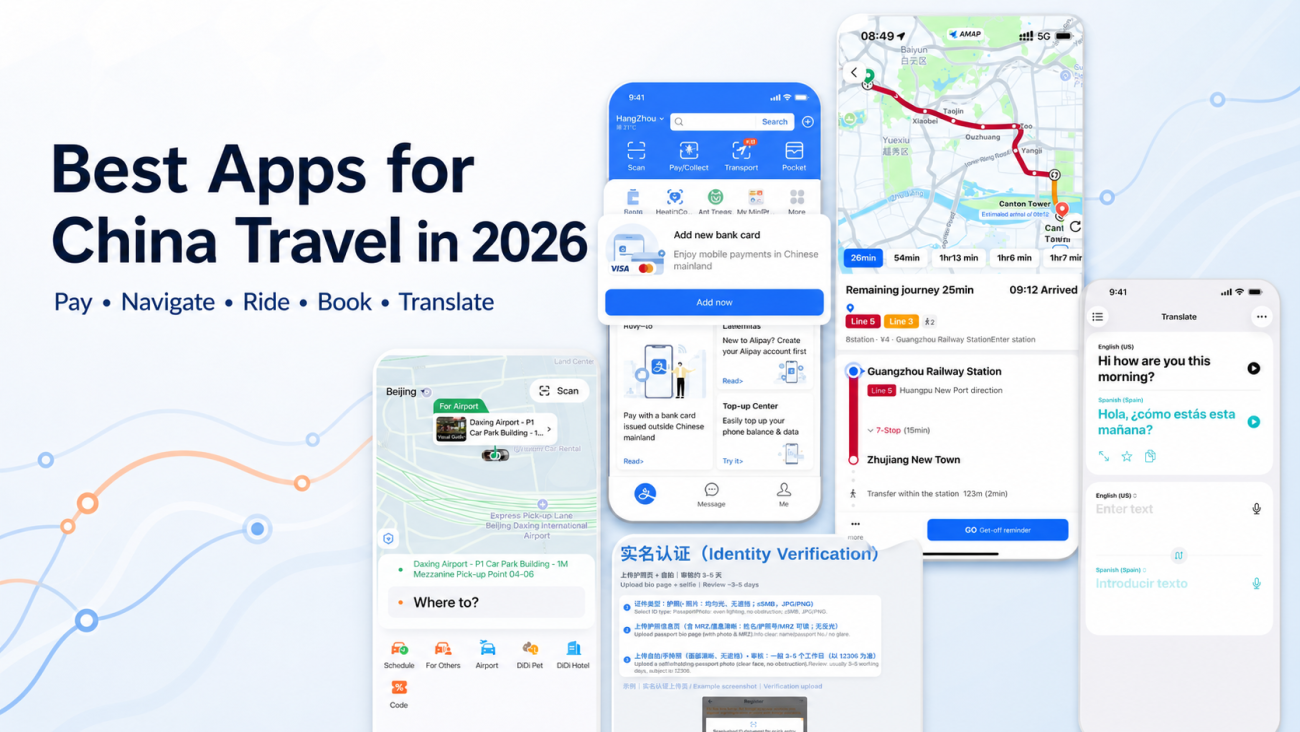
For app preparation, see Best Apps for China Travel. For expectations around supported apps and routing, read Does WhatsApp Work in China?.
| Before you leave | What to confirm |
|---|---|
| Phone | Unlocked, exact model and eSIM compatibility |
| Plan | Coverage, validity start, data allowance, speed policy and hotspot rules |
| Accounts | Payment verification, travel app login and access to one-time codes |
| Offline backup | QR code, bookings, maps, translations, addresses and support details |
Compare current China eSIM plans
Review mainland coverage, data type, validity, hotspot support and the live checkout price before your trip.
Frequently asked questions
Can tourists buy a local SIM card in China?
Yes. Foreign visitors can generally apply at a directly operated telecom service hall using an original passport or an eligible foreign permanent resident ID. Real-name registration and in-person verification apply, so confirm the store’s current ability to serve foreign visitors before going.
Is a travel eSIM better than a local SIM in China?
For many short-term visitors, a travel eSIM is easier because it can be arranged before arrival and does not require a store visit. A local SIM is better when you need a mainland Chinese phone number, domestic calls or SMS. Device compatibility and plan details still need to be checked.
Can I use my normal SIM card in China?
You may be able to use it through international roaming if your home carrier supports China. Check the official price, data allowance, activation trigger, hotspot rules and overage terms before enabling mobile data abroad.
Can public Wi-Fi replace a SIM or eSIM in China?
Not reliably. Public Wi-Fi can require a captive portal or local verification, may be slow, and only works inside the venue. Keep a mobile-data option for navigation, transport, translation and urgent communication.
Does a China travel eSIM include a local phone number?
Many travel eSIMs are data-only and do not include a mainland Chinese number, voice calls or SMS. Read the plan details carefully. If you need a local number, compare a local SIM instead.
The practical choice for most short trips
The best way to get internet in China as a tourist depends on the role your connection needs to play. A travel eSIM prioritises pre-arrival data, a local SIM prioritises a Chinese number, roaming prioritises continuity with your home carrier, pocket Wi-Fi prioritises group sharing, and public Wi-Fi is a backup.
Start with phone compatibility, number requirements, data needs and the exact plan rules. If a travel eSIM fits your trip, compare the current Ezigo China eSIM plans and keep the installation instructions available offline.
Sources and editorial notes
Local-SIM requirements were checked against Ministry of Industry and Information Technology guidance and Beijing government guidance. Short-term-plan examples were checked against Shanghai official guidance. Device-region distinctions were checked against Apple’s eSIM guidance and Samsung’s eSIM guidance. Public-network security wording follows FTC guidance.
Ezigo plan features, prices, validity, networks, hotspot rules and fair-use terms should be rechecked against the live product page immediately before publication. This article does not promise universal access to every app or network condition.
High-speed data, wherever your journey leads
Enjoy instant, secure mobile data with Ezigo eSIM in 200+ destinations. No physical SIM needed.