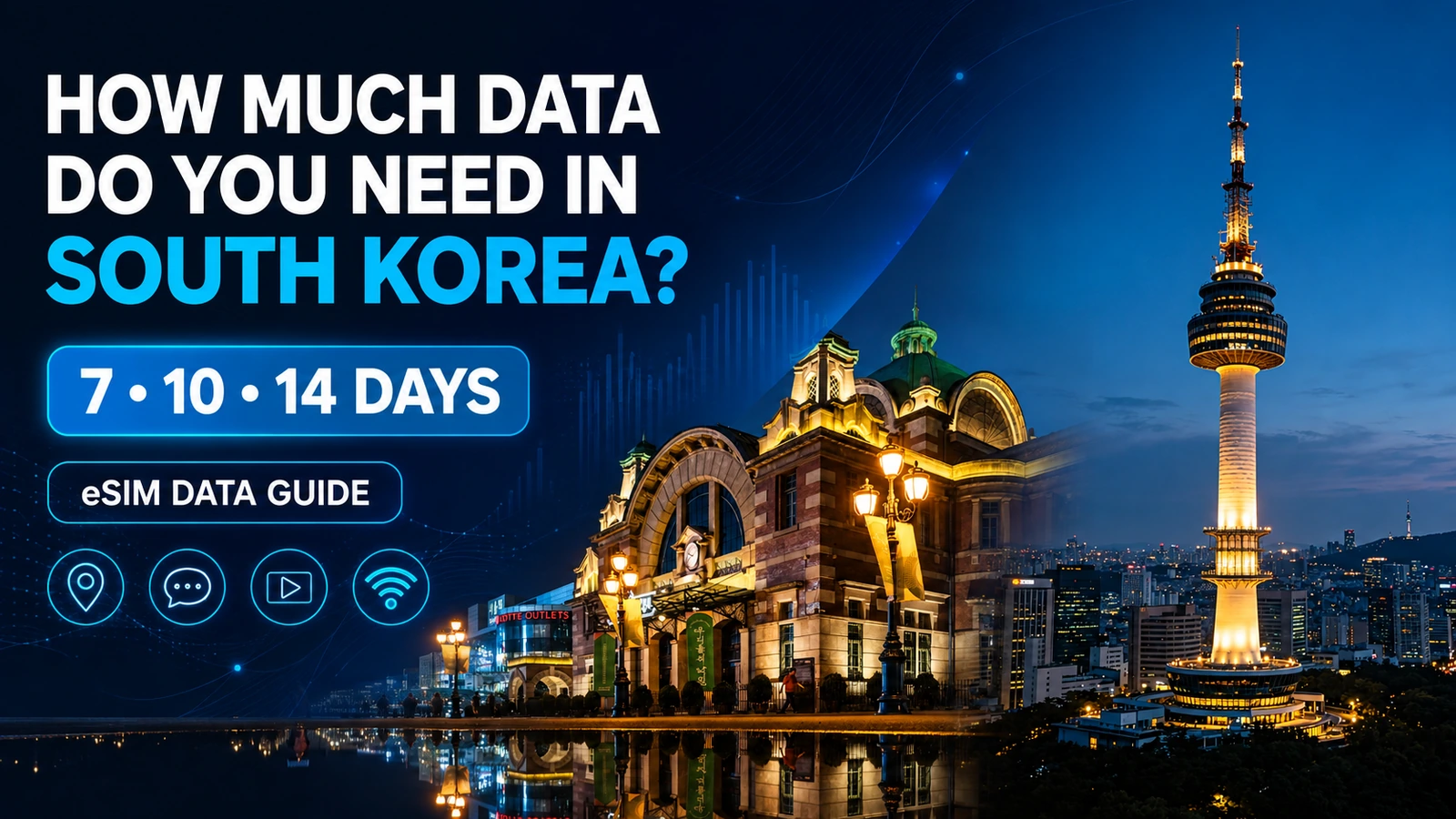
How much data do you need in South Korea? Most tourists should start with 5–10GB for seven days, about 10GB for 10 days, or 10–20GB for 14 days. Maps and messaging use relatively little. Video, cloud uploads and laptop hotspot use are what usually push a traveler into a larger plan.
Prices shown in USD
Usage ranges are planning estimates
Quick answer
| Trip length | Light use | Typical tourist | Heavy use | Very heavy use |
|---|---|---|---|---|
| 7 days | 3–5GB | 5–10GB | 10–14GB | 2GB+/day |
| 10 days | 5GB | About 10GB | 15–20GB | 2–3GB+/day |
| 14 days | 5–10GB | 10–20GB | 20–30GB | 3GB+/day |
These ranges assume you use mobile data while sightseeing but leave large downloads and long video sessions for Wi-Fi. Add a buffer if losing connectivity would disrupt navigation or work.
Commercial disclosure: EziGo publishes this guide and sells the South Korea eSIM plans discussed below. Recommendations use the stated allowances, validity and post-allowance rules; they are not based on a controlled usage test. Prices were checked on September 3, 2026 and may change.
How much data do you need in South Korea by trip length?
A seven-day visitor using Naver Map, messaging and ticket apps can often stay within 5GB. Ten gigabytes is safer with daily social media and photo uploads. Regular video or hotspot use calls for a larger allowance.
For 10 days, 10GB is the practical default. Light users can manage with 5GB, while 15–20GB suits frequent uploads or video away from Wi-Fi.
For 14 days, start between 10GB and 20GB. Choose the lower amount with reliable accommodation Wi-Fi. Choose 20GB or a daily plan for regular video, uploads or hotspot sharing.
A simple calculation keeps the decision grounded:
expected daily mobile use × number of travel days × 1.2 safety buffer
For example, 0.75GB per day over 10 days equals 7.5GB. With a 20% buffer, the estimate becomes 9GB, so a 10GB plan is the sensible fit.
Estimate your daily South Korea travel data usage
Choose the description closest to your normal behavior—not the person you hope to become on vacation.
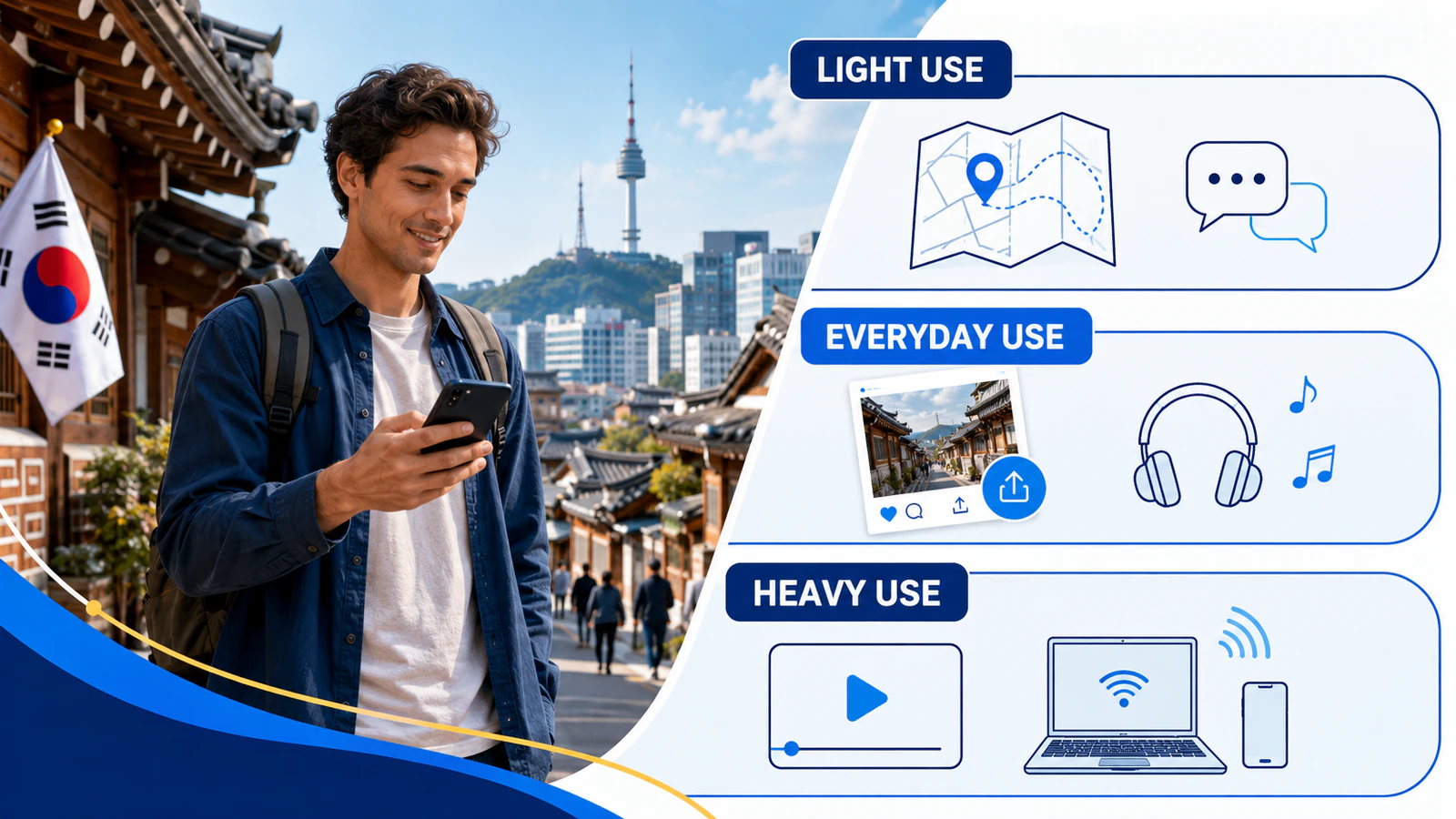
- Light: 0.3–0.5GB/day. Maps, text messages, tickets, translation and occasional searches, with little mobile video.
- Typical: 0.5–1GB/day. Navigation, bookings, social feeds, photo uploads and short periods of video.
- Heavy: 1–2GB/day. Frequent video, video calls, cloud uploads or occasional laptop tethering.
- Very heavy: 2GB+/day. Daily hotspot work, long streaming sessions, large transfers or several connected devices.
Your first full day is the best reality check. Reset cellular statistics on arrival and review app-level use that evening. Apple places this under Settings > Cellular; Android phones provide a similar view.
Which travel activities use the most data in Korea?
Maps matter, but video usually determines plan size. The Korea Tourism Organization describes Naver Map as a widely used service for routes, places and public transport. Live results need connectivity, but navigation is lighter than continuous video or large uploads.
| Activity | Relative use | What changes consumption | Planning advice |
|---|---|---|---|
| Naver Map, KakaoMap and transit searches | Low | Place photos and repeated live refreshes | Keep data active; do not buy a large plan for maps alone. |
| Messaging and translation | Low | Voice notes, photos and automatic downloads | Text is light; media-heavy group chats are not. |
| Social feeds and photo uploads | Medium | Autoplay and original-quality uploads | Budget closer to 1GB/day if used regularly. |
| Music and podcasts | Low–medium | Audio quality and pre-downloaded tracks | Download playlists before long train journeys. |
| Video streaming | High | Resolution and autoplay | Netflix lists up to 0.3GB/hour at low quality, 0.7GB at medium and 3GB at HD. |
| Hotspot, video calls and backup | High–variable | Laptop updates, file size and call quality | Prefer a daily plan with a clear post-limit rule. |
There is no dependable universal “MB per hour” figure for Naver Map. Cached data, place images and refresh frequency change the result, so your phone’s app statistics are more useful than another traveler’s estimate.
Total, daily or unlimited South Korea eSIM data?
What happens after the allowance is used matters as much as the plan’s headline number.
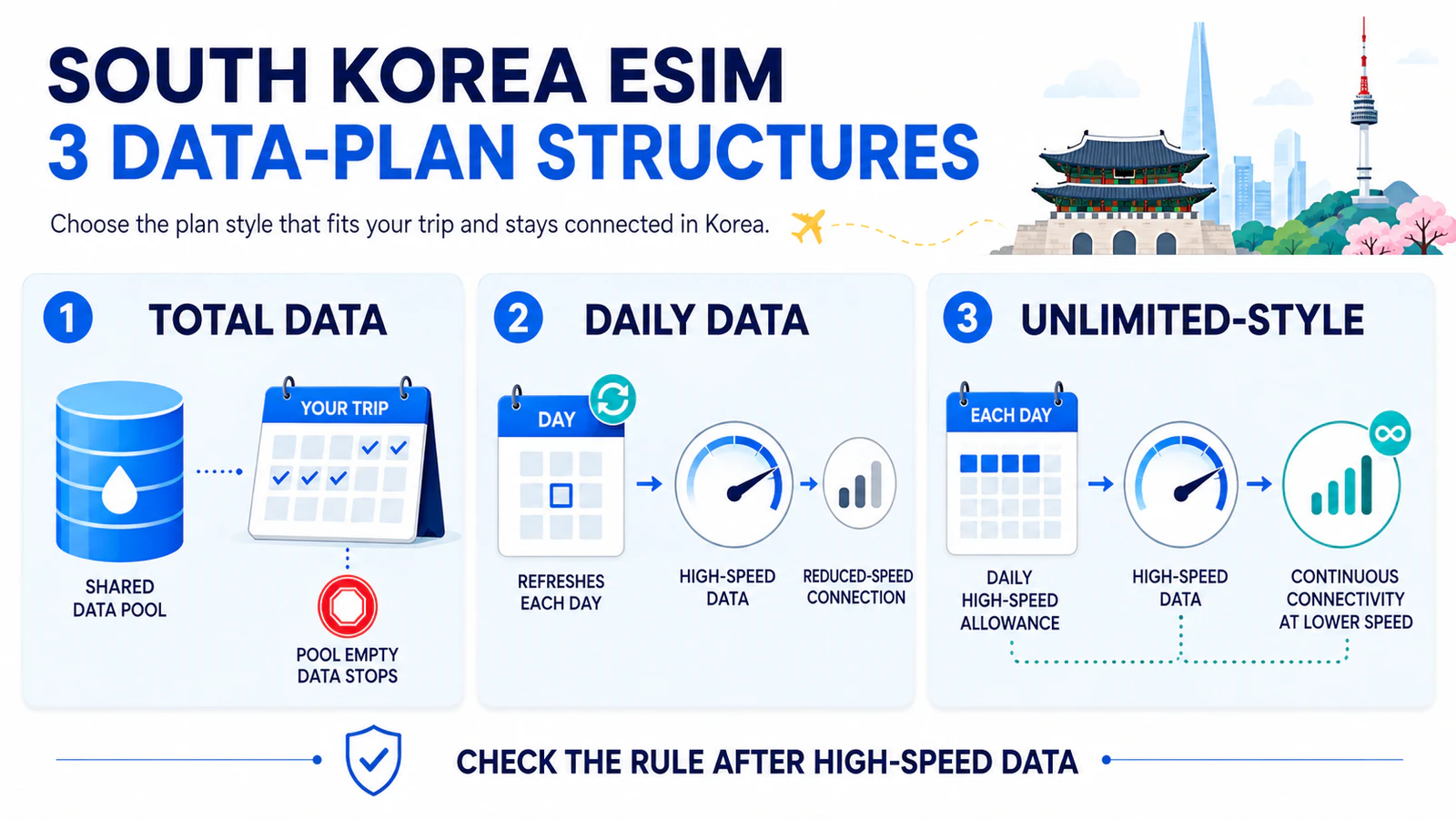
Total data: best value for most travelers
A Total plan is one flexible pool. You can use more data on a busy day and less on another. The 10GB/30-day plan costs $7.62, making it the price-led recommendation for a typical 7–14 day trip. The 5GB option is $5.09, so an extra 5GB of buffer costs $2.53 more.
Total plans stop when the included allowance is exhausted, but they support top-ups if you need additional data during your trip.
Daily data: better for consistent heavy use
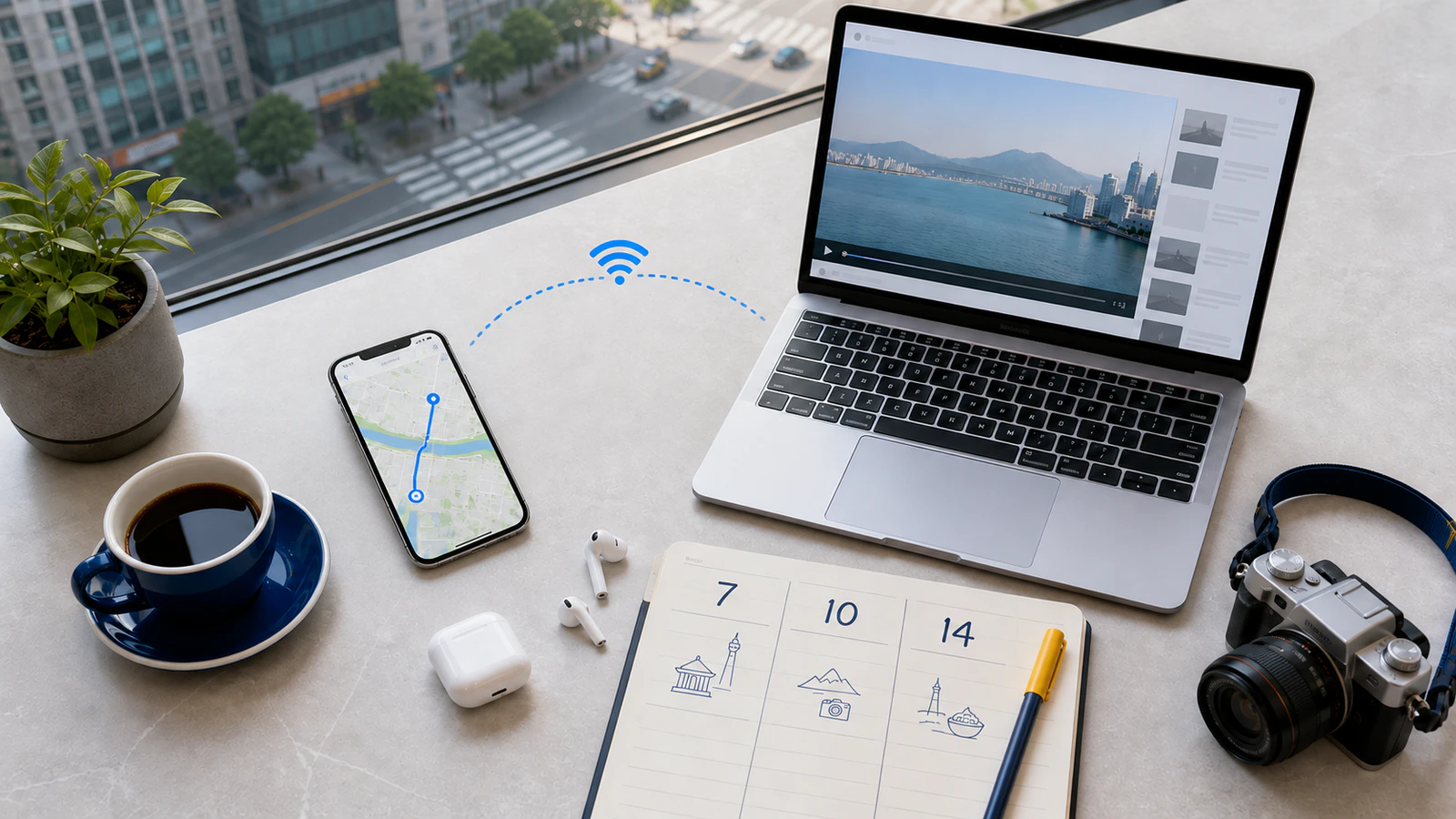
Daily plans provide 2GB or 3GB of high-speed data per day. After that day’s allowance is used, service continues at up to 384 Kbps until the daily reset. That fallback can handle basic messaging, but it is not comfortable for video or large uploads.
Choose Daily for steady heavy use and Total when consumption varies from day to day.
Unlimited-style data: better post-limit continuity
EziGo’s Unlimited plans include 2GB of high-speed data per day, then data at up to 5 Mbps until reset. This is not unlimited high-speed data. Choose it when post-limit usability matters more than the lowest price.
All currently listed EziGo South Korea plans support hotspot sharing. They are data-only and do not include a Korean number, calls or SMS. Validity starts when the eSIM first connects to a supported network in South Korea. Total plans support top-ups if you need additional data during your trip.
Recommended EziGo plans for 7, 10 and 14 days
| Trip | Usage | Suggested plan | Price | Why it fits |
|---|---|---|---|---|
| 7 days | Light | 3GB Total/15 days or 5GB Total/30 days | $3.83 / $5.09 | Flexible low-cost data |
| 7 days | Typical | 10GB Total/30 days | $7.62 | Strong value with a useful buffer |
| 7 days | Heavy | 2GB/day or 3GB/day/7 days | $7.02 / $8.88 | Up to 14GB or 21GB at high speed across the trip |
| 7 days | Very heavy | Unlimited-style/7 days | $18.51 | Up to 5 Mbps after 2GB of daily high-speed data |
| 10 days | Typical | 10GB Total/30 days | $7.62 | Best balance for ordinary sightseeing |
| 10 days | Heavy | 2GB/day/15 days or 20GB Total/30 days | $17.12 / $19.05 | Daily fallback versus flexible total use |
| 14 days | Typical | 10GB or 20GB Total/30 days | $7.62 / $19.05 | Choose by the amount of social video and uploading |
| 14 days | Heavy | 2GB/day or 3GB/day/15 days | $17.12 / $23.06 | Closely matches a two-week itinerary |
| 14 days | Very heavy | Unlimited-style/15 days | $38.58 | Stronger connection after the daily high-speed allowance |
Daily and unlimited-style plans list KT, LG U+ and SK Telecom, with 4G/LTE/5G where available. Total plans list SK Telecom and LG U+, with 5G where available. Device support, coverage and congestion still affect service.
Is 10GB enough for South Korea?
For most tourists, yes. Ten gigabytes is generous for seven days, a practical default for 10 days, and workable for 14 days if long video sessions, automatic backup and laptop use stay on Wi-Fi.
It is less suitable when your phone is the main entertainment connection or you upload original-quality video daily. In that case, use 2GB/day or 3GB/day. Choose unlimited-style data when post-limit speed matters.
How to reduce mobile data use in South Korea
Download media, language packs and travel documents on Wi-Fi. Turn off cellular photo backup, app updates and video autoplay; these changes matter more than micromanaging map searches.
Seoul offers Wi-Fi in many public locations, but it will not follow you throughout the trip. Mobile data remains useful between stations, on day trips and when a venue requires a login. Avoid sensitive transactions on untrusted open networks.
Offline maps can provide a backup, but Google notes that offline mode does not include public-transport, walking or cycling directions. In Korea, keeping a small amount of live data available is more useful than trying to travel entirely offline.
Frequently asked questions
How much data do I need for seven days in South Korea?
Most tourists should choose 5–10GB. Three to five gigabytes can work for light maps and messaging; regular video or hotspot use is better suited to 2GB/day or more.
How much data do I need for 10 days in Korea?
Around 10GB is the practical default. Choose 5GB if you are disciplined about Wi-Fi, or 15–20GB if you stream and upload frequently.
How much data do I need for two weeks in South Korea?
Plan on 10–20GB for ordinary sightseeing. Heavy users should consider 2GB/day; daily laptop work and long video sessions may justify 3GB/day or an unlimited-style plan.
Is 2GB per day enough in Korea?
It is enough for most tourists, including regular maps, messaging, social media and some video. It may not be enough at full speed for hours of streaming or daily laptop tethering.
What happens when an EziGo allowance is used?
Total plans stop when the included allowance is exhausted, but they support top-ups if you need more data. Daily plans continue at up to 384 Kbps until reset. Unlimited-style plans provide 2GB of high-speed data each day and then continue at up to 5 Mbps.
Conclusion
So, how much data do you need in South Korea? Start with 5–10GB for seven days, about 10GB for 10 days, or 10–20GB for 14 days. Move to 2GB/day, 3GB/day or an unlimited-style plan only when frequent video, uploads or hotspot use justify it.
For most travelers, the 10GB Total plan is the strongest value starting point. Review the full South Korea eSIM plans before checkout. If your next question is which provider or plan type to choose, see our separate comparison of the best eSIM options for South Korea.
Sources
High-speed data, wherever your journey leads
Enjoy instant, secure mobile data with Ezigo eSIM in 200+ destinations. No physical SIM needed.