Editorial note: Travel schedules, ticket release calendars, visa rules, and transit regulations in this guide are cross-referenced with announcements from China Railway 12306, the Palace Museum, the National Immigration Administration (NIA), and the Civil Aviation Administration of China (CAAC).
✓ Practical guide for international travelers: real-name passport ticketing rules, luggage guidance, mobile payment fee thresholds, and cross-border connectivity.
Quick answer: when is the best time to visit China?
The Optimal Windows: For broad cultural sightseeing across major regions (Beijing, Shanghai, Xi’an), the most balanced periods are autumn (mid-October to late November) and spring (April to May, outside statutory holiday weeks). Weather is generally temperate, rainfall is moderate, and domestic travel operates at regular baseline volumes.
- National Holidays to Plan Around: High domestic leisure volumes concentrate during National Day Golden Week (October 1–7) and the 5-day Labor Day break (May 1–5). Bullet train tickets sell out rapidly upon release, landmark entry slots exhaust days in advance, and scenic tourist hotels surge in price. Consider planning around these windows if you prefer lower crowd density.
- The Spring Festival (CNY) Reality: Chinese New Year (late January to mid-February) triggers the massive 40-day Chunyun transit migration. While major imperial palaces remain open, many independent restaurants, neighborhood markets, and private services may close for 7 to 15 days depending on the city.
- Key Ticketing Rules: High-speed rail tickets release 15 days in advance (inclusive of departure day) on 12306; Forbidden City tickets release at 20:00 (8:00 PM) Beijing Time 7 days prior via its official WeChat mini-program and desktop English portal. Note: The Palace Museum is strictly closed on Mondays throughout the year (except statutory public holidays).
- Stay Connected: Public Wi-Fi authentication at Chinese transit hubs is inconsistent and frequently requires domestic SMS logins. Setting up an Ezigo China Travel eSIM before departure provides immediate cellular data on arrival for navigation, digital payments, and ride hailing.
- Regional Climate Realities: Weather Beyond Generic Seasonal Averages
- Holiday Travel Peaks: Golden Week vs. Chinese New Year (Chunyun)
- China Travel Seasonality Matrix: Month-by-Month Guide
- Typical Peak-Period Patterns: 12306 Release Windows, Quotas, and Hotel Realities
- Essential Practical Logistics: 12306 Verification, Luggage Space, and Power Banks
- Realistic Travel Strategies: How to Handle Inflexible Holiday Itineraries
- A Critical Pre-Departure China Checklist
- Frequently Asked Questions
Regional Climate Realities: Weather Beyond Generic Seasonal Averages
Because mainland China spans subarctic latitudes in the north to tropical coastlines in the south, broad statements claiming a single “best month” oversimplify practical travel conditions. Weather patterns differ substantially across distinct regional climatic zones:
- Northern China (Beijing, Xi’an): Experiences cold, dry winters and warm summers. Autumn (mid-September through early November) delivers crisp air and stable blue skies. Spring brings mild weather, though occasional dry continental winds and dust can occur in early April.
- Yangtze River Basin & Eastern China (Shanghai, Hangzhou, Suzhou): Spring and autumn are temperate and pleasant. Summer is hot and humid, punctuated by the genuine Meiyu (Plum Rain) season from mid-June to early July, characterized by continuous overcast drizzle and elevated humidity.
- Southern China & Lingnan (Guangzhou, Shenzhen, Guilin): Subtropical maritime climate. Early spring (March to April) brings humid conditions locally known as Huinantian (回南天). Late spring brings heavy convective showers and the “Dragon Boat Rains” (龙舟水) from late May into June. Late autumn through early winter (October to January) is dry, comfortable, and sunny.
- Southwestern Plateaus (Yunnan, Western Sichuan): Marked by high elevation and variable microclimates. Summer (June to August) is cool but coincides with seasonal rainfall. Autumn (September to November) provides clear skies and vivid mountain landscapes across Lijiang and Shangri-La. Health Tip: Pack high-SPF sunscreen and allow a day of gradual acclimatization for high-altitude spots like Shangri-La (3,160m+).
- Northwestern Silk Road (Xinjiang, Gansu): Continental arid climate. Summer and early autumn (June to September) offer long daylight hours, dry conditions, and ripe local harvests. Winters are severely cold.
- Northeastern China (Harbin, Jilin): Winter (December to February) is not an off-peak dead zone, but a world-famous peak season for winter sports and the Harbin International Ice and Snow Sculpture Festival.
Holiday Travel Peaks: Golden Week vs. Chinese New Year (Chunyun)
When foreign travelers evaluate the best time to visit China, domestic travel surges present distinct challenges:
1. National Day Golden Week (October 1–7): High Volume, Full Operations
National Day commemorates the founding of the PRC. The statutory 7-day holiday mobilizes hundreds of millions of cumulative domestic passenger trips. Tourist landmarks, museums, retail centers, and urban transit remain open at full capacity. The challenge during early October is not commercial closures, but extreme passenger density, rapid high-speed rail sellouts, and surges in scenic accommodation rates.
2. Chinese New Year (Late Jan – Mid Feb): The Chunyun Migration & Neighborhood Closures
The Lunar New Year triggers Chunyun, an intensive 40-day domestic transit rush as workers travel across the country for family reunions. In tier-1 metropolitan centers like Beijing, Shanghai, and Shenzhen, commuter traffic eases considerably. However, independent restaurants, neighborhood markets, and private service providers may close for 7 to 15 days depending on the city. Intercity transport remains heavily booked, while historic temple fairs experience concentrated local crowds.
3. The 2026 Mid-Autumn Calendar & Labor Day Holidays
In 2026, the Mid-Autumn Festival falls on September 25 (with the weekend break spanning September 25–27), followed by three regular business days before National Day begins on October 1. Because the two holidays do not merge in 2026, they generate a double-peak transit pattern: a brief regional reunion travel surge in late September, followed days later by the primary national holiday rush. To explore the cultural traditions of this festival, read our guide on the Mid-Autumn Festival in China: Dates, Traditions & Travel Guide. Meanwhile, Labor Day (May 1–5) forms a statutory 5-day holiday, generating a secondary travel peak second only to October.

China Travel Seasonality Matrix: Month-by-Month Guide
When mapping out travel dates, evaluating climatic patterns alongside statutory holidays reveals practical travel windows across the year:

Typical Peak-Period Patterns: 12306 Release Windows, Quotas, and Hotel Realities
To navigate holiday periods successfully, international travelers should understand typical operational patterns:
| Travel Factor | Regular Travel Windows (e.g. Late Oct / Nov) | Peak Holiday Periods (Oct 1–7 / May 1–5) |
|---|---|---|
| High-Speed Rail (12306) | Tickets on non-peak dates often remain available closer to departure; official presales open 15 days ahead (inclusive of departure day) | Popular intercity routes often sell out rapidly once sales open 15 days ahead |
| Forbidden City Ticket Quotas | Bookable 3–7 days in advance | Daily quotas typically exhaust quickly when released at 20:00 (8:00 PM) 7 days prior |
| Hotel Pricing Divergence | Stable rates across all commercial zones | Scenic hotels may surge significantly; Central Business District (CBD) hotels frequently offer stable rates or promotions |
| Landmark Security & Entry Queues | 10–25 minutes | Wait times may extend to 60–120+ minutes during peak daytime entry |
- 12306 15-Day Booking Window: Train ticket presales commence exactly 15 days in advance, including the departure day (e.g., travel on Oct 1 opens on Sept 17). Release times vary by specific departure station and train category. Always consult the official “起售时间 (Ticket Release Time)” tool in the 12306 app to confirm the exact minute sales open for your station.
- Forbidden City Reservation & Monday Closure Rule: Overseas travelers can book via the official WeChat mini-program or the desktop portal (bookingticket.dpm.org.cn). Tickets release 7 days in advance at exactly 20:00 (8:00 PM) Beijing Time. Important: The Palace Museum is strictly closed on Mondays throughout the year (except during statutory public holidays). Always verify individual museum schedules before booking.
- Palace Museum Official Arrival Routes: The Meridian Gate (午门) serves as the sole entrance for visitors (Donghuamen and Shenwumen are exits). All visitors must undergo security checks before entering the Meridian Gate courtyard. Official arrival routes include walking north through Tiananmen Tower and Duanmen, or approaching Duanmen from Donghuamen Street (via Quezuomen) or Xihuamen Street (via Queyoumen). Always allocate ample buffer time for security checks, and adhere to on-site direction notices.
Essential Practical Logistics: 12306 Verification, Luggage Space, and Power Banks
International visitors navigating mainland China encounter local operational rules that require advance preparation:
- 12306 Passport Verification & Name Format Rules: Foreign passport details submitted on the 12306 platform must strictly follow the format and order shown on your passport data page. If hyphens, apostrophes, commas, or spaces cause system errors, align your entry with the Machine Readable Zone (MRZ) characters at the bottom of your passport. If your online verification remains pending while you are abroad and unable to visit a station ticket window in China, consider using authorized international platforms like Trip.com as a practical Plan B, as their enterprise interface enables international ticket issuance prior to physical station check-in. Note: Third-party booking does not replace any identity-verification or original-passport inspection requirements at the station.
- High-Speed Rail Turnstiles (Use the Staffed Lane): Automated e-Gates at Chinese high-speed railway stations only scan Chinese national 2nd-generation ID cards. Foreign passports cannot be read by automated gates. Pro Tip: Always look for the Staffed Lane (人工通道) located on the far left or far right of security checkpoints and boarding gates, where railway staff will manually scan and verify your passport.
- High-Speed Rail Luggage Space (28-Inch Suitcases): Overhead racks in Second Class (二等座) may not accommodate thick 28-inch suitcases, and shared storage closets at carriage ends fill quickly during holiday peaks. Luggage capacity and storage configurations vary by train model and passenger volume; do not block carriage aisles or emergency pathways.
- The 12306 Official “Waitlist (候补)”: When trains sell out immediately, avoid third-party “accelerator packages” (加速包), which are blocked by China Railway. Submit an official 12306 Waitlist request (候补购票) right away and add alternative train numbers and seat types; the fulfillment probability shown in the app is based on historical order fulfillment patterns and serves as an official reference.
- Power Bank (充电宝) Technical Safety Rules (Rail vs. Aviation):
• China Railway Rules: Portable chargers must have a rated capacity not exceeding 100Wh and must feature clearly printed, legible manufacturer specifications.
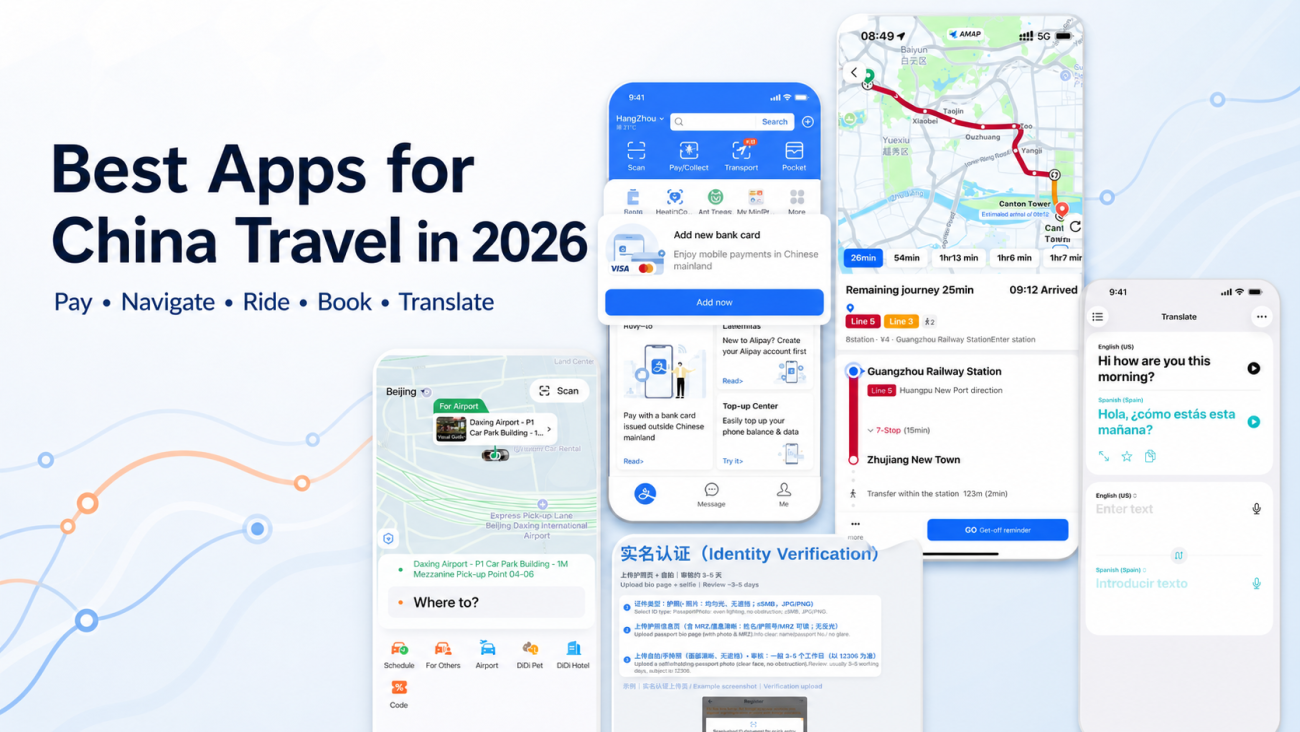
• Domestic Flights (CAAC Rules): Power banks $\le 100\text{Wh}$ (under ~27,000mAh at 3.7V) are permitted in carry-on baggage without airline approval. Units between 100Wh and 160Wh require airline authorization, and anything exceeding 160Wh is strictly prohibited. For flights within mainland China, power banks must feature a clear CCC (3C) certification mark and must not be recalled models. Chargers with worn-off, damaged, or unreadable specifications are not permitted past security checkpoints. Power banks are strictly forbidden in checked luggage. - Alipay & WeChat Pay Security Verification (KYC): While international credit cards link smoothly, continuous or higher-value transactions can trigger security fraud-prevention freezes. Complete in-app Identity Verification (KYC passport photo upload) before departure to prevent payment rejections at dining spots or ticket gates. Note that transactions over ¥200 RMB incur a 3% fee, and linked foreign cards cannot pay personal transfer codes; carry ¥200 to ¥500 in physical cash as a backup.
- Navigation Apps (Amap, Apple Maps, and MetroMan): Because mainland China uses an encrypted coordinate system (GCJ-02), Google Maps displays coordinate drift (often 50–500 meters off) and contains outdated public transit data. For reliable walking and driving directions, use Amap (高德地图) or Apple Maps. For Android users navigating subway networks across major cities, download MetroMan, an excellent bilingual, offline-capable Chinese subway routing app.

For a balanced technical comparison between airport physical SIM cards, local domestic plans, and digital eSIM options, explore our guide on How to Get Internet in China as a Tourist: eSIM vs. Local SIM vs. Roaming.
Realistic Travel Strategies: How to Handle Inflexible Holiday Itineraries
If your travel dates coincide with National Day or Labor Day, adopt realistic travel adjustments:
- Leverage CBD Hotel Deals: Instead of booking near overcrowded scenic areas where hotel prices surge, consider staying in central business districts (such as Beijing’s Financial Street/CBD, Shanghai’s Pudong/Lujiazui, or Shenzhen’s Nanshan). With corporate business travel paused during national holidays, luxury business hotels frequently offer competitive rates and tranquil environments.
- Consider Domestic Flights: When high-speed rail sells out, China’s domestic aviation network often retains available seats. Overseas travelers can book domestic flights with international credit cards via Trip.com.
- Avoid “Crowded Alternative” Pitfalls: Be cautious of generic advice recommending popular ancient towns like Pingyao or scenic areas like Yangshuo as “quiet alternatives”—these are top-tier national attractions that experience severe holiday congestion. If seeking lower crowd density, consider lesser-known regional destinations (such as Xingyi’s Wanfenglin in Guizhou or border regions in western Yunnan) rather than standard 5A heritage landmarks.
Many overseas itineraries combine mainland cultural capitals with international stopovers in Hong Kong and Macao. Select the travel data profile tailored to your travel route:
A critical pre-departure China checklist
Essential travel checks before departure
- Check Official Visa Exemption Criteria: Visa-free eligibility, permitted stay duration, and eligible travel purposes vary by nationality and passport type. Always verify current criteria via the official National Immigration Administration (NIA) portal before departure.
- Pre-Authenticate Mobile Payments: Link your credit card to Alipay and WeChat Pay, and complete in-app Identity Verification (KYC) with your passport photo. Remember that single transactions over ¥200 RMB incur a 3% fee; carry ¥200 to ¥500 in physical cash for small street vendors.
- Verify 12306 with Matching Name Format: Download the 12306 app and enter your passport details matching your passport data page (refer to MRZ line if punctuation errors occur). Remember to use the Staffed Lane (人工通道) at railway checkpoints.
- Inspect Power Bank Markings: Ensure your portable charger is rated under 100Wh and features clearly printed manufacturer capacity specifications and applicable 3C certification marks.
- Verify Handset eSIM Compatibility: Confirm your phone model supports digital eSIM technology. Note that most iPhone models manufactured for mainland China feature physical dual-nano-SIM slots and do not support eSIM; check your model details under Settings > General > About.
- Pre-Install Travel Data: Install an Ezigo China Travel eSIM over home Wi-Fi before boarding, ensuring you have mobile data the moment you touch down.
- Install Domestic Maps & Transit: Download Amap (高德地图) or use Apple Maps to avoid coordinate drift, and install MetroMan for English subway navigation across Chinese cities.
- Save Emergency Numbers: Police (110), Ambulance (120), Fire (119). For municipal public service inquiries and English government assistance in major metropolitan centers, dial the 12345 Citizen Hotline.
Frequently asked questions
How do Ezigo data validity and daily reset policies work in China? +
Data calculation depends on the package type selected:
• Total Data Plans (Fixed Gigabyte Buckets): Validity begins from the exact moment of activation and runs continuously for its full duration (e.g., a 7-day plan provides 168 uninterrupted hours).
• Daily Data & Unlimited Plans: Daily high-speed allotments reset daily according to mainland China local midnight (00:00:00 UTC+8), not a rolling 24-hour cycle. If you activate a daily plan at 17:00, your first calendar day completes at midnight local time.
Can foreign tourists buy attraction tickets on-site during Golden Week? +
Major cultural venues—including the Forbidden City and the Terracotta Army—rely on 100% real-name online pre-booking systems. During peak statutory holidays, visitor quotas sell out days or weeks in advance; walking up without a booking will result in denied entry. The Palace Museum does not sell same-day tickets on-site; its offline service desk at the Meridian Gate (午门) assists solely with online registration and identity inquiries. Note that the Forbidden City is strictly closed on Mondays throughout the year (except statutory public holidays).
Does WhatsApp work in China with a travel eSIM? +
Standard local domestic Wi-Fi and mainland physical SIM cards restrict access to overseas apps like WhatsApp and Google. International travel eSIMs route data through overseas partner networks (typically providing baseline round-trip latencies of 50–90 ms via regional transit hubs), enabling messaging, email, and social apps without third-party VPN configurations. Service availability depends on carrier routing and app policies. For detailed technical background, see our guide: Does WhatsApp Work in China? A Practical Connectivity Guide.
Are shops, restaurants, and transit closed during National Day Golden Week? +
During National Day Golden Week (Oct 1–7), retail stores, dining venues, and urban transit operate at peak capacity with extended hours. In contrast, during Chinese New Year (Spring Festival), many independent restaurants, neighborhood markets, and private service providers may close for 7 to 15 days as owners return home for family reunions.
Is late October cold in northern China (Beijing, Xi’an)? +
Late October in northern China brings crisp, pleasant autumn conditions. Daytime temperatures typically range between 15°C and 18°C (59°F–64°F), dropping to 5°C–8°C (41°F–46°F) at night. A mid-weight jacket or layered fleece with a windbreaker is ideal for daytime sightseeing.

Stay Seamlessly Connected in China with Ezigo
Avoid public Wi-Fi SMS login barriers and airport SIM queues. Activate cellular roaming across mainland China for reliable access to mobile payments, navigation, and messaging.
View China eSIM PlansSources and methodology
- Ministry of Culture and Tourism of the PRC: National Statutory Holiday Announcements
- China Railway 12306: Official Presale Regulations & Identity Verification Rules
- The Palace Museum (Forbidden City): Official Ticket Reservation Portal for International Visitors
- National Immigration Administration (NIA): Official Visa Exemption & Transit Policies
- Civil Aviation Administration of China (CAAC): Safety Transport Guidelines for Lithium Batteries
- Ezigo Benchmark: Best eSIM for China: Trip.com, Ezigo, Airalo & More Compared
- Ezigo Technical Guide: How to Get Internet in China as a Tourist
This seasonal timing and travel evaluation guide is developed using verified data from official government departments, railway presale rules, museum admission platforms, and real-world travel connectivity testing.
High-speed data, wherever your journey leads
Enjoy instant, secure mobile data with Ezigo eSIM in 200+ destinations. No physical SIM needed.