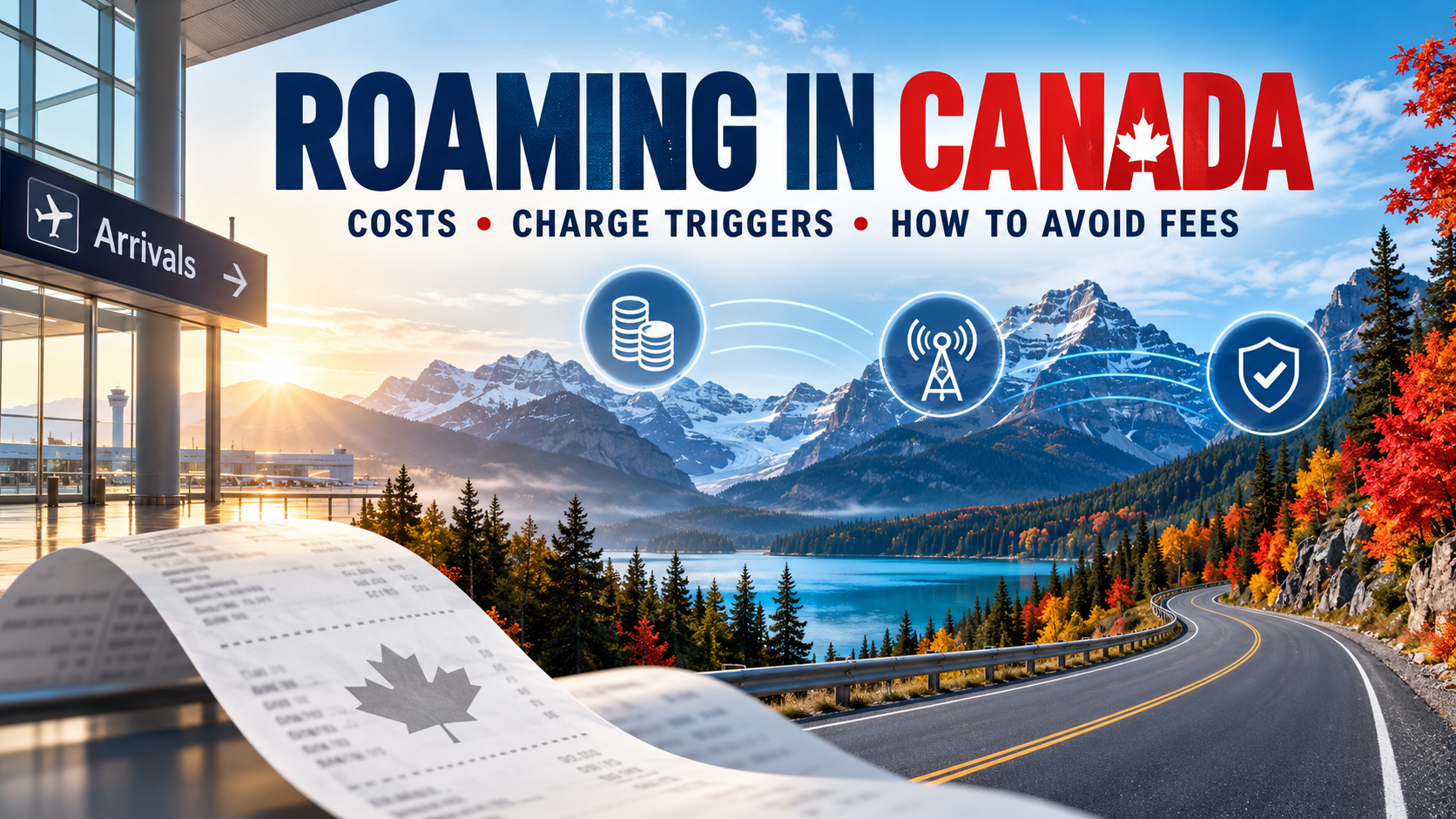
Roaming in Canada can be convenient, but convenience is not the same as predictable cost. A phone can connect to a Canadian partner network within minutes of arrival, and a call, sent text or small amount of background data may be enough to start a daily roaming session under some home-carrier plans.
This guide is for international visitors arriving in Canada with a foreign mobile plan. It does not cover Canadian customers using their phones in another country, whose prices and consumer protections follow a different set of rules.
The safest approach is to check the exact rules attached to your home plan before departure. If Canada is included at no extra charge, roaming may be the simplest option. If it is not, compare the full-trip price of a daily pass with a prepaid Canada eSIM or local SIM, then configure the phone so the home line cannot silently take over mobile data.
Quick answer: will you pay roaming charges in Canada?
You may pay roaming charges if your home carrier does not include Canada and your phone uses a Canadian network for mobile data, calls or sent messages. The exact trigger varies by carrier and plan.
- Use your home plan when Canada is already included and its data, speed and hotspot limits fit the trip.
- Add a carrier roaming pass when the trip is short, you need conventional calls and texts on your usual number, and the total cost remains reasonable.
- Use a Canada travel eSIM when you mainly need data and want to separate travel data from the home line.
- Use a local prepaid plan when you need a Canadian phone number or will stay long enough for local service to make sense.
- Use Wi-Fi only when you can accept being offline between trusted networks.
Do not assume that turning off one setting solves every billing risk. Data roaming controls mobile data, but calls, sent texts and voicemail behaviour can still be chargeable under some plans. Confirm the carrier's own trigger rules.
What roaming in Canada actually means
Roaming occurs when your home mobile subscription connects through a network operated by another carrier. For an international visitor, the phone normally authenticates through the home carrier and then uses a Canadian partner network. The Canadian network carries the service, while the home carrier decides how the usage appears on your bill.

This distinction explains three common surprises:
- The network name does not reveal the price. Seeing a Canadian carrier at the top of the screen confirms a connection, not whether it is included.
- A daily pass may start only after eligible use. Depending on the carrier, making or receiving a call, sending a text or using cellular data can begin a paid session.
- Background traffic still counts as traffic. Email sync, cloud-photo uploads, app refreshes and map updates can use data without an obvious action on screen.
The Canadian Radio-television and Telecommunications Commission describes roaming as using another service provider's network and advises travellers to check what activities create charges, what fees apply and how usage can be monitored. Its billing protections apply to customers of Canadian wireless providers; visitors should rely on the rules and protections of their own home carrier.
How much does roaming in Canada cost?
There is no single Canada roaming price. The extra cost may be zero when Canada is included in the home plan, a fixed daily fee under a roaming pass, or pay-per-use billing for data, calls and messages. Check the exact line before comparing eSIM prices because the plan name, account age and prepaid or postpaid status can change the answer.
Do not assume that a regional roaming benefit covers Canada. A US plan may include Canada and Mexico, while EU or UK roaming allowances commonly treat Canada as a separate destination. The carrier's country checker and the terms shown in the account are more reliable than the plan's marketing name.
Current US-carrier examples illustrate why checking the exact plan matters:
| Home carrier example | What the official information says | What to verify in your account |
|---|---|---|
| AT&T | Its current Unlimited plans include talk, text and data in and between the US, Mexico and Canada. Pay-per-use rates can apply when service is not included or covered by an add-on. | Whether your specific plan is eligible, its high-speed allowance and hotspot terms |
| Verizon | Canada and Mexico are included with its Unlimited plans. For eligible plans without included Canada use, TravelPass is listed at US$6 per line per day in Canada. | What starts a session, the session period and the post-high-speed rule |
| Google Fi Wireless | Unlimited Standard, Unlimited Premium and Flexible include data, calls and texts within Canada and Mexico; Unlimited Essentials does not include international data. | Your active plan, high-speed pool and any international-use restrictions |
| T-Mobile | Canada benefits depend on the qualifying plan, device and account. Its destination checker directs customers to sign in for plan-specific inclusions. | Included high-speed data, voice price, prepaid restrictions and pass options |
These are examples, not universal prices. Carrier terms can change, and corporate, prepaid, family and older plans may behave differently. Save a screenshot or PDF of the live terms that apply to your line before departure.
What can trigger a roaming charge?
The only reliable answer comes from the home carrier, but these activities deserve specific attention:
Cellular data and background app activity
Opening maps or a browser clearly uses data. Less obvious activity includes automatic app updates, photo backup, email fetch, weather widgets and cellular assistance when Wi-Fi is weak. If the home line remains eligible for cellular data, a tiny transfer may begin a daily pass.
Calls, voicemail and call forwarding
Making a normal cellular call is commonly chargeable. Receiving a call, sending it to voicemail or listening to voicemail can also be treated differently by different carriers. Wi-Fi Calling is not automatically free: billing can depend on the country called, the account and how the call is routed.
Sent text and picture messages
Receiving a basic SMS is often treated differently from sending one, but this is not universal. MMS can require cellular data. Do not use a general internet guide as the final authority for your number.
Automatic data switching on dual-SIM phones
Some phones can move cellular data to the other line when the chosen data line has no service. That is useful at home but risky abroad. Turn off Allow Cellular Data Switching, Mobile Data Switching or the equivalent unless you intentionally want home-plan fallback.
Border and cruise connections
Near the US border, a phone can attach to a network on the other side if automatic network selection is active. On ferries or cruises, maritime networks may have separate rates and may not be covered by a normal Canada pass. Check the network name before using service.
Roaming pass, Canada eSIM, local SIM or Wi-Fi?

| Option | Best fit | Main advantage | Main trade-off |
|---|---|---|---|
| Home plan with Canada included | Short or long trip when the allowance already fits | Keep the usual number and service with minimal setup | Included data may be limited or slowed; not every plan qualifies |
| Daily roaming pass | Short trip or business travel needing normal calls and texts | Familiar number and domestic-plan behaviour | The cost repeats on each charged day and can add up quickly |
| Canada travel eSIM | Data-first travel on an unlocked, compatible phone | Install before departure and separate travel data from the home line | Usually data-only; the home line still needs careful configuration |
| Local prepaid SIM or eSIM | Longer stay or need for a Canadian number | Local calls/SMS may be included, depending on the plan | Purchase, identity, activation and expiry rules vary |
| Wi-Fi only | Very light use with predictable access to trusted networks | No mobile-data purchase | No connection between hotspots; public Wi-Fi has privacy and reliability limits |
The decision should be based on the whole trip, not a single day's headline price. Multiply a daily roaming fee by the number of likely use days, then compare it with the actual allowance, validity, network, hotspot rule and post-limit behaviour of the alternative.
When a Canada eSIM makes more sense
A travel eSIM is most useful when the phone is carrier-unlocked, supports eSIM and the traveller mainly needs data for maps, bookings, messaging and browsing.
A travel eSIM is less suitable when you need a Canadian phone number, depend on conventional calls and SMS, or have a locked or incompatible phone. In those cases, a home-carrier pass or local prepaid service may fit better.
Before buying, compare the allowance across the whole trip, when validity begins, which network the plan uses, whether hotspot sharing is allowed and what happens after the high-speed allowance is used. These details matter more than the lowest advertised price. A road trip also needs a route-level network check, because no eSIM can create service outside the underlying carrier's coverage.
Once you know how much data and validity you need, compare the available Canada eSIM plans on those same criteria. If the allowance is still unclear, the Canada data guide provides a more useful starting point than choosing the smallest package by price.
A trip-length decision guide
One to three days
First check whether Canada is already included. If not, a roaming pass may still be reasonable when you need normal calls, texts and your existing number for work. A small travel eSIM can cost less when data is the main need, but compare a realistic allowance rather than the lowest advertised entry price.
Seven to fourteen days
Repeated daily-pass fees become more important. A fixed data pool works well for uneven sightseeing days, while a plan with a daily allowance suits travellers who expect regular navigation, social uploads and booking activity. Keep the home line from using mobile data if it remains active for verification texts.
Three to four weeks
Compare a 30-day travel eSIM with a local prepaid plan. A local plan may be preferable if you need a Canadian number, while a data-only eSIM avoids a store visit and can be installed before departure. Remote work and frequent tethering require more attention to the high-speed allowance and post-limit speed.
A cross-country road trip
Network fit matters more than the largest data number. A plan cannot create coverage where no terrestrial mobile network exists. Check the network used by the exact package against the route and download offline maps before long rural sections. The Canada road trip connectivity guide covers dead zones and offline preparation in detail.
How to avoid roaming charges with a dual-SIM phone

Menu names vary, so use this as a logic checklist rather than a universal sequence.
- Install the travel eSIM over reliable Wi-Fi. Keep the order email and installation instructions available offline.
- Label the lines clearly. Names such as Home and Canada Data reduce mistakes.
- Select the Canada eSIM for cellular data. Confirm the selection again after landing and after restarting the phone.
- Turn off cellular-data switching. This prevents automatic fallback to the home line when the travel line is weak.
- Keep data roaming off for the home line. A travel eSIM may require data roaming on for its own line because it connects through partner networks; the two lines need different settings.
- Decide whether to leave the home line active. Keeping it on may allow incoming SMS or calls, but those services can have carrier-specific charges. Turn the line off entirely if zero accidental use is more important than availability.
- Disable background-heavy features. Pause cloud backups, automatic downloads and app updates over cellular.
- Check the status bar and usage counters. Confirm which line is providing data before opening data-heavy apps.
For the lowest-risk configuration, ask the home carrier to block international roaming on the line or turn the line off during the trip. Merely choosing another line for data does not replace the carrier's own billing rules.
Keep your home number without using its mobile data
Many travellers want the home number available for bank codes or account verification. A dual-SIM phone can often keep the home line active while the Canada eSIM handles data, but three caveats matter:
- receiving SMS may be free on one carrier and treated differently on another;
- calls and voicemail can start a paid session even when home-line data is off;
- some verification services block roaming delivery or data-based numbers for security reasons.
Test important authentication methods before departure. Add an authenticator app, backup codes or another approved sign-in method rather than relying on one roaming SMS.
What to do if you see an unexpected roaming charge
- Stop further home-line use and take screenshots of the phone's line settings and usage counters.
- Save the carrier's welcome text, roaming-pass notice and the times of relevant calls, texts or data sessions.
- Compare the charge with the plan terms saved before travel.
- Contact the carrier promptly and ask which event triggered the session.
- If the explanation conflicts with the published terms, use the carrier's formal billing-dispute process and the consumer-complaint route available in your home country.
Do not delete the Canada eSIM as a first troubleshooting step. Deletion can make reinstallation harder and does not reverse a charge already generated by the home line.
Frequently asked questions
Is data roaming free in Canada?
Only when the home plan explicitly includes Canadian use or the carrier applies no extra fee under the selected add-on. Some US plans include Canada, while others use a daily pass or pay-per-use rates. Check the exact line, not only the carrier name.
Will airplane mode stop roaming charges?
Airplane mode stops cellular connections while it remains enabled. Wi-Fi can then be turned on separately. It is a strong option for Wi-Fi-only travel, but it also blocks normal cellular calls and texts until cellular service is restored.
Can I be charged if I do not actively use my phone?
Yes. If the home line can use cellular data, background refresh, email sync, cloud backup or another small transfer may count as roaming use even when you do not open an app. Calls and voicemail may also have separate triggers. Turn off roaming data for the home line, disable automatic data switching and check the carrier's rules for calls and messages.
Do I need to turn on data roaming for a Canada travel eSIM?
Often, yes. Many travel eSIMs connect through partner networks and require data roaming on for the travel line. This does not mean roaming must also be enabled for the home line. Follow the instructions supplied with the exact eSIM.
Can I keep receiving texts on my home number?
A dual-SIM phone may keep the home line active for SMS while the Canada eSIM provides data. Whether incoming messages, sent messages, calls or voicemail create charges depends on the home carrier. Confirm those rules before leaving the line active.
Is a Canada eSIM cheaper than a roaming pass?
It often becomes more competitive as the trip gets longer, but not automatically. A home plan that already includes Canada may cost nothing extra, and a short business trip may justify a daily pass. Compare the full-trip charge with the eSIM's usable allowance and rules.
Final checklist before arriving in Canada
- Confirm whether Canada is included in the exact home plan.
- Record what starts a charge and when a paid session resets.
- Compare the total trip cost, not only the daily fee.
- Check that the phone is unlocked and eSIM-compatible.
- Install the Canada eSIM over Wi-Fi before departure.
- Select the travel line for data and turn off data switching.
- Keep roaming off for the home line unless its plan is intentionally being used.
- Download offline maps, bookings and essential contacts.
- Save carrier terms and support details in case a charge needs to be disputed.
Roaming in Canada is not inherently expensive when the plan already includes it. The problem is uncertainty. A five-minute account check and a deliberate dual-SIM setup can prevent a background process or accidental fallback from becoming a full day of charges. When Canada is not included and data is the main need, a prepaid eSIM for Canada gives you a separate travel-data path without replacing the home number.
Sources and verification
- CRTC: International roaming fees
- CRTC: The Wireless Code, simplified
- AT&T: International pay-per-use rates and Canada inclusions
- Verizon: TravelPass
- Google Fi Wireless: International travel
- T-Mobile: International roaming plans for Canada
- Apple Support: Cellular data roaming options
Carrier prices, inclusions and roaming triggers can change. Official pages were reviewed on 12 October 2026. Verify the terms shown in your own account before travel.

High-speed data, wherever your journey leads
Enjoy instant, secure mobile data with Ezigo eSIM in 200+ destinations. No physical SIM needed.