Internet in the UK for tourists is easiest to plan by starting with the trip, not the technology. For most visitors, that means arranging mobile data before departure and keeping public Wi-Fi as a backup. A travel eSIM is convenient when your phone is unlocked and eSIM-compatible; a UK prepaid SIM is better when you need a local number; roaming can suit a very short trip with a clear pass; and Pocket Wi-Fi works best for a group that stays together.
The choice becomes easier once you answer four questions: Do you need a UK phone number? Will your group split up? Does your route extend beyond major cities? And how much setup are you willing to handle after landing?
Internet in the UK for tourists: compare the five main options
Start with the function you need, not the format of the SIM. A data-only travel eSIM and a local mobile plan with a UK number solve different problems, even if both connect your phone to a British network.
| Option | Best for | Arrange it | UK phone number | Main trade-off |
|---|---|---|---|---|
| Travel eSIM | Data-first trips on one unlocked, compatible phone | Usually before departure | Usually no | Easy setup, but the plan may be data-only |
| UK prepaid SIM or local eSIM | Longer stays or travelers who need a UK number | Online or after arrival | Often yes | More plan rules and arrival-day setup |
| Home-carrier roaming | Short trips with a clearly priced roaming pass | Before departure | Keeps your home number | Repeated daily fees or data limits can add up |
| Pocket Wi-Fi | Families or groups carrying several devices | Reserve before travel or rent locally | No | Everyone must stay near the router and keep it charged |
| Public Wi-Fi | Backup access and large downloads | After arrival | No | It does not provide continuous service while moving |

There is no universal winner. For a short city break, start with a travel eSIM or a clearly priced roaming pass. Choose a local prepaid plan when a UK number matters, and consider Pocket Wi-Fi only when several devices will stay together. Whatever the trip type, check the underlying network against the full route rather than relying on a national coverage headline.
When a travel eSIM is the simplest choice
A travel eSIM is a strong fit when you mainly need mobile data and want to prepare before flying. There is no physical card to collect, and compatible dual-SIM phones can usually keep a home line present while the travel line handles data.
Before choosing one, check:
- whether the exact phone model supports eSIM and is carrier-unlocked;
- whether the plan is data-only or includes a number, calls and SMS;
- which UK network or networks the plan can use along your route;
- whether the allowance is fixed or daily, what happens after the high-speed limit, and when validity begins; and
- whether hotspot sharing is allowed.
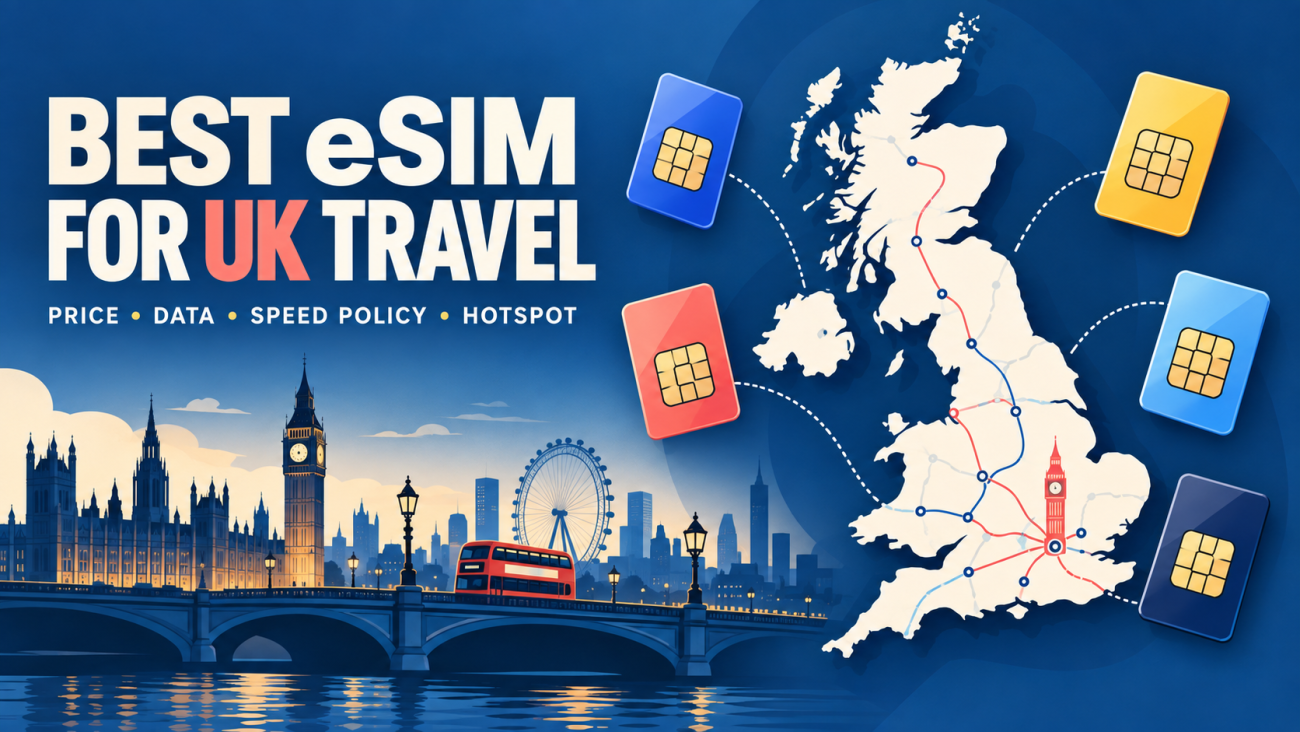
These details matter more than labels such as “unlimited.” If data-only service fits the trip, compare the current UK eSIM plans by allowance, validity, network access and reduced-speed policy. If you still need to compare providers within that category, use the separate best eSIM for UK travel guide.
Do not expect a data-only eSIM to provide a UK phone number or receive ordinary carrier SMS. WhatsApp, FaceTime, Signal, email and other internet-based services can use mobile data, but services that require conventional SMS may still depend on your home line or a local number.
When a UK prepaid SIM or local carrier eSIM is better
Choose a local prepaid plan when a UK number is part of the requirement. Local plans may include calls, texts and data, but activation steps, top-ups, renewal settings and hotspot allowances vary by provider.
A physical SIM may also be the practical answer for a phone without eSIM support. The drawback is timing: buying after arrival can mean comparing plans in an airport or shop before you have dependable mobile data.
For a closer look at buying channels and plan checks, use the separate UK prepaid SIM card guide. It covers a different decision from this article, so there is no need to turn this section into another local-plan comparison.
When home-carrier roaming is worth keeping
Roaming is reasonable when your existing carrier includes the UK or sells a pass with a clear full-trip cost. It keeps the usual number active and avoids installing another profile, which can be valuable on a one- or two-day visit.
Before relying on it, ask your carrier:
- Is the United Kingdom included in this exact plan?
- Is the charge daily, weekly or usage-based?
- How much high-speed data is included?
- Are hotspot use, calls, voicemail and incoming texts treated separately?
- Can background data trigger a daily fee?
Ofcom's roaming guidance advises travelers to check their package and charges before going abroad. A roaming pass can be the simplest option, but only when you know what activates it and what the complete trip will cost.
Pocket Wi-Fi or phone hotspot for several devices
Pocket Wi-Fi is a portable cellular router. It can connect several nearby devices, but it still relies on a mobile network and cannot create coverage where that network has no usable signal.
It works best for a family or work group that remains together. The practical costs are carrying another device, charging it and arranging collection or return if it is rented. Check the network, battery expectations, device limit and high-speed allowance before booking.
A phone hotspot removes the extra router. It uses the phone's battery and the same data allowance, so it is better for occasional laptop or tablet access than for constant group use. Hotspot support depends on the plan and device; do not assume that every “unlimited” plan permits unlimited tethering.
Public Wi-Fi is a backup, not a complete travel connection
Free Wi-Fi is widely available in London at hotels, cafés, retailers and some transport locations. Visit London notes that networks may require sign-up and that travelers may need to reconnect when service drops.
That makes public Wi-Fi useful for hotel downloads, video calls or app updates. It is less dependable for walking directions, ride-hailing, platform changes or travel between towns because the connection ends when you leave the venue.
Security still requires judgment. Confirm the network name with staff, keep the device updated and avoid unknown hotspots. The UK's National Cyber Security Centre recommends tethering through a mobile connection instead of joining an unknown network when possible.
Use public Wi-Fi to reduce data use, not as the only internet plan for a multi-stop trip.
Buy before travel or connect after arrival?
Arranging data before departure removes one arrival-day task, but buying locally gives you access to plans designed for UK residents and visitors who need a British number.

| Decision | Before departure | After arrival |
|---|---|---|
| Best fit | Travel eSIM or prearranged roaming | Local prepaid SIM or carrier eSIM |
| Immediate navigation | Usually available after setup and connection | May require airport or venue Wi-Fi first |
| UK number | Usually not included with a data-only travel eSIM | Often available with a local plan |
| Support | Online instructions and remote support | In-store help may be available |
| Main risk | Installing too early or misunderstanding activation | Paying for convenience or losing time comparing plans |
If you buy before travel, save the installation details offline and read the activation rule carefully. If you wait until arrival, note the opening hours and location of the shop you plan to use. Travelers who have already chosen data-only service can compare an eSIM for UK travel without changing the article's broader decision: the option still has to match the phone, route and communication needs.
Mobile internet in the UK outside London
Strong service in central London does not guarantee the same result on every coastal road, rural rail line or hiking route. Buildings, terrain, congestion and the underlying network all affect performance. Coverage maps are useful planning tools, but they are not promises for every indoor location or moving train.

London itself also has gaps in motion. On 11 June 2026, Transport for London reported that around 60% of Underground stations classified as underground had mobile coverage, with expansion still in progress. Coverage at a station or on one tunnel section should not be treated as continuous service across an entire journey.
Before a route with uncertain reception:
- download offline maps and rail tickets;
- save accommodation addresses and booking references;
- keep a power bank or charger available;
- check the exact partner network against the route; and
- do not rely on a live connection as the only way to access essential travel details.
Keep your home number, WhatsApp and messages working
A data-only travel eSIM does not replace the phone number attached to your main line. On a compatible dual-SIM phone, you can often keep the home SIM active for calls or texts while assigning mobile data to the UK travel line. Apple's travel eSIM guidance explains this arrangement for supported iPhones; Android behavior varies by model, region and manufacturer.
Use these settings carefully:
- select the travel line for mobile data;
- turn off data roaming on the home line unless you intend to use its roaming plan;
- follow the travel provider's instructions for data roaming on the travel line;
- disable automatic cellular-data switching if it could move data back to the home line; and
- check how your carrier charges incoming calls, outgoing calls and SMS abroad.
WhatsApp normally continues to use the number already registered to the account while communicating over mobile data or Wi-Fi. Avoid changing the registered number unless that is your intention, and keep access to any verification method you may need.
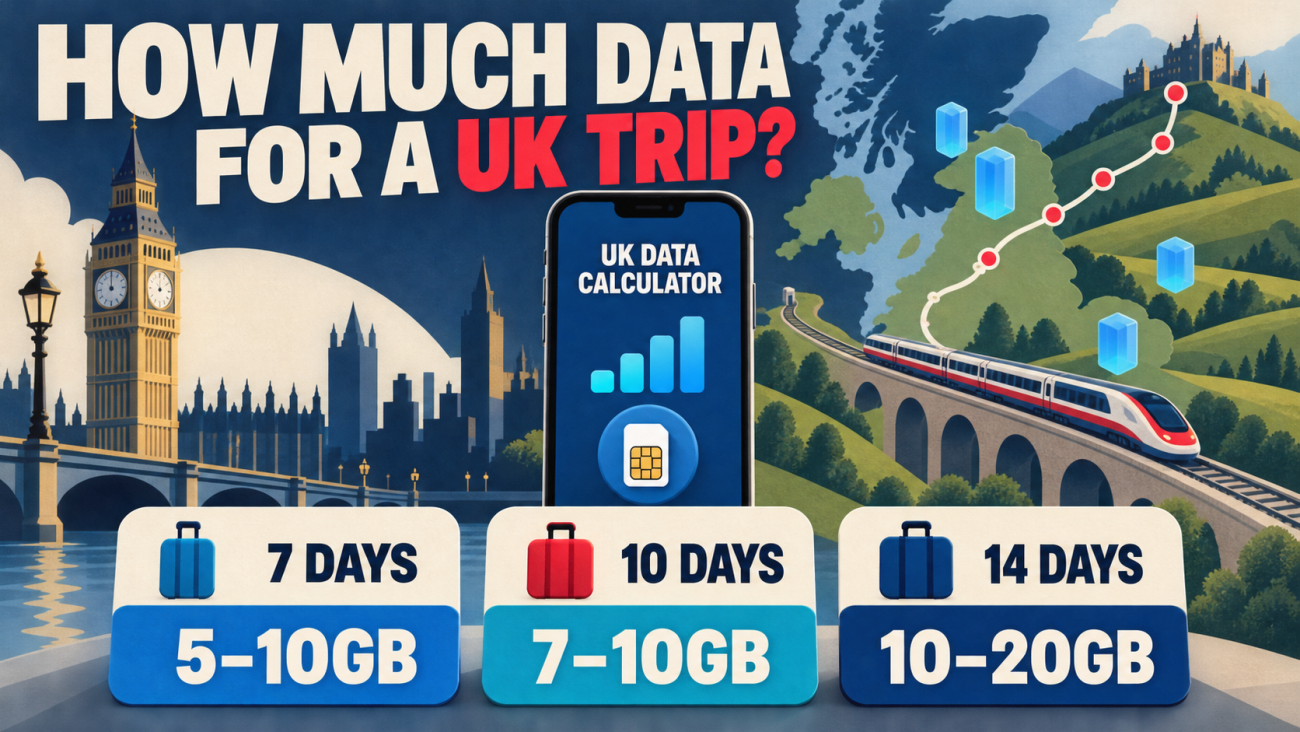
How much UK mobile data do tourists need?
Estimate data from the heaviest activity in the trip. Maps, web searches and app-based messages are relatively light; video, cloud photo backup, laptop tethering and app updates can consume much more.
A better estimate comes from your own phone. Review recent cellular-data usage, subtract activity you will do on hotel Wi-Fi, then leave room for navigation and unexpected changes. The separate UK travel data guide gives planning ranges without repeating them here.
When comparing plans, read the high-speed rule. A fixed allowance may stop when the data is exhausted, while another plan may reduce speed after a daily threshold. Neither is automatically better: a fixed pool suits controlled use, while a daily allowance may suit travelers whose demand varies from day to day.
Set up your UK internet before departure
Most avoidable connection problems begin before the plane lands. Use this checklist:
- Check the phone and required service. Confirm carrier-unlocked status and exact-model eSIM or physical-SIM support, then decide whether you need data only, a UK number or multi-device sharing. The UK phone compatibility guide covers the device checks in more detail.
- Match the network to the route. Look beyond the arrival airport and central London to the towns, rail lines and overnight stops you will use.
- Read activation and validity separately. Installation does not always start the plan, but policies vary.
- Prepare for a connection gap. Save installation details, addresses, tickets and maps offline, then set the intended mobile-data line and disable unwanted switching to the home line.
For device-specific installation steps, use the eSIM installation guide rather than deleting an eSIM profile during troubleshooting.
Frequently asked questions
What is the best way to get internet in the UK as a tourist?
For a data-first trip, a travel eSIM is usually the easiest option on an unlocked, compatible phone. Choose a local prepaid plan if you need a UK number, Pocket Wi-Fi if several devices will remain together, or roaming if your home carrier offers a clear and reasonable full-trip pass.
Should I buy an eSIM before traveling to the UK?
Buying before departure can give you data soon after landing, but check when validity starts. Save the installation details offline and install only at the time recommended by the provider.
Do I need a UK phone number?
Not for maps, email, WhatsApp and most app-based travel tasks. A UK number is useful when you need ordinary local calls, conventional SMS or a service that will not accept your overseas number.
Can I keep my regular number while using a UK eSIM?
Often, yes, if the phone supports the required dual-SIM combination. Use the travel line for data, keep the home line available only for the services you need, and check the home carrier's roaming charges.
Can I use a UK travel eSIM as a hotspot?
The technology supports tethering, but permission and limits depend on the plan and phone. Check the hotspot terms and remember that connected devices use the same allowance.
Can tourists rely only on public Wi-Fi in the UK?
Public Wi-Fi can work for a highly planned city visit, but it leaves gaps between venues and may require repeated sign-ins. Mobile data is more dependable for navigation, transport changes and multi-stop travel.
Choose the option that removes the right problem
The best solution for internet in the UK for tourists is not automatically the cheapest plan or the option with the largest data label. It is the one that provides the functions you need across the route without creating unnecessary setup or unexpected charges.
Make the decision in that order: required functions, phone compatibility, route coverage, activation timing and data policy. If a data-only connection is the right outcome, compare prepaid UK eSIM plans only after those requirements are clear.

High-speed data, wherever your journey leads
Enjoy instant, secure mobile data with Ezigo eSIM in 200+ destinations. No physical SIM needed.