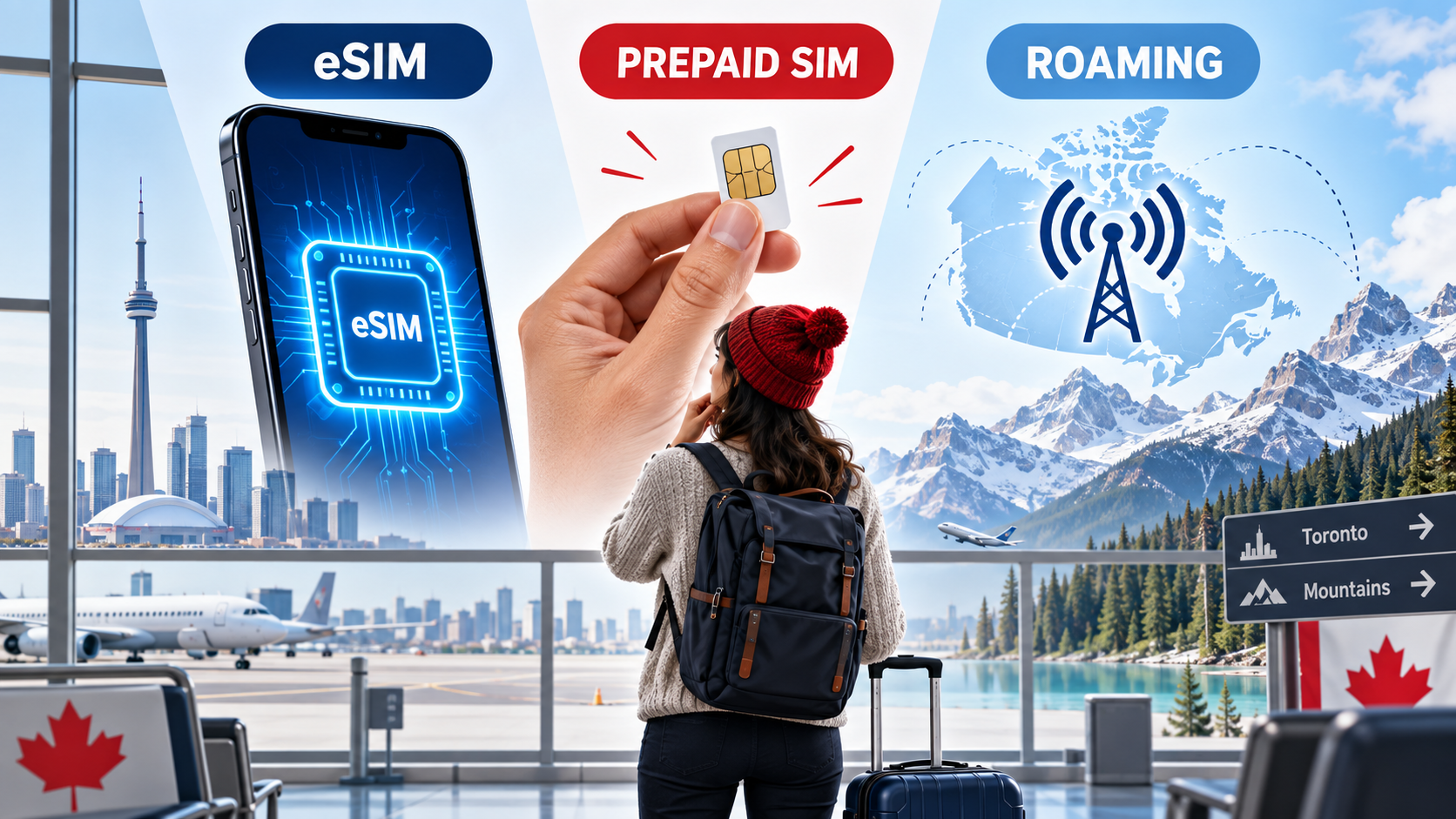
A Canada SIM card can give tourists local calls, texts, and mobile data, but it is not the only way to stay connected. For most short trips, the practical choice is between a local prepaid SIM with a Canadian number, a travel eSIM that can be prepared before departure, and roaming on your existing line.
Choose a local prepaid SIM if you genuinely need a Canadian phone number or in-store help. Choose a travel eSIM if mobile data is enough and you want to keep your home SIM in your phone. Keep your home plan only when Canada is already included at a price you accept—not simply because roaming is familiar.
This guide compares those options, explains local prepaid costs, shows where tourists can buy service, and helps you estimate how much data your Canada itinerary may use.
Quick answer: which Canada SIM option should you choose?
Local prepaid SIM
Best when conventional calls, SMS, or a Canadian number are genuinely essential.
Travel eSIM
Best when data is enough and you want to keep your home SIM installed.
Home roaming
Best when Canada is already included at a price and allowance you accept.
For a typical tourist who mainly uses Maps, WhatsApp, rideshare apps, email, and bookings, a data-only Canada eSIM is usually the simplest route. It can be purchased and installed before departure, while your home line stays available for incoming texts or calls if your carrier settings allow it.
Canada eSIM vs prepaid SIM vs roaming
The word “SIM” describes the connection profile, not necessarily a plastic card. A physical prepaid SIM and a local carrier eSIM can both provide a Canadian number. A travel eSIM is designed around convenient short-term data and may not include voice or SMS.
| Feature | Travel eSIM | Local prepaid SIM/eSIM | Home SIM roaming | Public Wi-Fi |
|---|---|---|---|---|
| Set up before arrival | Yes | Sometimes | Yes | No setup |
| Physical card required | No | Only for physical SIM | No change | No |
| Canadian number | Usually no | Usually yes | No | No |
| Regular calls and SMS | Usually no | Commonly included | Depends on plan | App-based only |
| Cost predictability | High when prepaid | Check tax, SIM fees, and renewal | Varies by carrier | Free where available |
| Best for | Short trips and data-first travelers | Longer stays or a local number | Included roaming or very short visits | Backup only |
Choose a local prepaid SIM when a Canadian number matters
A local number can be useful for conventional calls, local business contacts, longer stays, or situations where app-based calling is not enough. Canadian prepaid plans often bundle domestic talk and text with data. The trade-off is that a tourist may need to find a SIM, complete activation, select a province or number, and understand monthly renewal or top-up rules.
Choose a travel eSIM when data is the priority
A travel eSIM suits people who use internet-based communication. WhatsApp, iMessage, FaceTime, Signal, Messenger, Google Maps, transit apps, and booking platforms work over mobile data. You can normally keep WhatsApp registered to your existing number even when another SIM supplies the data.
A data-only travel eSIM typically does not include a Canadian number, conventional voice minutes, or SMS. If you need those services, compare local prepaid options instead. Hotspot rules and post-threshold speeds vary by provider, so check the selected plan before purchase.
Use home-carrier roaming only after checking the complete charge
Roaming can be excellent when your plan already includes Canada, particularly for visitors from the United States. The important question is not whether your phone will roam, but what your carrier charges per day, what data is included, and whether a partial day triggers a full daily fee.
How much does a prepaid SIM card cost in Canada?
Canadian local prepaid service is commonly sold as a recurring monthly plan rather than a tourist package lasting exactly 7 or 15 days. That can work well for a longer visit, but a short-stay traveler should compare the total checkout price—not just the advertised monthly plan.
Official examples checked September 10, 2026 · prices in CAD| Provider | Selected official examples | SIM and activation notes | Useful for |
|---|---|---|---|
| Public Mobile | CA$24/month for 5GB at 4G speed; CA$28 for 10GB at 4G speed; CA$35 for 50GB at 5G speed | Official pages advertise $0 eSIM and $0 activation; physical SIM pickup is available | App-based activation and Canadian talk/text plans |
| Lucky Mobile | CA$19/month for 500MB, CA$25 for 5GB, CA$30 for 15GB, and CA$35 for 30GB; some data depends on automatic top-up | eSIM is listed at $0; a one-time CA$10 physical SIM charge may apply | A local number with prepaid talk, text, and data |
| Freedom Mobile | Prepaid 4G LTE and 5G options with no credit check or contract | Visitors may join with an unlocked compatible phone; a standalone SIM is listed at CA$10 and eSIM can be activated online | Travelers whose itinerary fits Freedom coverage and who need a Canadian line |
Promotions, province, taxes, SIM fees, automatic top-up requirements, and renewal rules can change the final price. Confirm the live carrier checkout before purchase.
For a one- or two-week visit, a local monthly plan may offer more talk and text than you need. A travel eSIM often aligns better with the trip because it has a fixed upfront price, instant delivery, and no store visit. A longer-term visitor who needs a Canadian number may find the local prepaid route more useful.
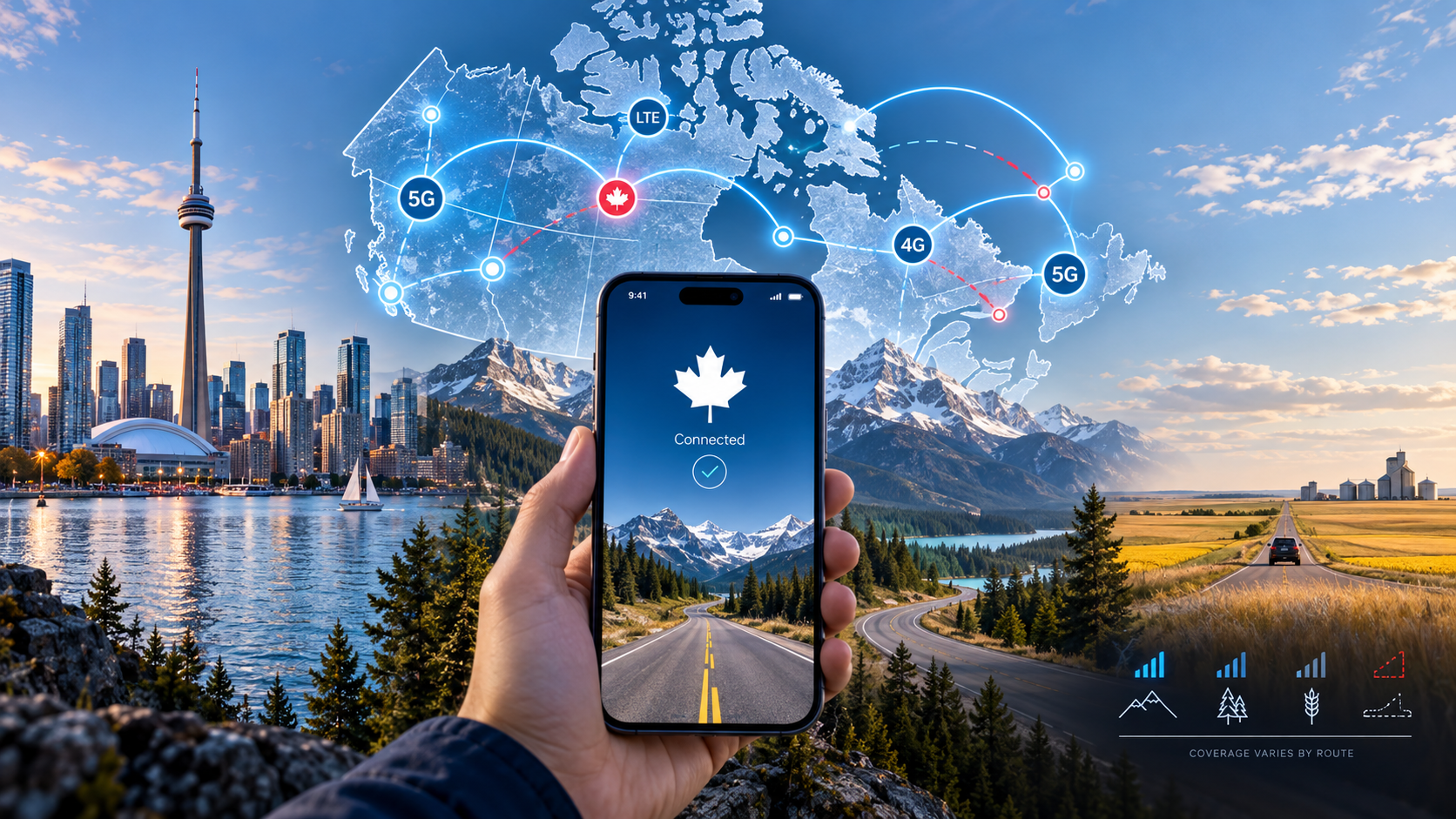
Canada mobile networks and coverage
The CRTC identifies Bell, Rogers, and TELUS as Canada’s three largest mobile operators. SaskTel is especially important in Saskatchewan, while Freedom Mobile and regional providers add alternatives in parts of the country.
Canada has an enormous land area. A provider can reach a very high percentage of the population while still having limited or no service along remote roads, inside parks, or far from populated corridors. Check coverage for your actual route, not only Toronto, Vancouver, or Montréal.
A travel eSIM may use one Canadian network or several partner networks. Before purchase, check whether the plan covers the provinces and routes you expect, whether it supports 4G/5G, and whether remote or northern travel has limitations. Actual service still depends on location, device support, signal conditions, and congestion.
Where can tourists buy a SIM card in Canada?
Airport shops
Useful when you need immediate help, but inventory, opening hours, brands, and prices vary by terminal. Check the airport directory shortly before departure.
Carrier stores
Best when you want a Canadian number, activation help, or a compatibility check. Bring an unlocked phone, photo ID, and payment method.
Retailers
Electronics stores, supermarkets, pharmacies, and convenience stores may sell prepaid SIMs or vouchers, but the cashier may not provide activation support.
Online eSIM
Removes the search after arrival. Delivery is digital, and installation can usually be completed before departure. Check when the provider starts validity.
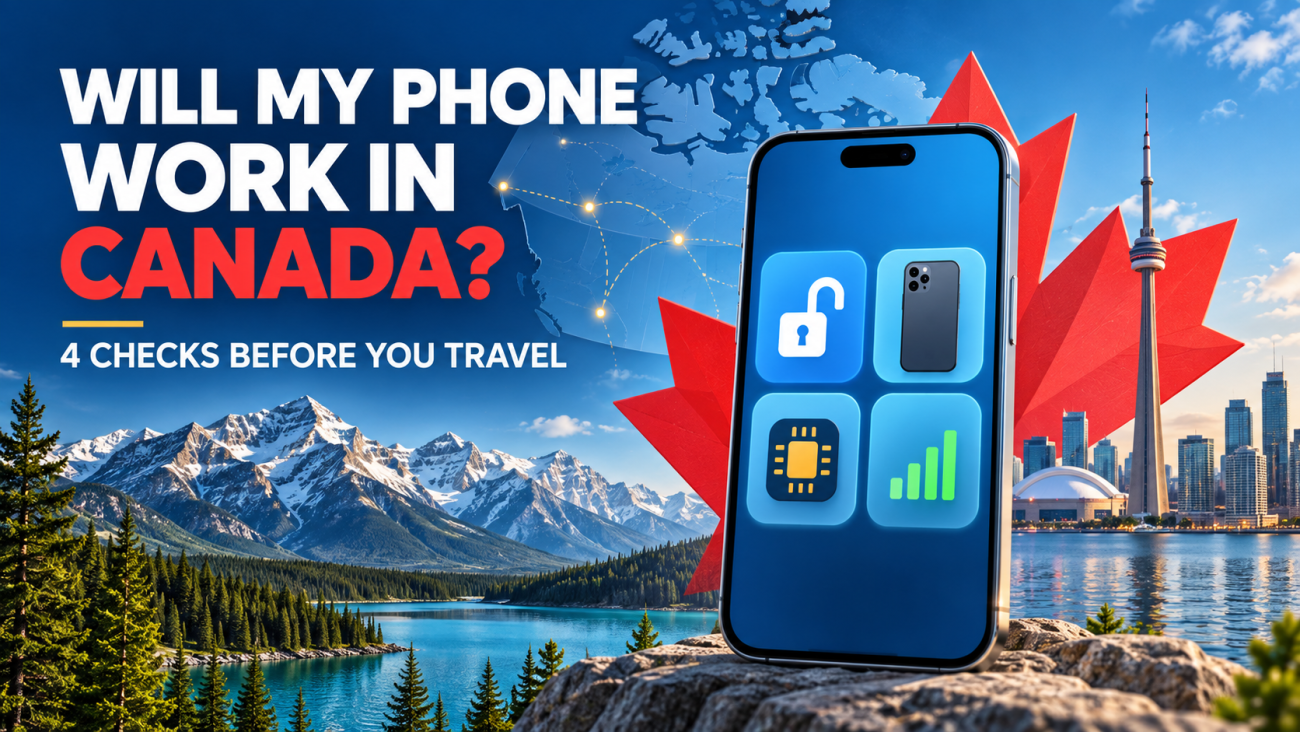
What do you need to use a Canada SIM or eSIM?
1. An unlocked phone
The device must accept another provider. On iPhone, check Settings → General → About → Carrier Lock. Android wording varies.
2. eSIM compatibility
Unlocked status and eSIM support are separate. Check whether your phone supports eSIM, including its exact regional model.
3. Compatible bands
Modern global phones commonly work in Canada, but older or region-specific models deserve a closer check. Plan access and phone hardware both affect 4G/5G.
4. Stable installation Wi-Fi
Install while you can access the QR-code email and follow the provider’s activation instructions. Some plans start on installation; others start when they connect to a supported network.
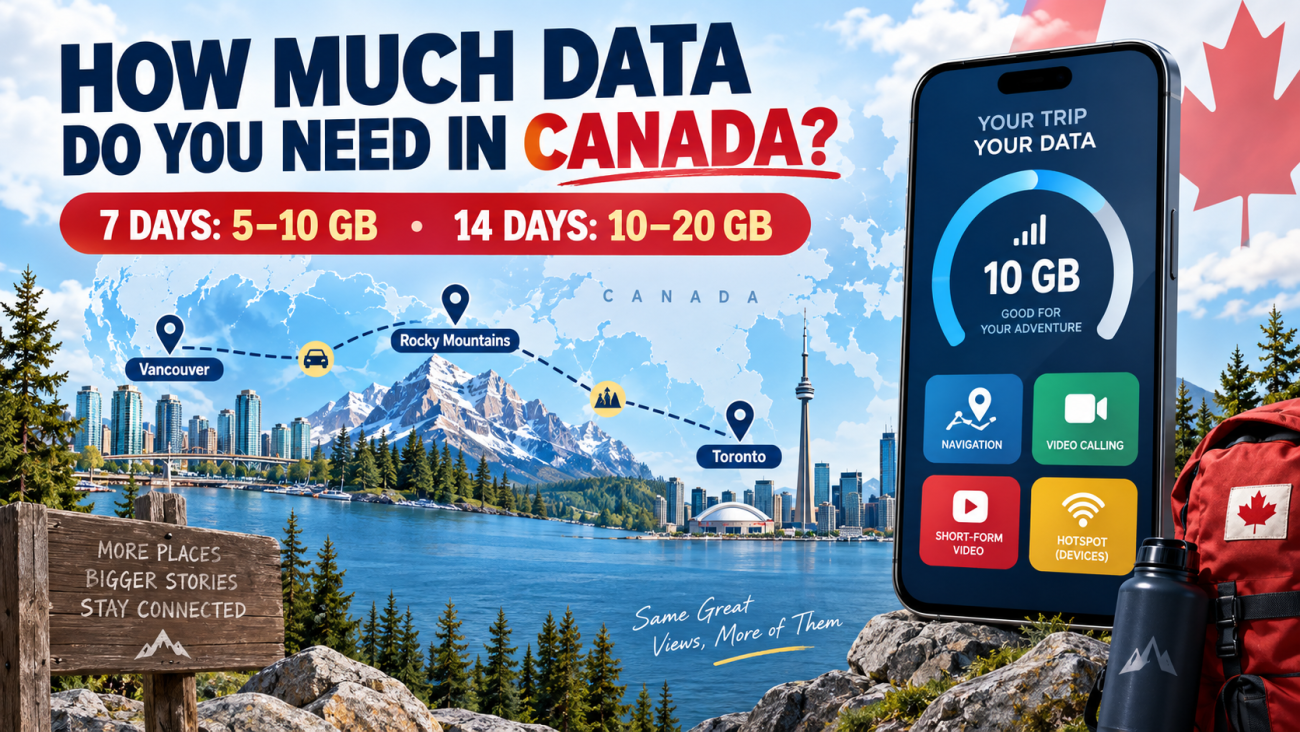
How much data do you need for Canada?
There is no single “best” data allowance for every Canada trip. Start with the way you will use your phone: maps and messaging use relatively little data, while photo backup, video, hotspot use, and long days away from Wi-Fi can raise the total quickly.
About 1–3GB total
Often enough for maps, messages, bookings, and light social use when you download offline maps and use hotel Wi-Fi.
About 3–5GB total
A reasonable starting point for regular navigation, messaging, photos, and occasional social browsing.
10GB or a daily allowance
Consider more data when you rely on live navigation, upload photos, stream video, or share a connection with another device.
When comparing travel eSIMs, look beyond the headline allowance. Check the validity period, whether data is pooled or resets daily, the network used on your route, hotspot rules, and what happens after a high-speed limit is reached.
| Trip pattern | Starting point | What to check |
|---|---|---|
| 3–7 days in one or two cities | 1–3GB total | Offline maps, hotel Wi-Fi, and whether photo backup is enabled |
| 7–14 days with regular sightseeing | 3–5GB total | Navigation frequency, social media, and airport or train-day usage |
| Cross-country route or remote areas | 5–10GB or a daily plan | Route coverage, map updates, and limited access to Wi-Fi |
| Video, hotspot, or work travel | 10GB+ or a daily plan | Post-threshold speed, tethering limits, and device battery use |
If you need a Canadian number, conventional calls, or SMS, compare local prepaid plans instead of choosing a data-only travel eSIM.
When a travel eSIM is the practical choice
A travel eSIM can suit tourists who want data ready after landing, prefer a fixed upfront cost, and do not need a Canadian phone number. Compare the live plan terms before purchase, including coverage, validity, activation timing, and post-threshold behavior.
View Canada eSIM plansHow to set up your Canada eSIM before travel
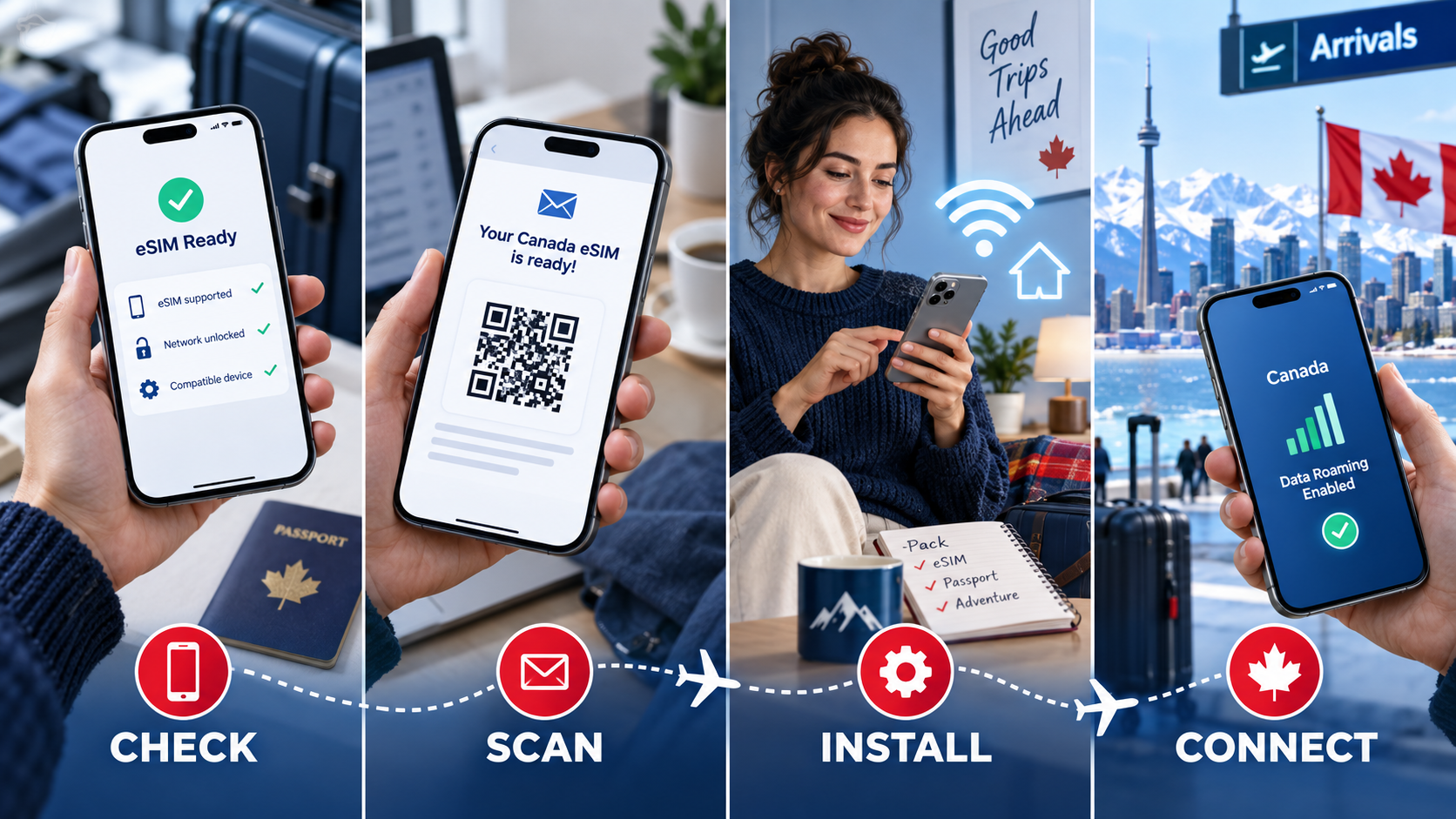
- Check compatibility and carrier lock. Confirm the exact phone model supports eSIM and accepts another carrier.
- Choose a plan. Match validity, total or daily data, network family, and post-threshold behavior to the trip.
- Complete payment. The provider sends the QR code and installation information after purchase. Keep the message accessible offline if you will install after landing.
- Install over stable Wi-Fi. You may install outside Canada before departure. Follow the eSIM installation guide and label the new line clearly.
- Connect after arrival. Select the eSIM for mobile data and enable data roaming on that line. Manual APN setup is not required.
Validity begins according to the provider’s activation policy. A one-day plan may cover a continuous 24-hour period rather than the remaining hours of a calendar day; daily-data allowances may reset on their stated schedule.
Common mistakes to avoid
- Buying a data-only eSIM when you require a Canadian phone number.
- Assuming every “unlimited” plan provides unlimited high-speed data.
- Choosing the smallest allowance without accounting for photo backup, video, or hotspot use.
- Disabling the home SIM before checking how two-factor authentication texts will arrive.
- Activating a local plan with automatic renewal and forgetting to turn it off.
- Assuming city coverage guarantees service on a remote mountain or northern route.
- Waiting until after departure to check whether the phone is unlocked.
Frequently asked questions
Which SIM card is best for tourists visiting Canada?
Choose a local prepaid SIM if a Canadian number, regular calls, or SMS is essential. Choose a travel eSIM if mobile data is enough and you want to prepare before arrival. Use home-carrier roaming when Canada is already included at an acceptable cost.
How much does a Canada SIM card cost?
Local prepaid examples checked in September 2026 started around CA$19–CA$24 per month before any applicable SIM fee or tax. Travel eSIM prices vary by allowance, validity, network, and post-threshold rules, so compare the complete trip cost.
Can a foreigner buy a prepaid SIM card in Canada?
Yes. Visitors can generally use prepaid service with an unlocked compatible phone, but activation, payment, ID, province, and device requirements differ by provider. Check the chosen carrier before visiting a store.
Do US SIM cards work in Canada?
Often, but the cost and allowance depend on the US plan. Some include Canada; others charge a daily roaming pass or use a separate international allowance. Confirm the exact terms before relying on it.
Is an eSIM worth it for Canada?
Usually, when the phone is unlocked and compatible and you need data but not a Canadian number. It avoids a physical SIM swap, can be installed before travel, and lets a dual-SIM phone retain the home line.
Can I keep my phone number while using a Canada eSIM?
Yes. Keep your home line installed and use the travel eSIM for mobile data on a dual-SIM phone. WhatsApp normally remains linked to its existing number, but your home carrier may still charge for calls, outgoing texts, or roaming data.
Bottom line
The best Canada SIM card for tourists is the one that fits the communication you actually need. A local prepaid SIM is the better tool for a Canadian number and conventional calls. Home roaming is reasonable when the price is already included. A travel eSIM is the most direct option when data, pre-trip setup, and keeping your home SIM matter most.
Before purchase, check lock status, eSIM compatibility, itinerary coverage, validity, high-speed allowance, and what happens after the limit. A data-only travel eSIM is convenient when you need internet access but not a Canadian number; a local prepaid plan is the better fit when calls or SMS matter.
Sources and verification
- Canadian Telecommunications Market Report 2026 — CRTC
- Public Mobile plans and SIM/eSIM options
- Lucky Mobile prepaid plans
- Freedom Mobile visitor and prepaid activation guidance
- Rogers device compatibility guidance
- Ezigo Canada eSIM plan terms — verify live coverage, prices, activation rules, and refund eligibility before purchase
Carrier promotions, availability, coverage, and terms may change after the verification date. Recheck live official pages before purchase.
High-speed data, wherever your journey leads
Enjoy instant, secure mobile data with Ezigo eSIM in 200+ destinations. No physical SIM needed.