


The East Coast Australia road trip works in 12 days only as a selective Sydney-to-Cairns corridor, not as a tour of every coastal town. Pick one transport model, commit to three route blocks with slack, and cut ruthlessly. Drive the sections worth seeing, fly the long empty transfer days, and keep weather-sensitive activities movable.
The plan comes down to four questions: Who is driving? Which two or three regions actually matter? Do any must-do activities need rescheduling room? And where does a flight save a full transfer day?
Updated October 18, 2026 · verify road access, activity terms and live prices before departureCommercial disclosure: Ezigo publishes this guide and sells data-only Australia travel eSIMs. The route advice below is independent of that; the only eSIM mention appears where mobile data is a practical route input.
Choose the transport model before you choose the stops
A self-drive route gives flexibility for coastal lookouts and smaller towns, but it also assigns someone the work of driving, parking, refuelling and moving luggage. A campervan adds overnight flexibility but not immunity from distance. Long-distance buses reduce driving stress but lock the route to a timetable. Flights compress geography but break the feeling of one continuous road trip.
| Route model | Choose it when | Trade-off you accept | What it protects |
|---|---|---|---|
| Continuous self-drive | The journey between places matters as much as the stops | More driving, parking and luggage handling | Freedom to pause in smaller coastal towns |
| Road trip with one strategic flight | You want two distant regions without repeated long transfer days | The itinerary is no longer one continuous drive | More time in chosen regions |
| Bus or rail-led route | You prefer not to drive and can work around timetables | Less control over small detours | Lower driving workload |
| Shorter geographic scope | A must-do activity carries weather risk | Fewer headline locations | Recovery space if an activity moves |
For a self-drive route, an Australia eSIM is a data option on a compatible phone; it does not change car-rental conditions, road access or weather decisions.

The 12-day route in three blocks
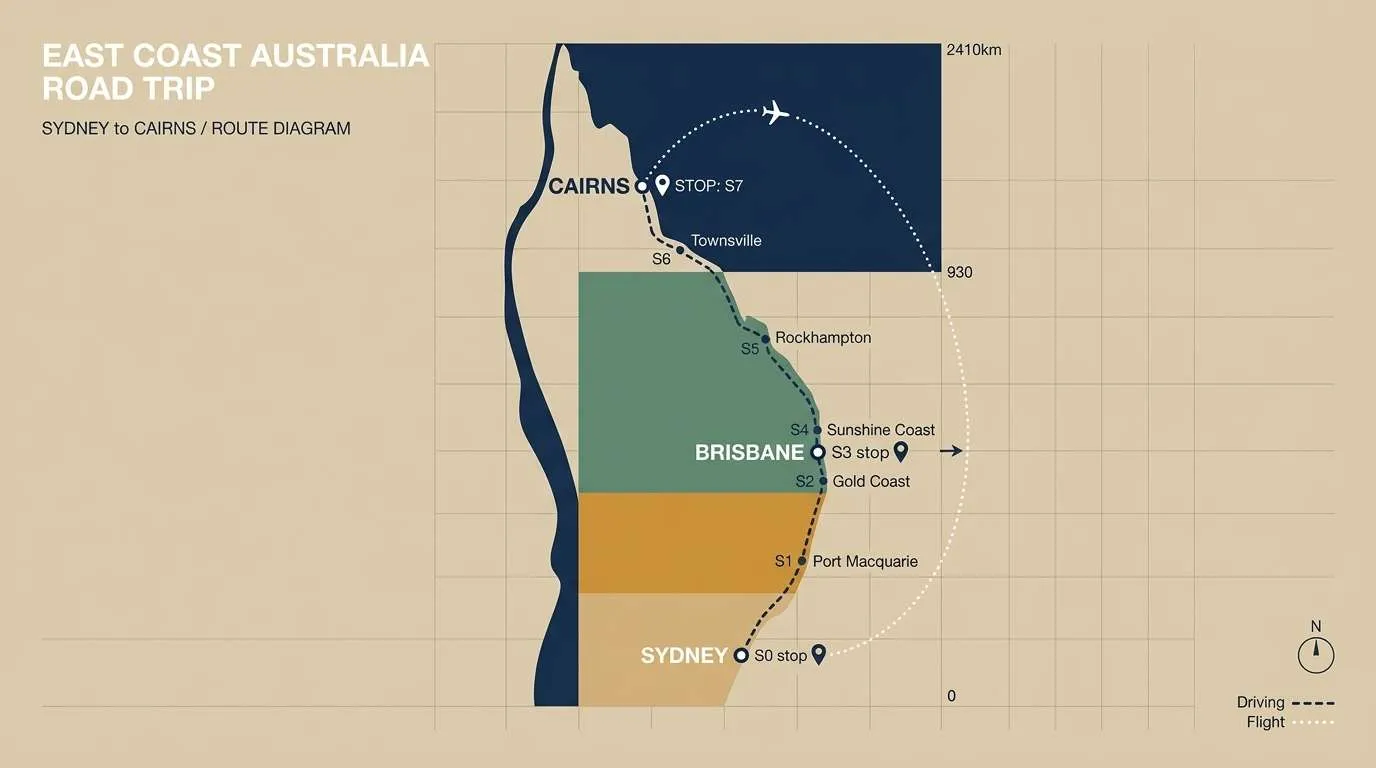
The classic Australia East Coast itinerary tries to cover the whole corridor in one pass; this 12-day Sydney to Cairns road trip instead breaks it into three blocks, not twelve equal days. This version keeps the driving to the sections worth seeing and uses one flight to skip the emptiest transfer. The official Tourism Australia Sydney-to-Cairns itinerary shows the full corridor; use it to identify regions, then prune.
| Block | Days | How you move | Rough driving | Overnight bases |
|---|---|---|---|---|
| 1 | Days 1–3 | Self-drive day trips from Sydney | About 2 h each way to the Blue Mountains | Sydney |
| 2 | Days 4–7 | Drive north, then one flight | Roughly 8 h Sydney→Byron (split over two days), ~2 h Byron→Brisbane; flight ~2 h | Port Macquarie or Coffs Harbour, Byron Bay, Brisbane, Airlie Beach |
| 3 | Days 8–12 | One transfer drive, then reef days | About 7 h Airlie Beach→Cairns | Airlie Beach, Cairns |
The honest constraint: Tourism Australia’s official itinerary puts the Sydney-to-Cairns corridor at about 2,609 km (1,620 mi) end to end. Twelve days works because the plan cuts hard and flies once — not because the driving is short.
Days 1–3: Sydney and the Blue Mountains
Land, collect the vehicle and recover from the time change. Give Sydney a full day, then use the Blue Mountains — about two hours each way — as the first contrast day. Cut: Canberra and the south coast — they belong to a different trip.
Days 4–7: Byron Bay, Brisbane, then fly to Airlie Beach
Drive the coast with one overnight break (Port Macquarie or Coffs Harbour) toward Byron Bay — Sydney to Byron is roughly 770 km, about eight hours, and it should not be done in a single hit — then continue about two hours to Brisbane. From there, fly to Airlie Beach (Proserpine): the same journey by road is roughly 1,100 km and eleven-plus hours of driving, against a flight of about two hours. Cut: Noosa and K’gari (Fraser Island) unless you add nights — each needs its own day.
Days 8–12: Whitsundays, then Cairns and the reef
Base in Airlie Beach for the Whitsundays and one reef or island day, then make the roughly 620 km, seven-hour transfer to Cairns for the reef and, if time allows, a Daintree day. Cut: Townsville and Magnetic Island if the reef is the priority; add them back only with extra days.
If you have two weeks instead, add the missing pieces one at a time — K’gari, Noosa, or Townsville and Magnetic Island — rather than adding all three and rebuilding the rush this plan removes.
What drives the cost: for most trips the three biggest items are the one-way car or campervan rental, the reef or Whitsundays excursion, and accommodation in Airlie Beach and Cairns. Fuel for the roughly 2,600 km corridor is smaller than people expect. Compare the rental’s one-way drop fee and the excursion’s cancellation window — those two line items usually decide whether the budget holds.
When to drive the east coast and how weather changes the plan
Season changes this route more than any other single decision. The broad sweet spot is the dry season, roughly May to October, when reef visibility is best and cyclone risk is lowest — but it is also peak demand, so book the headline stays and reef trips earlier. North Queensland reef trips and swimming are affected by marine stinger season (roughly November to May), and the tropical wet season and cyclone risk sit over December to April. Check current conditions for your dates instead of assuming one season fits the whole corridor.
Marine activities, island crossings and outdoor excursions are more vulnerable to conditions than a city museum or a café day. Put the least movable activity earlier in the stay when possible, so there is a chance to reschedule. Avoid placing an expensive excursion immediately before a long transfer or a flight.
This principle applies even when the forecast looks favorable. The purpose of slack is not to predict bad weather; it is to prevent one change from collapsing the rest of the route. A short itinerary should have fewer commitments per day, not only shorter driving legs.
- Keep an alternative on shore for weather-sensitive days.
- Avoid exact arrival commitments after an excursion day.
- Do not make a travel day double as an activity-heavy day.

Run these checks before you lock the route
Commit to the route only after these checks, because each one can move a whole block:
- Vehicle: one-way rental conditions, drop fees, pickup timing and driver licensing.
- Weather-sensitive activities: book reef, island and marine trips with a cancel-or-reschedule window.
- High-demand stays: secure Airlie Beach and Cairns accommodation early.
- Data and maps: download map areas offline and check your eSIM plan’s allowance mechanics for the corridor — see our Australia SIM card guide for the full SIM vs eSIM decision.
The route should never depend on one device staying charged. Keep booking references saved outside email and know your fallback before a low-signal day.
Frequently asked questions
Is 12 days enough for Sydney to Cairns?
It can be enough for a selective corridor route. It is not enough to explore every major coastal region in depth without flights or long transfer days.
Should I drive the whole way or fly a segment?
Fly the emptiest transfer. Driving Sydney to Cairns end-to-end costs two extra full driving days; flying Brisbane to Airlie Beach skips the longest stretch while keeping the coastal sections worth seeing.
What is most likely to disrupt the plan?
Weather-sensitive marine and island activities, long transfer days, late vehicle collection, and treating too many towns as overnight stops.
What should I book before departure?
One-way vehicle rental, Airlie Beach and Cairns accommodation, and any reef or island trips that sell out in season. Keep weather-sensitive activities refundable or reschedulable.
How should I handle maps and data on the route?
Download map areas and key addresses offline before leaving larger towns. Check your eSIM or SIM plan’s allowance mechanics and coverage terms for the corridor, and keep booking references saved outside email.
Choose the route you can actually finish
The right East Coast Australia road trip is the one you can complete without burning the daylight. Twelve days means three blocks, one well-chosen transport model and enough slack to move a weather-sensitive day — not a checklist of every beach between Sydney and Cairns. Lock the checks, cut hard, and keep the route usable offline.

High-speed data, wherever your journey leads
Enjoy instant, secure mobile data with Ezigo eSIM in 200+ destinations. No physical SIM needed.