
How to buy train tickets in Spain depends less on the brand you prefer than on which operators actually run your route on your date. You can buy on Renfe’s website or app, at station ticket offices and machines, or through retailers such as Trainline and Omio. AVE and Avlo are Renfe’s own high-speed and low-cost brands; OUIGO and iryo are separate companies.
This guide compares the practical options for buying Spain train tickets: where the booking window opens, how the fare families differ, what counts as a seat and a large bag on each operator, and what the journey actually looks like on the day. The first-person notes are from two of our own trips in October 2026, one on AVE and one on iryo.
Start with your route, not a brand name
Spain’s high-speed operators compete on trunk corridors, not everywhere. The busiest lines have three companies; many regional routes have one. So the first question is not which operator is cheapest, but who runs trains between your two cities on your date.
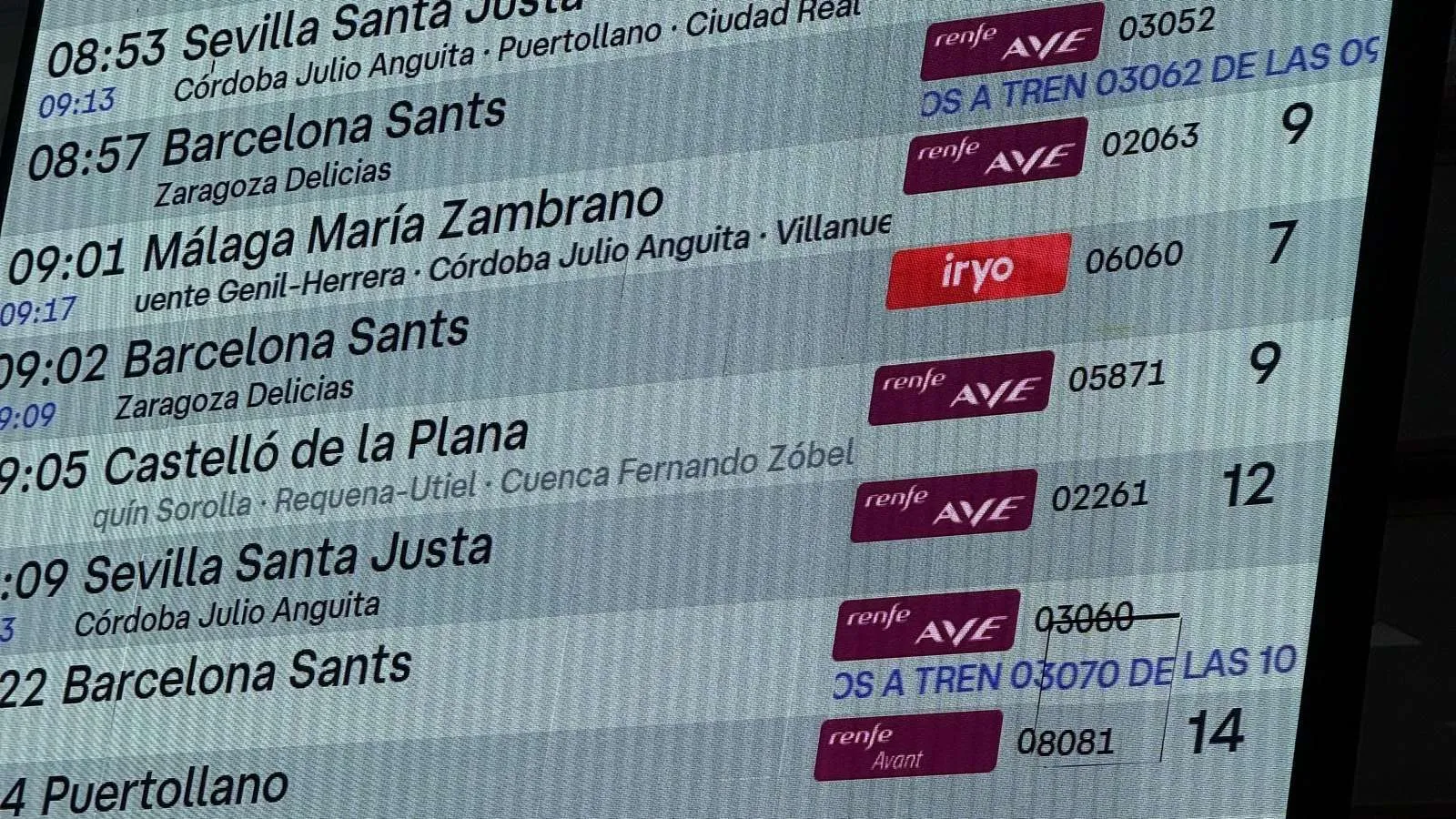
AVE, Avlo, OUIGO and iryo are not four companies
Two of the four names are Renfe products and two are competitors. AVE is Renfe’s full-service high-speed brand and Avlo is its low-cost sibling. OUIGO España belongs to France’s SNCF, and iryo is a joint venture led by Italy’s Trenitalia. That distinction decides what is included on board and what a rail pass will cover.
So an iryo vs OUIGO comparison only means something on a corridor both serve, and it is usually settled by the fare conditions attached to a specific train. On Madrid–Barcelona one date can produce three very different prices for a journey of the same length.
How to buy train tickets in Spain on Renfe: the sequence
iryo and OUIGO España follow a broadly similar flow. Use the language toggle before you start: the interface translates, the fare names do not.
- Enter the route, date and passengers. Use exact station names. “Todas” covers every station in a city at the same fare.
- Pick the train. Results use a 24-hour clock, and a “link” label means a connection with a change of train.
- Choose the fare. Básico allows no changes or refunds, Elige allows changes for a fee with partial refunds, Elige Confort adds a wider seat, Prémium is fully flexible with seat selection included.
- Enter passenger details exactly as on the passport. Switch the document field to passport, and use an email you can open on the day — the PDF is sent there.
- Review the add-ons. Seat selection is not included on the cheapest fares, and extra luggage on low-cost brands is added at this step.
- Pay. Cards issued outside Spain are occasionally refused; try a second card or a different channel.
- Save the ticket and the localizador. That reference loads the ticket in the operator’s app without re-entering anything.
When tickets go on sale, and why “book early” is not the whole answer
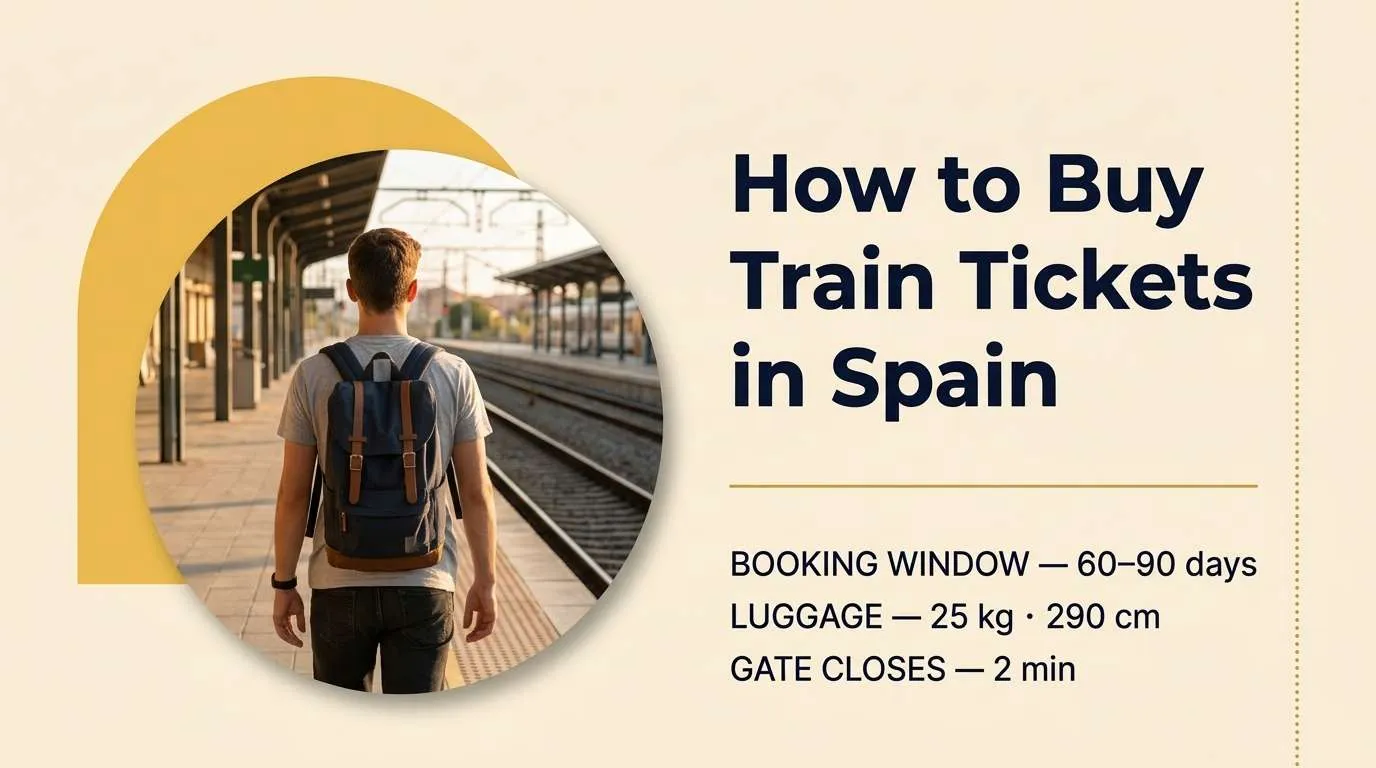
Release dates are not uniform. Renfe generally opens bookings about 60 days ahead and AVE often reaches 90, while iryo sometimes releases earlier. Low-cost brands put their cheapest stock out first and let it sell down, so the useful window for most travellers is two to twelve weeks out.
Twice a year Renfe overhauls its timetable — on the second Saturday of June and the second Saturday of December — and around those dates the booking window can shrink to about 30 days. A train you cannot see 90 days out is usually unreleased, not sold out.
Booking early is a default, not a rule. Midweek and midday departures are usually cheaper than Friday and Sunday peaks, and on quiet regional routes with fixed fares waiting costs nothing.
Seats, luggage and changes: read these before checkout
A seat is part of the ticket on AVE, iryo and other long-distance services, and it is normally assigned automatically. Choosing a specific seat is a paid add-on — about €5 on iryo — so pay for it during booking if sitting together matters, rather than hoping for adjacent allocation.
A rail pass is not unlimited travel. Interrail and Eurail are generally valid on Renfe, but the reservation is compulsory and charged per journey, and passes are typically not accepted on OUIGO España, which sells point-to-point tickets only. Compare pass price plus reservation fees against advance fares on competitive corridors.
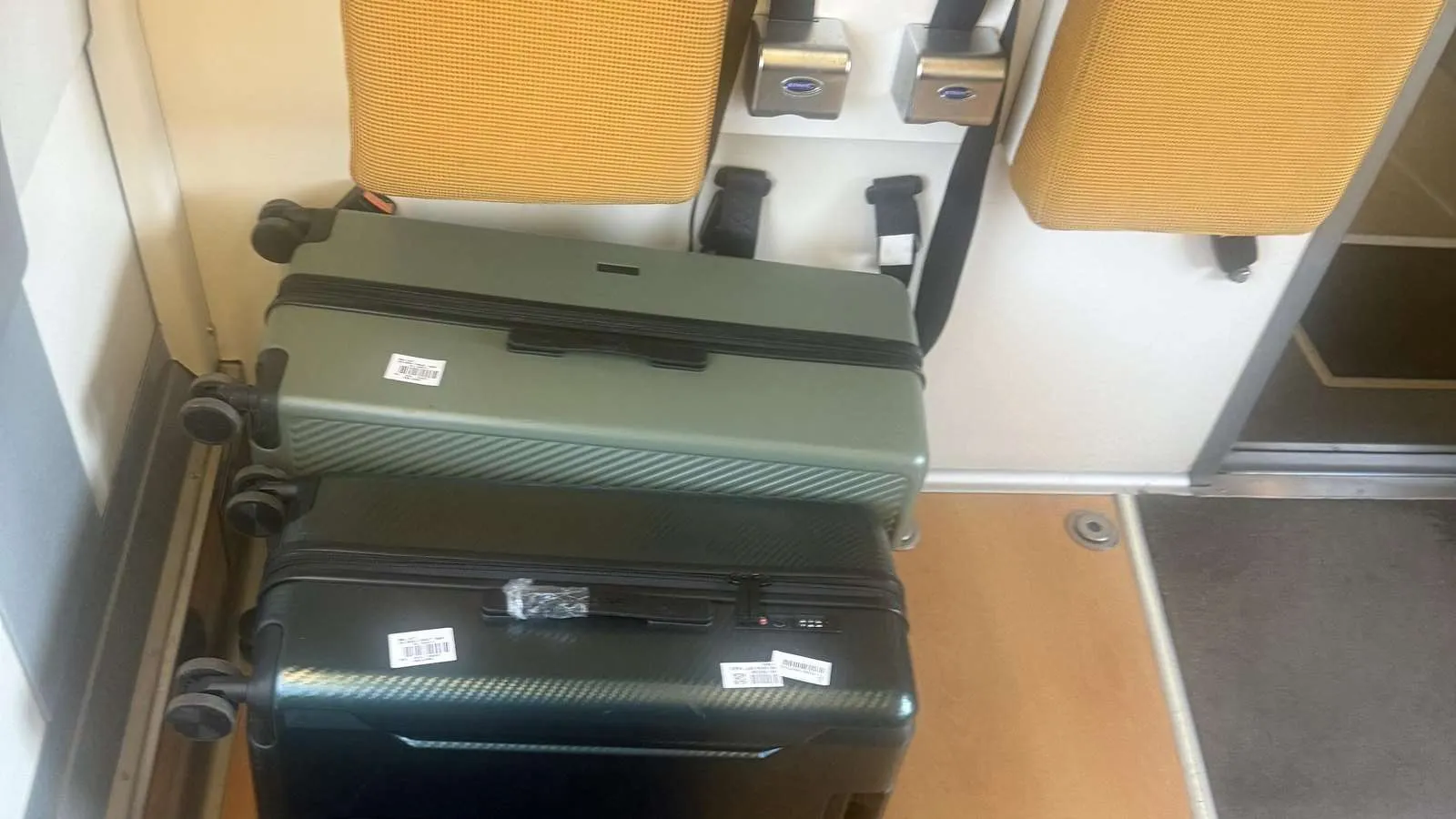
Luggage is where the brands diverge. Renfe allows up to three pieces per passenger. Their combined weight must stay under 25 kg and their combined dimensions under 290 cm, and no single piece may exceed 85 × 55 × 35 cm.
Avlo includes one small personal item up to 36 × 27 × 25 cm and one cabin bag up to 55 × 35 × 25 cm. Anything larger is a paid extra, cheaper during booking than afterwards. OUIGO España applies a similar add-on model, so the headline price is not the price you pay once a full-size bag is in the picture.
Madrid–Barcelona and other high-speed corridors
The Madrid–Barcelona train is the busiest high-speed service in the country and the clearest test of route-first thinking. The corridor runs roughly 621 km: the fastest journeys take a little over two hours, the typical journey around two and a half, with dozens of departures a day across AVE, OUIGO España and iryo. Trains leave Barcelona Sants and arrive at Madrid Atocha or Madrid Chamartín, so the arrival station changes your onward journey as much as the price does.
Other corridors work the same way at shorter length: Madrid–Seville and Madrid–Málaga sit near two and a half hours, Madrid–Valencia under two. Journey times barely differ, so the tie-breaker is fare conditions, departure time and arrival station. One Spain-specific step catches people out: major high-speed stations screen bags before the platform, so allow 20 to 30 minutes, and more if a change means a second screening.
What two real journeys looked like: notes from our own trips
Two of us travelled in October 2026 with a large case each: Barcelona to Madrid on AVE in the morning, then Madrid to Seville on iryo the same afternoon. Two different corridors is not a controlled comparison, but it is how the decision really gets made.
We bought the AVE leg in a third-party booking app, faster than working through the Spanish site with luggage in the way. What came back was a real Renfe e-ticket: service 03082, Estándar, seat 11A, a localizador and a Combinado Cercanías code. That code is the free suburban connection bundled with long-distance Renfe tickets: valid from four hours before departure to four hours after arrival, and at Madrid’s Cercanías barriers the AVE ticket itself opens the gate. Most travellers never notice it.
The iryo leg came from iryo’s own app, which required an account. We chose Infinita because it includes a large piece of luggage: against a cheaper fare plus a bag add-on the total landed in roughly the same place.
Neither operator asked us to choose a seat. Renfe put us in the same carriage, iryo assigned 3B plus its neighbour as a pair. The Infinita carriage is 2+1 — A, B and D, no middle seat — and carriage 3 was quiet, so a pair gets a block to itself.
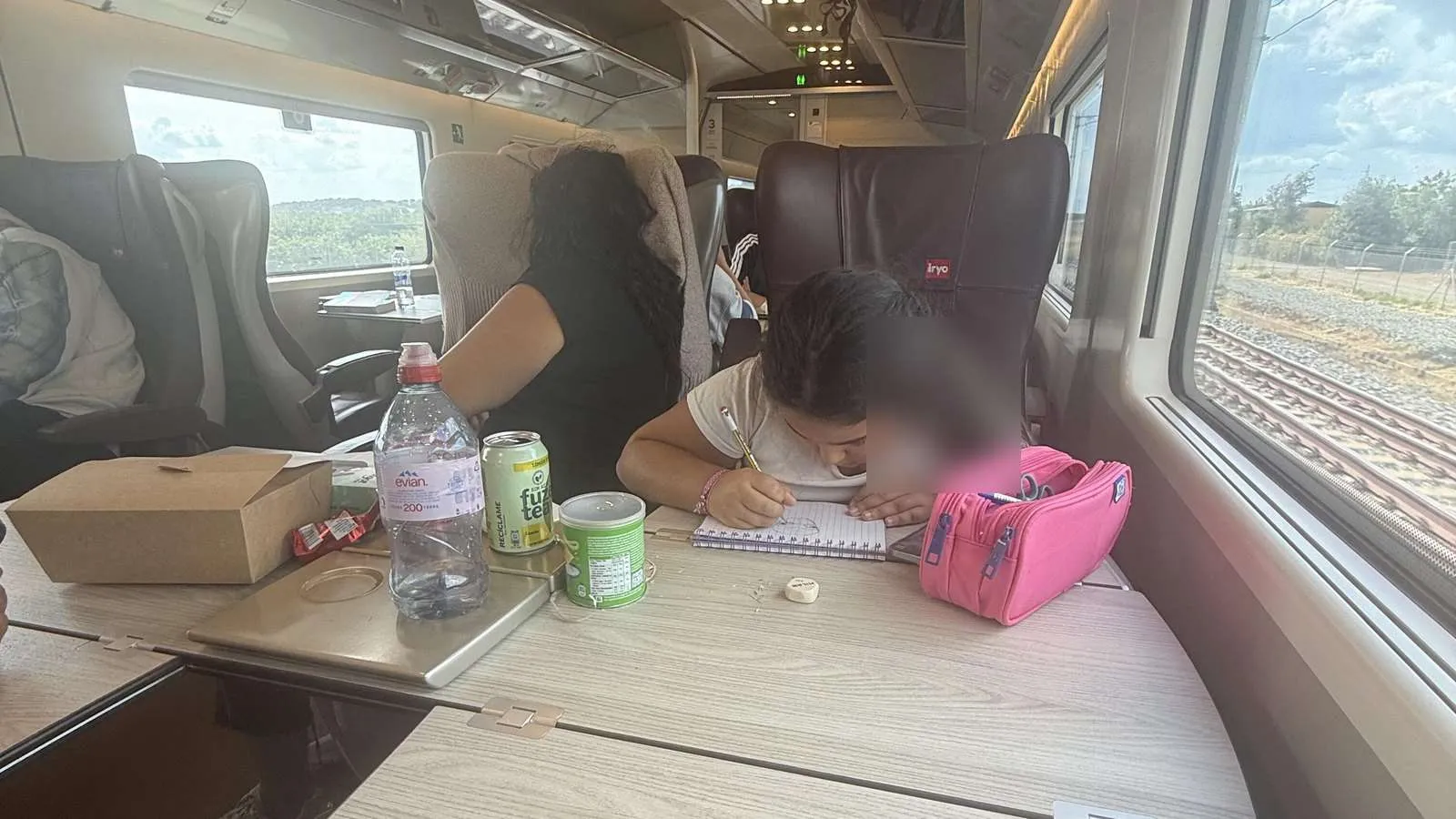
Two large cases went on board without being weighed, and on iryo we asked staff at the gate to confirm the bag was covered by Infinita — that is the check that actually happens, because the fare class is on the ticket. Both stations screened bags before the platform. The Renfe ticket also prints that access closes two minutes before departure, which is the deadline that matters.
Delay notices are not uniform. Our AVE left thirty minutes late and Renfe emailed the delay; the iryo train also ran late and no message arrived, only the onboard announcement. If someone is meeting you, that difference changes the last hour.

Neither brand won. We took AVE because booking was fast and the luggage position was known, and iryo because on that train the time, the price and the included bag lined up. The decision belongs to the journey.
Travel day: have the record ready before the station
Before you leave, confirm the departure station, allow time for screening, carry the travel document you booked with, and know where the ticket lives. Download the PDF while you still have Wi-Fi: gate staff scan a phone screen, and a dead battery is the one failure a booking reference cannot fix.
Most travellers now keep the ticket, the reference and the connection on one device, which quietly makes the handset part of the plan. Before relying on it at the gate, check that your phone works on Spanish networks — band support is a device question, and no amount of data fixes a handset that cannot hold the local bands.
The connection itself is the easier half to restore. An eSIM for Spain is a data-only line: it will load the ticket PDF, the delay email and the platform number, but it does not give you a Spanish phone number, so an SMS or a call from the operator still reaches the number you booked with, not the data line.
Spain train tickets FAQ
Final recommendation
The right Spain train ticket is the one that matches the journey you actually need to make. Start from the route and date, then see which operators run it. Compare the fare conditions on the specific train rather than the brand’s reputation. Read the seat, luggage and change terms before checkout, and recheck the booking window around the June and December timetable changes.
The first-person details in this guide are the kind that are not in the fare tables: where the second station is on the wrong side of the city, that the AVE ticket opens the Cercanías gate, that Renfe emails delays and iryo announces them, that a printed copy is rarely needed. None of those facts changes the fare. They do change the last hour before the train.

High-speed data, wherever your journey leads
Enjoy instant, secure mobile data with Ezigo eSIM in 200+ destinations. No physical SIM needed.