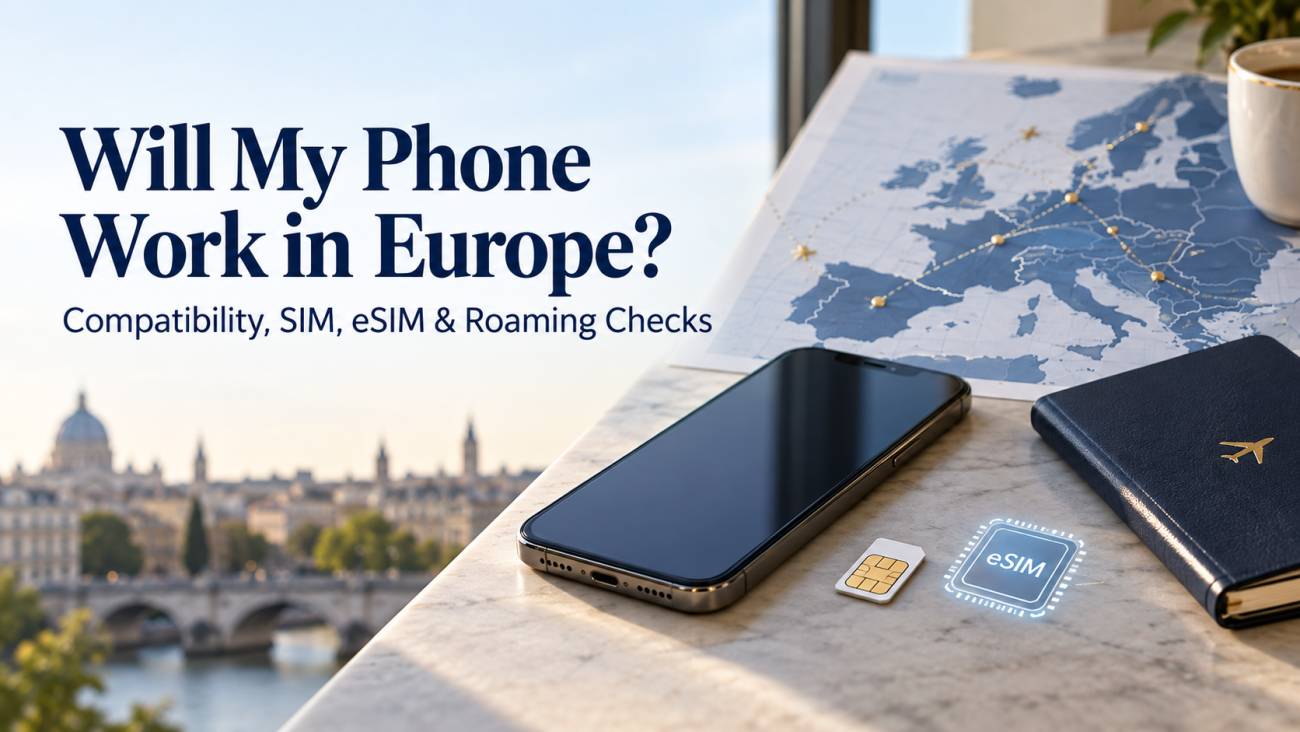
A Europe SIM card can be a local physical SIM bought after landing, a multi-country travel SIM, or an eSIM installed before departure. Those options do not solve exactly the same problem. The right one depends on your route, whether you need a phone number, how much data you use and whether your phone is unlocked.
This guide compares the main ways visitors stay connected in Europe, explains how cross-border coverage works, and shows where to buy and set up service without turning a simple purchase into an airport scavenger hunt.
Why get a SIM card for Europe?
The main reason is control. With a prepaid SIM or eSIM, you can see the data allowance, validity and covered countries before the trip rather than discovering roaming charges afterward. You also gain a separate travel-data line for maps, rail tickets, hotel messages and translation apps.
A physical local SIM can add a local number and ordinary calls or SMS. A regional travel eSIM is usually data-focused but avoids swapping your home SIM. Neither format is automatically cheaper or better; the plan details matter more than whether the SIM is plastic or digital.
- Choose local service when one country dominates the itinerary or a local number is important.
- Choose regional service when the trip crosses several covered countries.
- Keep home roaming when your existing plan already includes the route at an acceptable price.
Which SIM card is best for travel to Europe?
There is no single winner for every route. Start with the type of service that fits the trip: a local operator SIM for one main destination, a regional SIM or eSIM for several countries, or home-carrier roaming when convenience matters more than switching plans. Compare the restrictions before comparing headline data amounts.
| Option | Format and coverage approach | Good fit for | Main check |
|---|---|---|---|
| Local operator SIM | Physical SIM or local eSIM issued for one national market, sometimes with eligible EU/EEA roaming | A longer stay in one country or travelers who need a local number | Registration, activation and roaming allowance |
| Regional travel eSIM | Digital plan covering a published list of European destinations | Multi-country trips and travelers who want service ready before arrival | Country list, data policy, hotspot support and phone compatibility |
| Regional physical travel SIM | Removable SIM designed for use across several listed destinations | Multi-country travel on a phone without eSIM support | Delivery or pickup, SIM size, activation and included services |
| Home-carrier roaming | Your existing SIM and phone number using a roaming allowance or travel pass | Short trips when the total cost and route coverage are already clear | Daily charges, data caps and destination exclusions |
Local operator SIM: strongest for one main destination
A local SIM can be a practical choice when most of the trip is in one country, especially if you need a local phone number. Plans are sold for that operator’s home market, so registration, activation and roaming conditions can vary.
- Best for: longer stays, local calls or a trip centered on one country.
- Watch for: identification requirements, activation steps and how much of the allowance can be used abroad.
Regional travel eSIM: built for border-crossing routes
A regional eSIM can be installed before departure and used across the destinations named by the provider. Many travel eSIMs are data-only, while some plans also include a phone number, calls or texts.
- Best for: travelers moving between several countries who have an unlocked, eSIM-compatible phone.
- Watch for: the exact country list, validity start, full-speed allowance and what happens after that allowance is used.
Regional physical travel SIM: an option when eSIM is unavailable
A physical travel SIM follows the same multi-country idea but uses a removable card. It avoids relying on eSIM compatibility, although you may need to order it in advance, collect it after arrival or store your home SIM safely during the trip.
- Best for: unlocked phones that accept a physical SIM but do not support eSIM.
- Watch for: delivery time, activation instructions, phone-number support and top-up rules.
Home-carrier roaming: simplest when the price is known
Keeping your existing SIM avoids a new installation and preserves your usual number. The trade-off is cost: a daily pass or roaming bundle can be reasonable for a short trip but expensive when charged across a longer itinerary.
- Best for: short travel when your carrier already covers every destination at a clear total price.
- Watch for: daily fees, reduced roaming allowances and charges triggered by background data.
Will one European SIM card work across borders?
Often, but not because every European country shares one mobile system. Eligible EU subscriptions can use domestic allowances temporarily in other EU countries under the EU’s “roam like at home” rules, subject to fair-use limits. The same regime also applies in Iceland, Liechtenstein and Norway.
The UK, Switzerland and Turkey are outside that EU/EEA framework. Providers may include them voluntarily, but the inclusion comes from the plan’s own country list. This is why a SIM advertised for “Europe” still needs a route-by-route check.

How to use a SIM card in Europe
Most setup problems can be avoided before the flight. Start by confirming that the phone is carrier-unlocked. A phone may support European networks and still reject another provider’s SIM because of a carrier lock.

- Check the SIM format. Confirm whether the phone uses a physical nano-SIM, eSIM or both.
- Buy the plan. For a physical SIM, check whether the starter pack already contains an active bundle. For an eSIM, check when validity begins.
- Complete registration if required. Some local operators or countries ask for identification before service can be activated.
- Install the SIM. Insert the physical card with the phone powered off, or scan the eSIM QR code over stable Wi-Fi.
- Select the travel line for data. On a dual-SIM phone, keep the home line from switching back to mobile data automatically.
- Follow the provider’s roaming and APN instructions. Regional travel plans may require data roaming even though they are designed for travel.
- Test without Wi-Fi. Load a webpage and confirm which SIM is supplying data before leaving the airport or shop.
How much do SIM cards cost in Europe?
The price depends on what is bundled with the SIM, not the card itself. A low-cost starter card may contain no data until you add credit. A more expensive visitor pack may include regional roaming, a local number, calls, texts or a larger allowance.
Compare these details before treating one plan as cheaper:
- full-speed data and what happens after it is used;
- validity and the event that starts it;
- the exact country list;
- voice calls, SMS and a phone number;
- activation, top-up and renewal charges;
- hotspot or tethering support.
Airport pricing can be higher because it includes convenience and immediate help, although this is not universal. If you buy at an airport, compare the active bundle with the provider’s direct offer and test the SIM before leaving the counter.
Where to buy a SIM card for Europe
You can buy service before departure or after arrival. The best channel depends on whether you value price comparison, immediate help or having data ready before landing.

Airport kiosks
Choose the airport when you need service immediately or want help installing a physical SIM. Ask the seller to confirm the active allowance, expiry date and renewal rules, then test mobile data with airport Wi-Fi turned off.
Carrier stores
A carrier shop is usually the safest place to ask about a local phone number, registration and domestic coverage. It is especially useful for a longer stay in one country.
Supermarkets, convenience stores and electronics retailers
These shops can be convenient and inexpensive, but staff may not provide setup help. Read the pack carefully because the displayed price may cover only the SIM shell or initial credit.
Online before the trip
A physical travel SIM can be shipped before departure, while an eSIM can normally be delivered digitally. Buying online gives you time to compare the route and activation rules, but a physical card still depends on delivery time.
Consider an eSIM instead of a physical Europe SIM card
An eSIM is useful when the phone is compatible and mobile data is the main requirement. It can be installed without removing the home SIM, and a regional plan can stay on the phone while you cross covered borders. The trade-off is that many travel eSIMs are data-only and do not include a local number, normal calls or SMS.
Check three things before buying: the exact device model, the country list and the activation trigger. If any of those are unclear, a physical SIM from a staffed operator store may be the safer option.
Need data across Europe?
Three representative Ezigo plans are shown below. The full product page contains the current coverage list and other allowances.
Ezigo’s Europe eSIM is data-only and currently lists 34 destinations. Prices and coverage were checked October 9, 2026 and may change.
Quick recap: choose by trip, not by brand
- One-country stay: compare a local operator SIM, especially if you need a phone number.
- Multi-country route: choose a regional SIM or eSIM that includes every destination.
- Physical-SIM-only phone: compare regional travel SIMs and allow time for delivery or collection.
- Data needed on arrival: install a compatible travel eSIM before departure, but activate it according to the provider’s instructions.
- Several devices: check hotspot support or consider pocket Wi-Fi for a group.
Frequently asked questions
Which SIM card is best for Europe travel?
For a multi-country trip, start with a regional SIM or eSIM whose coverage includes every stop. A local prepaid SIM may be better for a long stay in one country or when a local number is essential.
Is there one SIM card that works across Europe?
Regional travel SIMs and eSIMs can cover many destinations under one plan, but no label guarantees all of Europe. Check the country list, especially for the UK, Switzerland and Turkey.
Where can I buy a SIM card for Europe?
You can buy a physical SIM at an airport kiosk, carrier shop, electronics retailer, supermarket or convenience store. You can also order a physical card online or buy an eSIM before departure.
How much does a SIM card cost in Europe?
Cost depends on the country, data allowance, validity and whether calls or texts are included. Compare the complete bundle and any activation, roaming or renewal charges rather than the starter-card price.
Can I use a European SIM card in an American phone?
Usually, if the phone is carrier-unlocked and supports the required SIM format and local network bands. Check the exact model and lock status before purchasing.
Do Europe travel eSIMs include a phone number?
Some do, but many are data-only. Check whether the product includes a local number, regular calls or SMS. On a dual-SIM phone, you can often keep the home line active while using the travel eSIM for data, but home-carrier charges may apply.
Final advice
The best Europe SIM card is the one that fits the route and the job you need it to do. Choose local service for a local number or a long stay, regional service for a border-crossing itinerary, and home roaming only when you have checked the allowance and cost. Before paying, confirm coverage, activation, full-speed data and what happens when the allowance runs out.
Sources and verification notes
High-speed data, wherever your journey leads
Enjoy instant, secure mobile data with Ezigo eSIM in 200+ destinations. No physical SIM needed.