Japan eSIM vs Pocket WiFi: Which Is Better for Your Trip?
Compare Japan eSIM and Pocket WiFi by price, hotspot use, setup, compatibility, network access, and trip length. See when Ezigo Total, Daily, or Unlimited plans fit best.
If you are comparing Japan eSIM vs Pocket WiFi options, the cheapest headline price is not enough to make the decision. The better choice depends on how many people need data, whether your phone is unlocked and eSIM-compatible, how much data you expect to use, and whether you need to collect and return a router.
For most solo travelers with a compatible phone, an eSIM is the simpler option. Pocket WiFi can be a better fit for families or groups that stay together and share several devices. If you are still comparing providers and plan types, see our Best eSIM for Japan guide. This article compares both options by total cost, setup, hotspot use, network access, and practical limitations. Prices below are based on the comparison snapshot checked on September 6, 2026.
Japan eSIM vs Pocket WiFi: Quick Answer
Choose a Japan eSIM if you want to install your plan before departure, avoid carrying another device, and pay for a fixed or daily amount of data on each phone. Choose Pocket WiFi if several people will share one connection, your devices do not support eSIM, or you want one portable hotspot for phones, tablets, and laptops.
| Your situation | Better starting point | Why |
|---|---|---|
| One traveler with an unlocked compatible phone | eSIM | No router, pickup, return, or extra battery to manage |
| A couple traveling together | eSIM or Pocket WiFi | Compare two eSIM prices with one shared router rental |
| Family or group staying together | Pocket WiFi | One device can serve multiple phones and tablets |
| Heavy use on one phone | Daily or Unlimited eSIM | Choose the allowance that matches your daily habits |
| Phone is locked or does not support eSIM | Pocket WiFi or physical SIM | eSIM cannot work until the device issue is resolved |
| Frequent separation during the day | Individual eSIMs | Each traveler keeps connectivity without sharing one router |
There is no universal winner. The right answer changes with group size, trip length, and the restriction that matters most to you.
eSIM vs Pocket WiFi: What Are You Actually Paying For?
An eSIM is a digital mobile plan installed on a compatible phone. Pocket WiFi is a rented portable router that creates a WiFi network for nearby devices. Both can provide mobile internet in Japan, but they charge you for different forms of convenience.
With an eSIM, the main cost is the data plan. With Pocket WiFi, the advertised daily rate may not show the full cost of delivery, airport collection, return, insurance, cancellation, or a lost device. JAL’s Japan connectivity guide describes airport pickup and daily router fees as part of the rental process, while noting that Pocket WiFi is useful for connecting several devices.
Pocket WiFi also has an attention cost. You need to keep the router charged, stay within its range, and remember to return it. An eSIM removes those steps, but it only works if your phone supports eSIM and is unlocked.
How Much Does Pocket WiFi Cost in Japan?
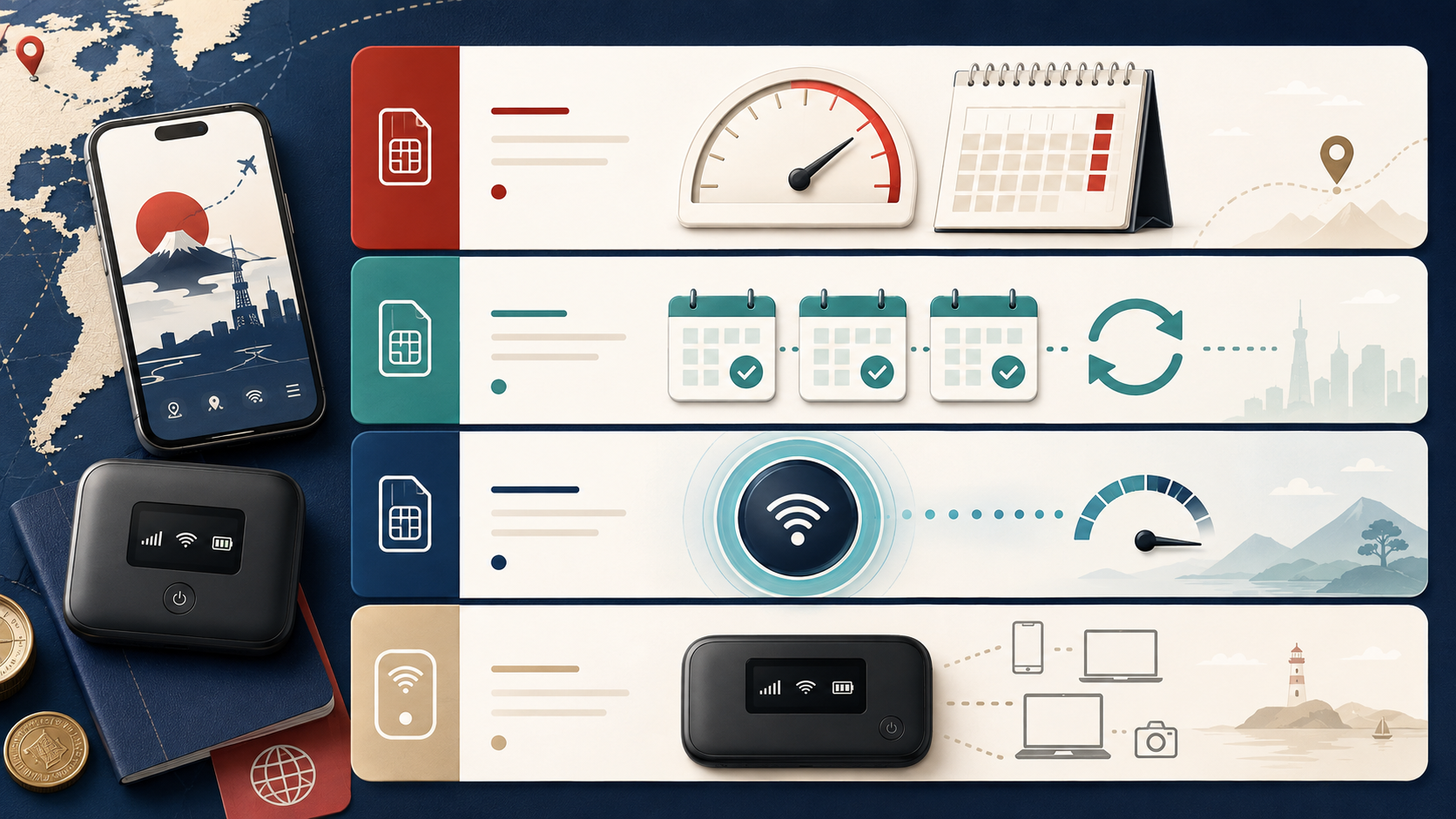
The phrase pocket wifi japan price can be misleading because providers use different rental periods and plan rules. A daily rate is only a starting point: delivery, airport pickup, return, insurance, and late fees can change the final total. If you are researching japan pocket wifi cost, compare the checkout total for your dates rather than multiplying the lowest daily rate by the number of days. JAL’s guide to portable Wi‑Fi and mobile connectivity in Japan is a useful reference for the rental process.
That range is a reference, not a universal market price. Promotions, insurance, delivery, and return fees can change the final total.
Before comparing a japan pocket wifi rental, check these items at checkout:
- Total price for the exact number of rental days
- Airport pickup, hotel delivery, and return method
- Insurance, deposit, cancellation, and late-return fees
- Number of devices allowed at the same time
- Battery duration and whether a power bank is included
- Speed limits or fair-use rules
- What happens if the router is lost or damaged
For a solo traveler, a router can be unnecessary overhead. For a group of four that stays together, one rental fee may be cheaper than buying four separate data plans. The break-even point depends on the provider’s total checkout price, not the daily number shown in a search result.
Ezigo Japan eSIM Prices Compared With Airalo, Saily, and Nomad
The most useful comparison is by plan type rather than by the word “unlimited.” A fixed-data plan, a daily plan, and an unlimited plan solve different problems.
| Plan type | Ezigo | Airalo | Saily | Nomad | Practical reading |
|---|---|---|---|---|---|
| 10GB / 30 days | $7.62 | $18.00 | $17.99 | $18.00 | Ezigo has a clear fixed-data price advantage in this snapshot |
| Unlimited / 7 days | $20.61 | $27.00 | $26.99 | — | Ezigo is lower among the listed 7-day options |
| Unlimited / 15 days | $42.24 | $48.00 | $48.99 | — | Ezigo remains competitive for a two-week trip |
| Unlimited / 30 days | $82.68 | $69.00 | $71.99 | — | Ezigo is not the lowest headline price for 30 days |
The price advantage is strongest for Ezigo Total plans. The 10GB/30-day plan is $7.62, compared with $18.00 for Airalo and Nomad and $17.99 for Saily in the same comparison list. Ezigo’s shorter Unlimited plans are also competitive, but the 30-day Unlimited plan should be judged by its fallback speed and network setup rather than by price alone.
These are listed prices from one comparison date. Promotions, currencies, taxes, and checkout conditions can change. Confirm the selected package before paying on the Ezigo Japan eSIM product page.
Which Ezigo Japan Plan Fits Your Data Use?
Total data: best when you can estimate the trip
Ezigo Total plans provide a fixed allowance for the validity period. Current examples include 1GB for 7 days at $2.55, 3GB for 30 days at $3.95, 5GB for 30 days at $5.09, 10GB for 30 days at $7.62, 20GB for 30 days at $19.05, and 50GB for 30 days at $39.09.
The Total range uses NTT Docomo, Rakuten Mobile, and KDDI/au profiles and supports 5G where the device and local coverage allow it. Once the total allowance is used, service stops. That makes this range a strong fit for maps, messaging, train searches, translation, and moderate browsing when you can estimate your total use.
Daily data: best when you want a predictable daily allowance
Ezigo Daily plans offer either 2GB or 3GB of high-speed data per day. For example, the 2GB/day plans are $8.84 for 7 days, $21.68 for 15 days, and $41.43 for 30 days. The 3GB/day plans are $13.64 for 7 days, $27.06 for 15 days, and $52.22 for 30 days.
These plans use NTT Docomo and IIJ on 4G/LTE. After the daily high-speed allowance is used, service continues at up to 384Kbps until the next reset. The allowance resets according to Japan local time. This fallback is useful for messages and light updates, but it is not designed for video streaming or large uploads.
Unlimited: best when continuous access matters
Ezigo Unlimited plans cost $3.65 for 1 day, $7.61 for 3 days, $20.61 for 7 days, $42.24 for 15 days, and $82.68 for 30 days. They use SoftBank and KDDI and support 4G, LTE, and 5G.
Each day includes 1GB of high-speed data. After that allowance, the connection continues at up to 5Mbps. This is an important distinction: the plan is not unlimited full-speed data, but it can remain usable for ordinary browsing, maps, messaging, and many everyday tasks after the high-speed allowance is reached.
All currently listed Ezigo Japan plans support hotspot sharing. Hotspot use consumes the same plan allowance, so a laptop, cloud backup, or video meeting can use data much faster than ordinary phone navigation.
When Is Pocket WiFi Better Than an eSIM?
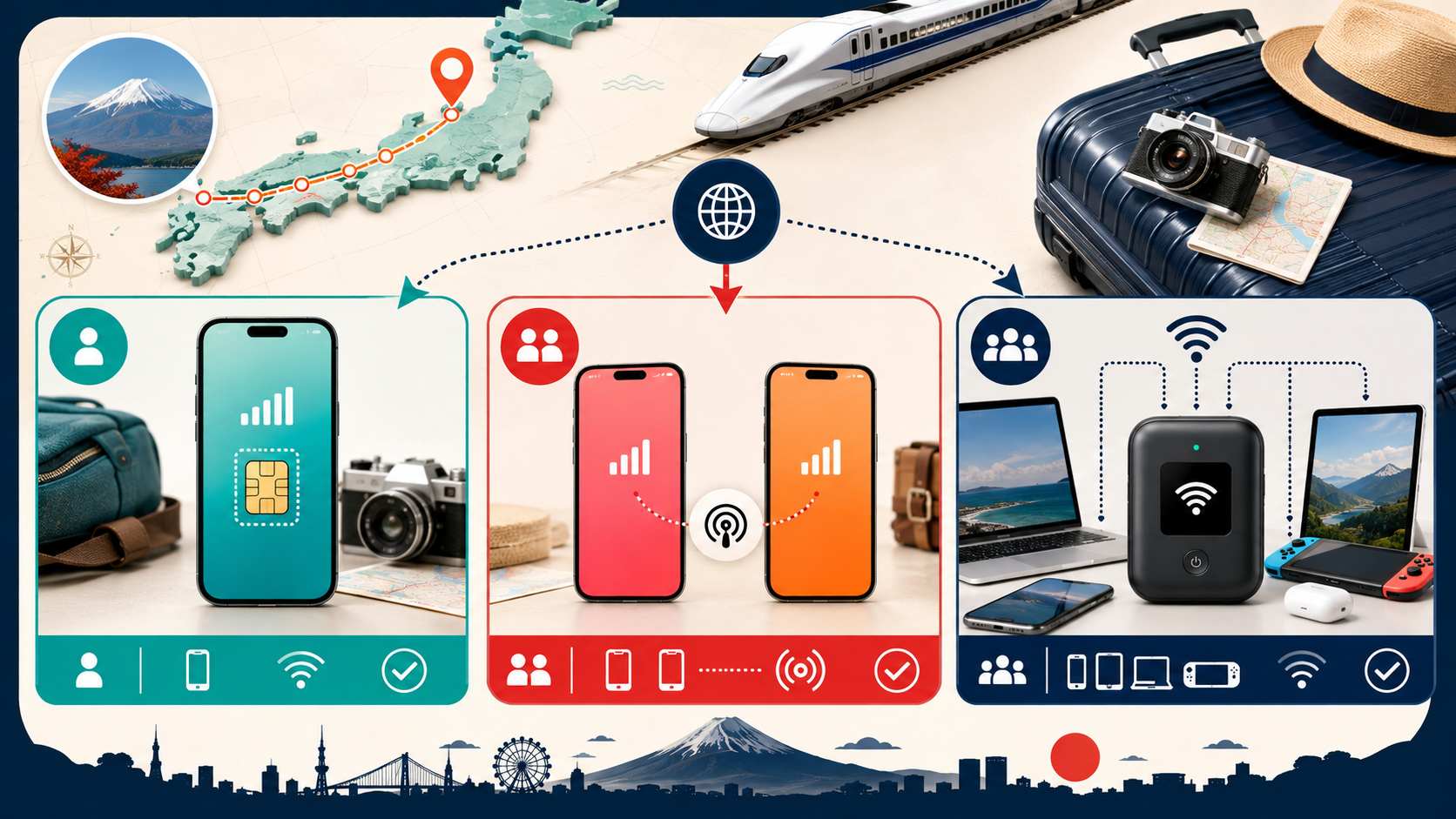
Pocket WiFi is usually the better fit when several people share one connection and remain close to each other. It can connect phones, tablets, and laptops without requiring every device to support eSIM. Japan’s official tourism organization also describes WiFi rental as useful for travelers who want more guaranteed connectivity, particularly for remote areas, and lists airport pickup or hotel delivery as common rental methods.
Choose Pocket WiFi when:
- Two or more people will use the same connection heavily.
- A family needs internet on phones, tablets, or a laptop.
- One or more devices do not support eSIM.
- The group usually stays together.
- You prefer one router rather than configuring several phones.
The trade-off is that everyone must stay near the router, and the group loses connectivity if the device battery runs out or the router is left behind. Pocket WiFi is less convenient when travelers split up during the day.
When Is an eSIM Better Than Pocket WiFi?
An eSIM is usually better for solo travelers, couples who do not need heavy shared data, and anyone who wants to connect immediately after landing without visiting a counter. Before buying, compare network access, data capacity, validity, device compatibility, hotspot rules, and support options in our Best eSIM for Japan guide.
Choose an eSIM when:
- Your phone is unlocked and eSIM-compatible.
- You want to install the plan before departure.
- You do not want to carry or return another device.
- You may separate from your travel companions.
- You want to choose between Total, Daily, and Unlimited data.
- You mainly need maps, translation, messaging, tickets, and browsing.
For a 7-day light-use trip, Ezigo Total 5GB/30 days at $5.09 or Daily 2GB/day at $8.84 may be more economical than paying for a full Unlimited plan. For a 10–14-day trip, 10GB/30 days at $7.62 is a practical starting point if your usage is moderate. Our guide to how much data you may need in Japan can help you estimate that allowance. Heavy hotspot use requires a larger Total plan, a Daily plan, or Unlimited data with its high-speed limit understood.
Japan eSIM Compatible Phones: Can You Use an iPhone or Samsung?
The answer depends on the exact model and region, not only the brand name. Apple states that iPhone XS, iPhone XS Max, iPhone XR, and later models can support travel eSIM, provided the carrier and device requirements are met. Apple also explains that a travel eSIM requires an unlocked phone; on an iPhone with a SIM tray, “No SIM Restrictions” appears next to Carrier Lock when the device is unlocked. See Apple’s international travel eSIM guide.
Compatibility can still vary by exact model, country of purchase, and carrier-lock status. Check the manufacturer’s specifications and the provider’s compatibility checker before buying; do not assume that every phone in a supported product family will work.
For a japan esim iphone search, check:
- Settings → General → About → Carrier Lock.
- Confirm that the phone shows “No SIM Restrictions.”
- Check whether the exact regional model supports eSIM.
- Confirm that the phone is not already using all available eSIM profiles.
- Keep access to WiFi for installation.
Samsung compatibility is similarly model- and region-dependent. Do not assume that every Galaxy device supports eSIM. Use the provider’s compatibility checker or the phone manufacturer’s specifications for the exact model.
How to Use an eSIM in Japan Without Triggering Roaming Charges
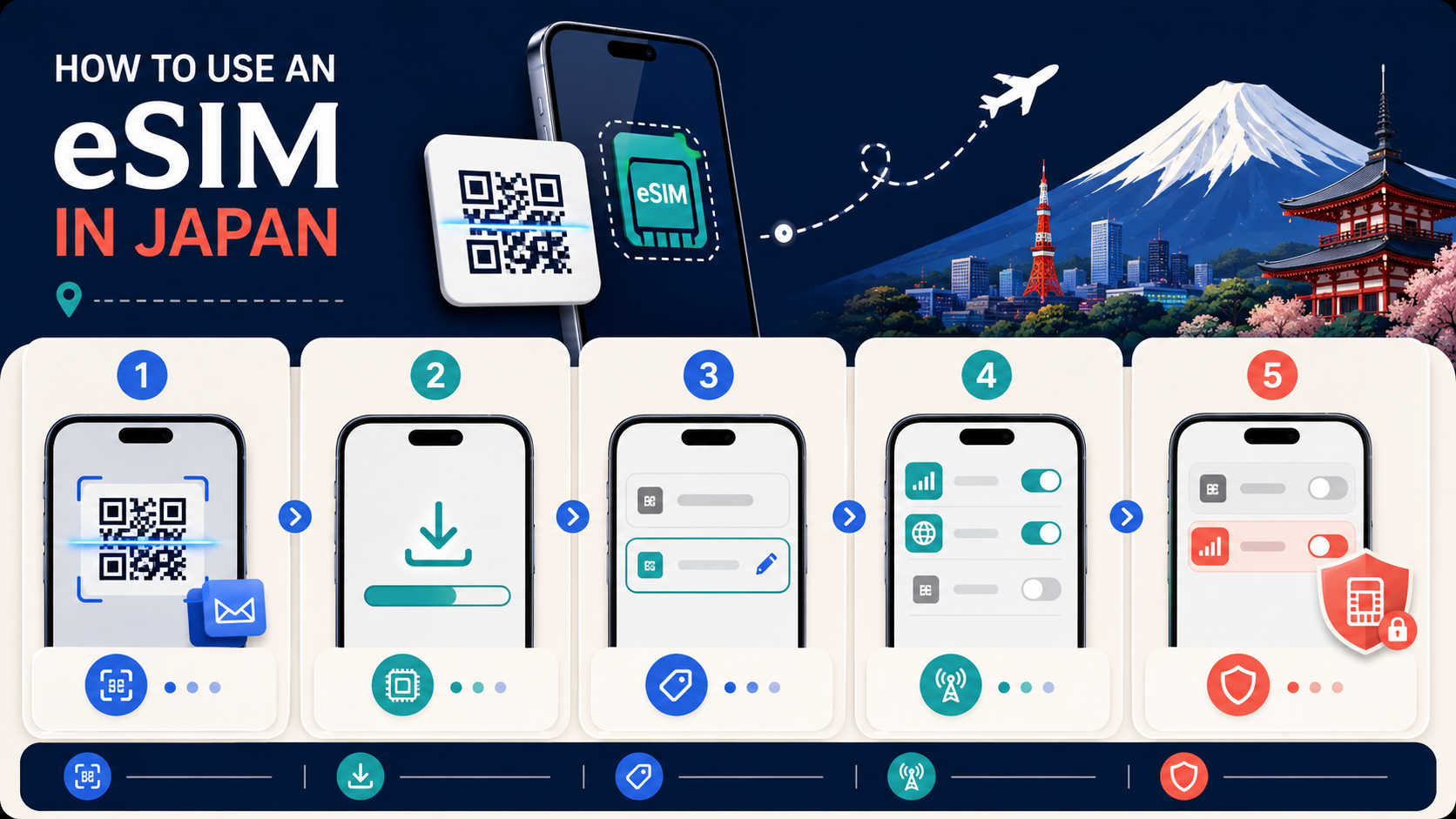
The setup is straightforward when you separate installation from activation. Follow the provider’s instructions for the exact package, because validity can begin at a different point for different products.
- Confirm that your phone supports eSIM and is unlocked.
- Purchase the plan over a reliable WiFi connection.
- Save the QR code and manual activation details.
- Install the eSIM before departure if the plan allows it.
- Keep the travel eSIM turned off until you are ready to connect.
- After landing, select the Ezigo eSIM as the mobile-data line.
- Turn on Data Roaming for the Ezigo eSIM, as required for the Japanese partner network.
- Turn off Data Roaming and mobile-data switching on your home SIM.
- Keep the home line active for calls or SMS only if you understand your home carrier’s charges.
If the QR code is displayed on the same phone, open it on another screen, print it, or use the manual activation details. Do not delete the eSIM while troubleshooting unless support tells you to; some QR codes can only be installed once.
How to Get Internet in Japan: SIM Cards, International Roaming, or Free WiFi?
An eSIM is not the only way to get internet in Japan. A travel SIM card Japan option can work well for an unlocked phone that lacks eSIM support, but it requires a physical SIM and may require you to change cards. JNTO notes that visitors can buy SIM cards at airports and major electronics stores, and that the phone must be unlocked.
International roaming is convenient when your home plan includes Japan at a reasonable rate. Otherwise, check the daily fee, high-speed allowance, and overage rules before turning it on. If you are comparing international roaming Japan options, Apple recommends checking whether your carrier includes international roaming or offers a travel pass before departure. See Apple’s roaming guidance.
Free WiFi is useful at airports, stations, hotels, cafés, and some tourist locations, but it is not a reliable primary connection for every itinerary. JNTO notes that free WiFi availability and quality vary by location. For broader planning, see our Japan Travel Guide.
FAQ
Is Pocket WiFi worth it in Japan?
It can be worth it for families and groups that share heavy data and stay together. For a solo traveler, compare the full rental total with one eSIM plan and include pickup, return, charging, and damage risks.
Is an eSIM cheaper than Pocket WiFi in Japan?
Often, yes for one phone or a light-use traveler, especially with a fixed Total plan. Pocket WiFi may be cheaper per person when several travelers share one router. Compare the total trip price rather than the advertised daily rate.
Does eSIM work in Japan?
Yes, when the phone is eSIM-compatible, unlocked, and supported by the provider’s Japanese network. The exact model and country version matter, particularly for iPhone and Samsung devices.
Can I use an eSIM as a hotspot in Japan?
All currently listed Ezigo Japan plans support hotspot sharing. The connected devices use the same plan allowance, so hotspot use can consume data quickly.
Is 10GB enough for two weeks in Japan?
For maps, messaging, train searches, translation, and moderate browsing, 10GB is a reasonable starting point for many travelers. Video streaming, automatic photo backup, laptop use, and frequent hotspot sharing can require more.
Conclusion
For most solo travelers, an eSIM is the easier way to stay connected in Japan because it removes router pickup, return, charging, and group coordination. Pocket WiFi remains a practical choice for families and groups that share several devices and stay together. If you are comparing Japan eSIM vs Pocket WiFi, start with your group size and expected data use, then compare the full trip cost and the plan’s limits.
High-speed data, wherever your journey leads
Enjoy instant, secure mobile data with Ezigo eSIM in 200+ destinations. No physical SIM needed.