

Quick answer
Is it safe to travel to Israel in 2026? The main tourist areas — Tel Aviv, Jerusalem, the Dead Sea, Haifa and the Galilee — sit outside the official “do not travel” zones. The U.S. rates Israel at Level 3 (“Reconsider Travel”) and the U.K. advises against specific border regions. Check advisories close to your dates, register with your embassy, and travel with working mobile data so you can receive alerts and confirm flights.
This Israel travel guide gathers the practical questions people ask before booking a 2026 trip: what the official advisories say right now, which months have the best weather, how to build a realistic itinerary, what it costs, and how to stay online on arrival. Every section is built around current facts rather than generic travel clichés, because planning Israel this year is different from planning most trips.
Key takeaways
- The main visitor areas are outside the official “do not travel” zones, but U.S. and U.K. advisories still flag specific border regions — check them close to your dates.
- Spring (April–May) and autumn (September–November) have the best weather; July–August brings extreme heat.
- A 7-day trip covers Tel Aviv, Jerusalem, the Dead Sea and the Galilee; 10–14 days adds the north and the south.
- Budget roughly $80–$300+ per person per day, depending on lodging and dining style.
- U.S. and U.K. citizens usually enter visa-free for up to 90 days, but confirm the ETA-IL requirement for your trip.
- An eSIM on a local network is the simplest way to stay online from the moment you land.

Is it safe to travel to Israel right now? (2026)
The honest answer is not a flat yes or no — it depends on where you go and how you prepare. The main visitor destinations are outside the zones that governments warn against, but the broader security situation can shift quickly.
What the official advisories say (as of August 2026):
- U.S. State Department rates Israel at Level 3 — “Reconsider Travel.” It lists Level 4 — “Do Not Travel” for Gaza, areas within about 4 km of the Lebanon and Syria borders, and areas within about 2.4 km of the Egypt border (except the Taba crossing).
- U.K. FCDO lifted its blanket “advise against all travel” position in July 2026 (the first change since June 2025). It still advises against travel to Gaza, the Gaza border area, parts of the West Bank, and parts of northern Israel and the Golan Heights.

What this means for a typical trip: Tel Aviv, Jerusalem, the Dead Sea, Haifa and the Galilee are outside the “do not travel” zones. Even so, the country experiences occasional missile and drone alerts, and airspace or border closures can happen on short notice.
Habits that matter more here than on a normal trip:
- Register with your embassy before flying. U.S. travelers use STEP (step.state.gov); U.K. travelers register their presence on GOV.UK. It is the single most useful preparation step.
- Save the local alert system. Israel’s Home Front Command sends real-time warnings by app and SMS. Dial 104 inside Israel for guidance and shelter locations.
- Learn the shelter drill. If sirens sound, move to a protected space (a Mamad safe room or a windowless stairwell). Falling debris from intercepts is the main risk.
- Keep an exit plan. Travel documents, some cash and essential medication should stay accessible, and you should check your airline daily.
The situation changes fast, so re-check the advisories within a few days of departure, not only when you book: U.S. State Department – Israel and U.K. FCDO – Israel.
If an alert sounds while you are out, the local habit is calm and routine: people step into the nearest protected space — a building lobby, a marked shelter or a stairwell — wait a few minutes, then continue. Life in the main cities keeps running between alerts, and most visitors experience the country as they would anywhere else, with the added background of an active civil-defense system.
Why connectivity matters here
Working mobile data is not a luxury in this context — it is how you receive warnings, confirm whether your flight still operates and reach your embassy. The connectivity section below explains the eSIM option.
Israel travel advisories & restrictions: what they change
Advisory language differs by country, and it affects two practical things: your travel insurance and your entry or exit options.
| United States | United Kingdom | |
|---|---|---|
| Overall level | Level 3 — Reconsider Travel | No blanket ban; advice against specific zones |
| “Do not travel” zones | Gaza; Lebanon/Syria border ~4 km; Egypt border ~2.4 km | Gaza; Gaza border 500 m; parts of West Bank; parts of N. Israel/Golan |
| Insurance note | Travel insurance still recommended | Traveling against FCDO advice may invalidate your policy |
| Register | STEP | Register presence on GOV.UK |
Entry and exit reality right now:
- Ben Gurion Airport (TLV) is operating on a limited schedule. The approved carriers are El Al, Israir, Arkia and Air Haifa. Several major Western carriers, including some U.S. airlines, have suspended direct service into autumn 2026 — confirm your specific flight before booking non-refundable parts of the trip.
- Land exits via Jordan (Allenby/King Hussein Bridge) and Egypt (Taba) remain options, though crossing rules and fees can change on short notice.
For U.K. travelers, the July 2026 lifting of the blanket warning means standard travel insurance is available for most of Israel again. Policies may still exclude the warned zones, so read the fine print before you pay.
Best time to visit Israel
The best time to visit Israel is one of the most common questions in any Israel travel guide, and the answer comes down to weather, crowds and cost. Israel has two clear windows with good weather and one season worth avoiding.
Best: spring (April–May) and autumn (September–November). Daytime temperatures sit around 18–26°C (64–79°F), which suits walking cities, hiking the Galilee and floating in the Dead Sea. These are also the busy tourism windows, so book lodging early.
Avoid if you can: July–August. In the Negev, the Dead Sea and Jerusalem, daytime highs regularly reach 38–42°C (100–108°F). Sightseeing turns into an endurance test. If summer is your only option, plan outdoor activity for early morning and evening and drink constantly.
Winter (December–February) is cool and rainy in the north — Jerusalem can drop to 5°C (41°F) at night — but it is cheap and uncrowded. The Dead Sea and Eilat stay warm.

| Month | Weather | Notes |
|---|---|---|
| Jan–Feb | Cool, rainy north | Low season, lower prices |
| Mar–Apr | Warming | Spring blooms; Passover crowds late Apr |
| May | Excellent | Shoulder peak |
| Jun | Heating up | Fine but warming |
| Jul–Aug | Very hot | Avoid midday outdoors |
| Sep–Oct | Excellent | Rosh Hashanah/Yom Kippur affect closures |
| Nov | Mild | Quiet, pleasant |
| Dec | Cool | Christmas events in Bethlehem |
Religious holidays follow the lunar/Hebrew calendar, so the exact dates move each year. They affect opening hours, transport and prices more than almost any other factor, so check them for your travel year.
Regional timing also matters. The coastal plain around Tel Aviv stays mild even in cooler months, while the Negev and the Dead Sea run hot for most of the year and are most comfortable in spring and autumn. Jerusalem sits higher and cools noticeably at night, so even in summer a light layer is useful. If you want to avoid both heat and the heaviest holiday crowds, late April to early May and mid-September to October are the safest bets.
Israel itineraries: 7, 10 and 14 days
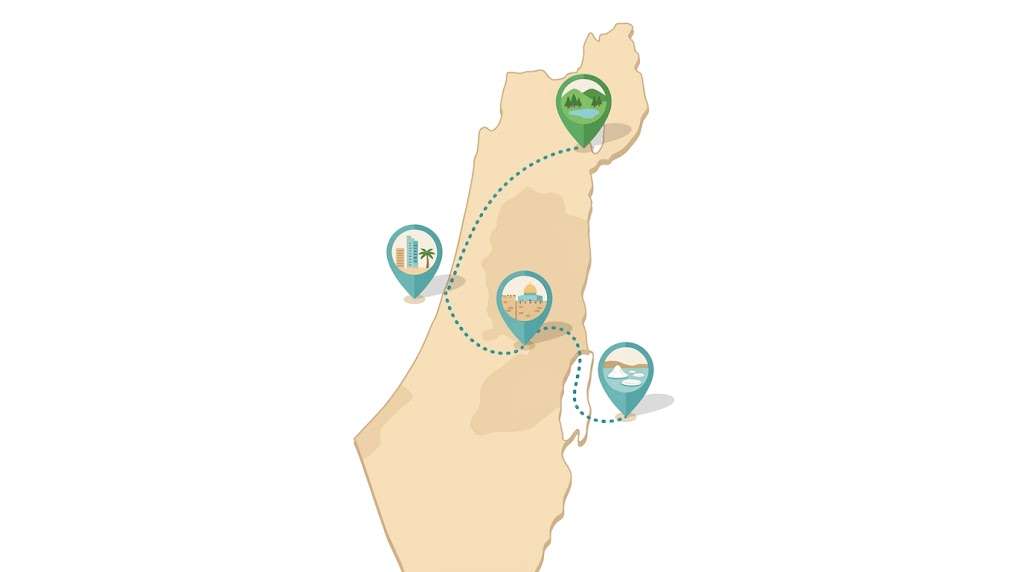
Most first-timers base themselves between Tel Aviv (coast, food, nightlife) and Jerusalem (history, religion), with day trips to the Dead Sea and the Galilee.
7-day classic
- Days 1–3: Jerusalem — Old City, Western Wall, Yad Vashem, Mahane Yehuda market.
- Day 4: Day trip to the Dead Sea and Masada.
- Days 5–7: Tel Aviv — beaches, Jaffa, museums, and a day trip to Haifa or Caesarea.
10-day extended
The 7-day route plus two nights in the Galilee (Tiberias, Safed, the Sea of Galilee) and a Nazareth day trip.
14-day in-depth
The above plus Eilat and the Red Sea (diving, snorkeling), the Negev Desert (Makhtesh Ramon), and extra time in the north.
Multi-country add-on. Many travelers pair Israel with Jordan (Petra is a short hop from the Allenby crossing) or treat Israel as one stop on a broader Europe or Middle East route. If that is your plan, a regional eSIM that covers several countries saves you from swapping SIMs at every border — see the connectivity section.
Getting between the stops. Tel Aviv and Jerusalem are linked by a fast train (about 30–40 minutes), which makes splitting your stay between the two cities easy. The Dead Sea and Masada are best done as a guided day trip or a rental-car drive from Jerusalem. The Galilee sits roughly two hours north of Tel Aviv by car or bus. Try not to change hotels every night — basing in two or three towns keeps transit from eating your sightseeing time.
Things to do & cities in Israel
No Israel travel guide is complete without a clear list of things to do, and the short answer is that the country packs an unusual range into a small area — ancient religious sites, Mediterranean beach life, desert landscapes and green northern hills all sit within a few hours of each other.
Jerusalem holds the Old City’s four quarters, the Western Wall, the Church of the Holy Sepulchre and the Israel Museum. Yad Vashem is essential but emotionally heavy.
Tel Aviv offers Mediterranean beaches, the restored port of Jaffa, Carmel Market and a strong food scene. Nightlife runs late.
The Dead Sea is the lowest point on Earth. Floating is the headline activity, and the mud is part of the experience. Go early to beat the heat.

The Galilee has green hills, the Sea of Galilee, Safed (associated with Kabbalah study) and small wineries worth a detour. Masada is the mountain fortress above the Dead Sea; sunrise hikes there are memorable. Haifa is known for the Baha’i Gardens and a calmer port-city feel. Nazareth draws visitors for its basilica and markets; the Negev rewards those who want desert landscapes and clear night skies.
One scheduling pain point: opening hours shift sharply around Shabbat (Friday sunset to Saturday night). In Jerusalem especially, many businesses and much public transport close. Do Friday errands early and keep Saturday light.
Food is a highlight in its own right. In Tel Aviv, the café and restaurant scene blends Middle Eastern, North African and Levantine influences; Carmel Market and the port area are good places to start. In the north, Druze and Arab villages around the Galilee serve home-style cooking worth a detour. If you keep a single dietary rule, it is this: the best meals in Israel are usually the cheapest, and they are found where locals queue.
How long to spend. A first trip of 7–10 days covers the essentials without rush. Two weeks lets you add Eilat, the Negev and more of the Galilee. If you have only 4–5 days, skip the north and focus on Jerusalem plus a Tel Aviv base with one Dead Sea day trip.
Israel travel budget & what it costs
Money is where many Israel travel guide readers need hard numbers. Israel is not a cheap destination — it sits among the pricier places in the region. A realistic daily range per person, excluding international flights:
| Style | Daily (USD) | What you get |
|---|---|---|
| Budget | $80–$110 | Hostel or cheap guesthouse, markets and street food, public transport, free sights |
| Mid-range | $150–$250 | 3-star hotel, restaurant meals, paid tours, occasional taxi |
| Luxury | $300+ | 4–5 star hotels, fine dining, private guides, car rental |

Where the money goes:
- Accommodation is the biggest variable. Tel Aviv and Jerusalem cost the most.
- Food ranges widely. Markets and falafel or shawarma spots are cheap and good; sit-down restaurants add up.
- Transport is affordable by bus and train; car rental is moderate, but city parking is limited and pricey.
- Attractions are often free (many religious and historical sites), while some parks and museums charge $10–$20.
What the numbers look like in practice
A budget traveler might spend $35 on a dorm bed, $15 on market food across the day and $10 on buses, leaving headroom under $80. A mid-range day — $120 hotel room, two restaurant meals at $25–$40 each, a paid tour or museum at $15–$25, plus taxis — lands near $200. A luxury day with a $300 room and fine dining can pass $400 without trying. The wide gap is why “Israel is expensive” is true for some trips and manageable for others; your lodging and dining choices set the tone.
Money tips: use a card without foreign-transaction fees where possible, carry shekels (ILS) for small purchases, and tip about 10–15% in restaurants where service is not already added.
Travel insurance for Israel in 2026
Travel insurance is worth buying, and in 2026 the details matter more than usual.
- U.K. travelers should note the FCDO change: with the blanket warning lifted, standard policies are available for most of Israel again. But if you travel to a zone the FCDO advises against, your claim may be rejected. Read the exclusions.
- Some global insurers limited or excluded Israel coverage after October 2023. That eased through 2026, but verify “cancel for any reason” terms and medical or evacuation coverage before you pay.
- A policy with trip interruption protection is especially useful this year, given the small chance of flight or border disruption.
Treat insurance as backup, not formality
Working mobile data lets you file a claim from the road and reach your insurer or embassy quickly if plans change.
Getting to Israel: flights & airlines
Ben Gurion Airport (TLV) is the main international gateway, and as noted it runs a limited schedule in 2026.
- Operating carriers include El Al (the national airline), Israir, Arkia and Air Haifa.
- Several major Western carriers have paused direct service into autumn 2026, so always confirm your specific flight with the airline before locking in non-refundable bookings.
- Alternative routing — flying into Amman (Jordan) or Cairo (Egypt) and crossing by land — works for some travelers but adds border logistics.
Book with flexible dates and a clear cancellation policy this year. Prices swing with demand and with how many carriers are flying a given route, so set fare alerts and avoid locking in the whole trip around a single non-refundable ticket. If your dates are fixed, flying via a European hub or crossing from Jordan or Egypt can sometimes open up options that a direct search hides.
Getting around Israel
Israel is small and easy to traverse, which keeps in-country travel simple.
- Trains connect Tel Aviv, Jerusalem, Haifa and Be’er Sheva reliably and comfortably.
- Buses run through Egged, the main national operator; the Moovit app covers routes and times across companies.
- Car rental suits the Negev, the Galilee and flexible day trips, though city-center parking is limited and costly.
- Ride apps — Gett is the local equivalent of Uber and works in major cities.
- Security checks at bus and train stations and mall entrances are routine. They are not a sign of danger.
- Cost reality: a cross-city train ticket runs a few dollars; a short in-town Gett ride is comparable to a taxi elsewhere; rental cars cost more in fuel and parking than in daily rate, so only rent when you leave the center.
Israel visa requirements for U.S. & U.K. travelers
Most Western tourists do not need a visa in advance.
- U.S. and U.K. citizens can typically enter Israel visa-free for tourism for up to 90 days.
- Israel no longer stamps passports (electronic entry records since the mid-2010s), so you will not carry a visible Israel stamp that complicates later travel to some Arab countries.
- Check before you fly: Israel has been introducing an electronic travel authorization (ETA-IL) for visa-exempt visitors. Confirm on the official entry-requirements page whether it applies to your nationality and dates.
- Land borders into Jordan (Allenby/King Hussein) or Egypt (Taba) have their own rules and fees. Budget extra cash; the Taba crossing commonly requires a cash buffer of around $100 or more per person.
Always verify current entry rules on your government’s official site within a week of travel, because regional conditions can shift requirements.
Staying connected: Israel eSIM
The practical goal is simple: you want working data the moment you land, without hunting for a kiosk or paying hotel-wifi rates.
| Option | Pros | Cons |
|---|---|---|
| eSIM | Activates before or after landing; keeps your home number; no physical SIM swap | Needs an eSIM-compatible phone |
| Roaming | Zero setup | Expensive (often $5–15 per GB) and sometimes throttled |
| Pocket WiFi | Shares across devices | One more device to charge, carry and return; daily rental fees |
For most travelers, an eSIM is the simplest and cheapest choice. If your phone supports eSIM — most iPhones from the XS onward and recent Android models do — you can buy before departure and be online at touchdown.

About our plans (full disclosure: Ezigo eSIM sells these): we offer Israel eSIM on the Cellcom network, one of the country’s largest carriers, in two structures:
- Daily plans: 2 GB/day or 3 GB/day, from $2.34 for 1 day up to $53.25 for 30 days (2 GB/day) or $62.07 for 30 days (3 GB/day).
- Total-data plans: 1 GB over 7 days ($2.34) up to 20 GB over 30 days ($38.63).
Activation is by email: after purchase you receive instructions and connect in a few minutes. iPhones are supported. Speeds and coverage follow the Cellcom network and may vary by location — dense cities are fast, while remote desert or border areas may be slower or patchy, which is normal for any carrier here.
Daily or total — which to pick? If you rely on maps, translation and the occasional video every day, a daily plan (2–3 GB refreshes each day) removes the worry of running out mid-trip. If your use is lighter or you travel in spurts, a total-data plan (1–20 GB used whenever you like) is usually cheaper per gigabyte. Compare the latest Israel eSIM plans to see which allowance fits your trip.
One eSIM for multi-country trips: if your route includes Europe (40 areas) or the Middle East & North Africa, a regional plan that covers Israel means no SIM swaps at borders. That helps on an Israel-and-Jordan or Israel-and-Europe itinerary.
Not sure how much data you will actually use? That depends on maps, translation, video and tethering. If you would rather use home roaming or pocket WiFi, that is fine too; the point is to buy an Israel eSIM — or set up your roaming — before you land.
Before you go: packing & tips checklist
Documents & money
- Passport valid 6+ months; check ETA-IL if it applies
- Travel insurance confirmation (read the Israel clauses)
- Some USD cash for border crossings; shekels for daily use
- Embassy registration (STEP / GOV.UK)
Connectivity
- Set up your eSIM or roaming before you fly
- Download offline maps (Google Maps / Maps.me) and the Moovit app
- Save the Home Front Command information and emergency number 104
Pack smart
- Modest clothing for religious sites (shoulders and knees covered)
- Sun protection — hat, SPF, reusable water bottle
- Comfortable walking shoes (Jerusalem’s Old City is uneven stone)
- A light layer even in summer (strong air-conditioning and cool Jerusalem nights)
- Power adapter: Type C/H, 230V
Cultural notes
- Shabbat (Friday sunset to Saturday night): plan around reduced transport and hours in Jerusalem
- Tipping runs about 10–15% in restaurants
- Hebrew and Arabic are official; English is widely spoken in tourist areas
- Photography: ask before photographing people at religious sites, and avoid shooting near any security installation or checkpoint
Israel travel guide: frequently asked questions
Is it safe to travel to Israel right now?
The main tourist areas — Tel Aviv, Jerusalem, the Dead Sea, Haifa and the Galilee — sit outside the “do not travel” zones. Even so, the U.S. is at Level 3 (“Reconsider Travel”) and the U.K. advises against travel to specific border regions. Register with your embassy, save the Home Front Command alerts, and monitor advisories close to your dates.
Do U.S. citizens need a visa for Israel?
Generally no. U.S. citizens can enter visa-free for tourism for up to 90 days. Check whether the ETA-IL electronic authorization applies to your trip.
Can you drink tap water in Israel?
Yes. Tap water is safe to drink nationwide, though some travelers prefer filtered or bottled water for taste.
Is eSIM better than roaming in Israel?
For most travelers, yes — eSIMs cost far less per GB and activate instantly while keeping your home number. Roaming works but is usually expensive and throttled.
What is the best month to visit Israel?
April–May and September–November offer the best weather. Avoid July–August’s extreme heat if you can.
What currency is used in Israel?
The Israeli new shekel (ILS). Cards are widely accepted; carry some cash for markets and border crossings.
This Israel travel guide covers the questions that actually shape a 2026 trip: current safety advisories, the best months to travel, realistic itineraries, daily costs, visa rules, and how to stay connected on arrival. Conditions in the region can shift, so confirm advisories and flight status with official sources shortly before you go — and land with your data plan already sorted.
Editorial note: Prepared by the Ezigo eSIM Content Team and fact-checked on August 18, 2026. Advisory levels, airline schedules and entry rules reflect official sources as of that date and can change; always confirm current conditions with your government and airline before you travel. Ezigo eSIM sells the Israel eSIM plans described above.
High-speed data, wherever your journey leads
Enjoy instant, secure mobile data with Ezigo eSIM in 200+ destinations. No physical SIM needed.
