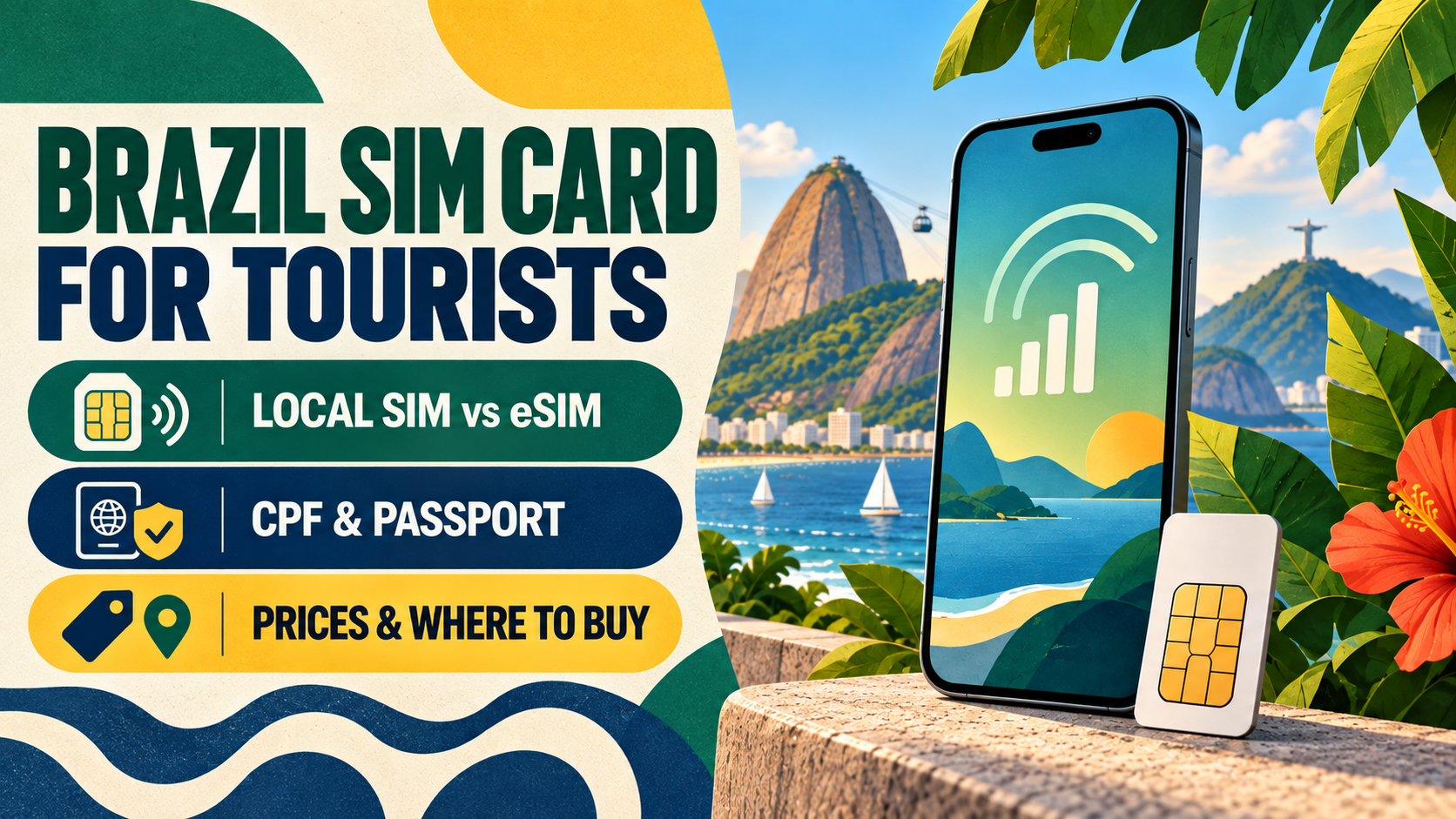
Buying a Brazil SIM card sounds simple until you reach the registration step. Local prepaid service can be inexpensive, but the standard activation process is built around Brazilian identity details, especially a CPF tax number. Foreign visitors do have passport-based options with some carriers, although the process is more reliable at an official store than at an airport kiosk or convenience retailer.
For most short trips, an eSIM bought before departure is the easier route. A physical prepaid SIM still makes sense when your phone does not support eSIM, you need a Brazilian phone number, or you are staying long enough to justify an in-store setup. This guide explains both options without pretending that one choice fits every traveler.
Last updated October 8, 2026. Registration routes and advertised prices were checked against Anatel and carrier pages; promotions and store procedures can change.
In this guide:
- Check whether your phone will work
- Understand CPF and passport registration
- Choose where to buy
- Compare current local prepaid prices
- Compare Vivo, Claro and TIM
- Choose local SIM or eSIM by trip type
Quick answer: should you buy a SIM card or eSIM for Brazil?
Choose an eSIM for Brazil if your phone is compatible and unlocked, you mainly need mobile data, and you want service ready when you land. It avoids the local registration process, lets you keep your home SIM in place, and can be installed before the flight.
Choose a local prepaid SIM card if you need a Brazilian number for standard calls or SMS, use an older phone without eSIM support, or will remain in Brazil long enough to visit a carrier store and manage local top-ups. The lower sticker price can be attractive, but the purchase takes more effort.
| Question | eSIM | Local prepaid SIM |
|---|---|---|
| Can you arrange it before departure? | Usually yes | Sometimes, but tourist travel SIMs differ from local plans |
| Is a CPF needed? | Not for a travel eSIM | Standard self-service registration uses a CPF; carrier stores may accept a passport for foreigners |
| Does it usually include a local number? | No; most travel eSIMs are data-only | Usually yes |
| Can you keep your home SIM active? | Yes, on dual-SIM phones | Sometimes, if the phone has a second SIM slot or dual-SIM support |
| Best fit | Short trips, immediate data, convenient setup | Local number, older phones, longer stays |
The practical difference is not only price. It is the trade-off between convenience and access to a fully local mobile line.
Will your US phone work with a Brazil SIM or eSIM?
Usually, yes—but check the exact device before buying anything. The phone must be carrier-unlocked, and its specific model number must support the network technology used by the selected Brazilian carrier. A US model and an international model with the same marketing name can have different radio support.
For an eSIM, confirm that the device supports eSIM and that the feature has not been disabled by the original carrier. For a physical SIM, confirm the required SIM size and whether you need the second slot for your home line. Dual-SIM phones are useful because you can keep your normal number available for account messages while assigning mobile data to the Brazil line.
Do not rely on “5G phone” alone as a compatibility check. A compatible plan and handset may still fall back to 4G because of local coverage, building conditions or band support. If the trip includes rural areas, download offline maps before leaving a city.
Can tourists buy a prepaid SIM card in Brazil?
Yes. Foreign visitors can buy and register prepaid service in Brazil, but the procedure depends on the carrier and sales channel.
Brazil’s telecom regulator, Anatel, describes a standard digital activation process that validates a CPF, date of birth, Brazilian postal code, identity document and selfie. That workflow is designed around residents. Carrier-specific routes exist for visitors who do not have a CPF:
- Claro says foreigners without a CPF must activate a prepaid SIM at a Claro physical store and bring a passport or RNE, Brazil’s foreign resident identity document.
- TIM says visitors can register prepaid service using a passport, RNE or an eligible foreign identity document. TIM also asks for the address where the traveler is staying, the document’s issuing country and other personal details.
- Vivo uses CPF-based instructions in its normal self-service activation flow. Its prepaid registration notice directs foreign customers to an operator store with a passport.
This explains why traveler reports appear inconsistent. Passport registration is a real carrier-supported route, but it is not the same as saying every kiosk, reseller or employee can complete it. An official carrier store is the safer choice if you want a local line.

Do you need a CPF for a Brazil SIM card?
A CPF is central to Brazil’s normal prepaid activation system, but a foreign tourist does not always need to obtain one before buying service. Claro and TIM publish passport-based procedures, while Vivo tells foreign prepaid customers to visit a store with a passport.
The useful distinction is between online or automated registration and assisted registration:
- Automated activation commonly asks for a CPF and other Brazilian data.
- Assisted activation at a carrier store may use a passport or accepted foreign identity document.
- A third-party seller may sell the plastic SIM but be unable to complete passport-based registration.
- Store staff, systems and opening hours can vary, so successful activation should not be assumed until the line is working.
If a salesperson asks for a CPF, do not borrow another person’s number or register the line under a stranger’s identity. Ask whether the store supports foreign-passport activation or try an official branch of another carrier. Travelers who only need data can avoid this uncertainty with a travel eSIM.
Where to buy a SIM card in Brazil
The most dependable place to buy and activate a local Brazil SIM card is an official Vivo, Claro or TIM store. These branches are more likely to have staff and systems capable of handling a foreign passport.
Official carrier stores and shopping malls
Large shopping centers often have official carrier branches. They are usually a better option than a small reseller because the staff can complete registration, explain current prepaid offers and verify that the line works before you leave.
Bring:
- Your original passport or accepted foreign identity document
- The address of your hotel or accommodation
- An unlocked phone compatible with Brazilian mobile networks
- A payment card and, if practical, a small amount of Brazilian reais
Ask the employee to confirm mobile data, outbound service and the local number before leaving the store. If your phone uses dual SIM, check which line is selected for mobile data so your home carrier does not continue roaming in the background.
Can you buy a Brazil SIM card at the airport?
SIM availability at São Paulo Guarulhos (GRU) and Rio de Janeiro Galeão (GIG) changes by terminal, retailer and operating hours. Search results and airport guides frequently mention airport SIM sales, but a kiosk being present does not guarantee that it can register a foreign passport at the time you arrive.
Airport buying has three common trade-offs:
- Plans or starter packs may cost more than city-store options.
- Late arrivals can miss normal store hours.
- A general retailer may sell a SIM without being able to solve registration problems.
If immediate connectivity matters for rideshare, maps or messaging, install an eSIM over Wi-Fi before flying. You can still buy a local SIM later if you decide that you need a Brazilian number.
Pharmacies, newsstands and other retailers
Claro and Vivo both note that SIMs are sold through outlets such as pharmacies, newsstands, supermarkets and other retailers. These locations are convenient for buying the card itself. For a foreign visitor, however, the difficult part is often registration rather than finding the plastic SIM. Treat independent retail as a secondary option unless the seller confirms passport activation.
How much does a SIM card cost in Brazil?
Local prepaid prices are quoted in Brazilian reais and change with promotions, recharge rules and customer eligibility. The TIM, Vivo Pré and Claro figures below were checked on September 24, 2026; the Vivo Tourist Plan was checked on October 8, 2026. They are published reference points—not promises that every airport kiosk or store will offer the same package.
| Carrier and offer | Advertised price and validity | Included service shown by the carrier | Tourist registration route |
|---|---|---|---|
| TIM Visitors | R$25 for 7 days | 1.5 GB; another pass can be requested when sufficient credit is available | TIM publishes a visitor-specific passport route |
| Vivo Tourist Plan | R$55 for 30 days | 25 GB, 300 minutes and 100 SMS | Online tourist eSIM purchased with a passport; Vivo says no CPF or store visit is required |
| Vivo Pré | R$30 for 30 days | 25 GB advertised as 20 GB plus a 5 GB bonus | Vivo’s normal flow is CPF-centered; foreign customers are directed to a store with a passport |
| Claro Chip Prezão+ | R$30 credit valid for 30 days | The starter offer is promotion-dependent; confirm the active bundle before paying | Foreigners without a CPF must use a physical Claro store with a passport or RNE |
A starter-pack price is not the whole cost. Ask how much you must recharge, when benefits expire, whether the advertised allowance includes a temporary bonus, and what happens after the allowance is used. TIM’s visitor page states a passport route, price, allowance and validity. Vivo’s separate Tourist Plan is an online eSIM rather than a plastic local SIM, but it is relevant for visitors because it combines passport purchase with data, calls and SMS.
Travel eSIMs are priced differently: you normally buy a stated allowance and validity in US dollars before departure. Compare the full-data allowance, daily reset, reduced speed and hotspot rules rather than the word “unlimited.” The detailed plan structures appear later in this guide so that the local-SIM decision does not turn into a product pitch.
Vivo, Claro and TIM: which is easier for tourists?
Anatel reported that Vivo, Claro and TIM together accounted for 95.2% of Brazil’s mobile market in the second quarter of 2025. That confirms their importance, but market share does not tell you which network will be strongest in a particular hotel, airport or rural route.
| Carrier | What makes it practical for a visitor | What to verify before paying |
|---|---|---|
| TIM | The clearest dedicated visitor page in this comparison, including passport registration, a stated visitor pass and multilingual help channels | Whether the store can finish activation immediately and whether the stated speed and allowance fit your needs |
| Claro | An explicit rule for foreigners without a CPF: activation at a physical Claro store with passport or RNE | The current Prezão bundle attached to the SIM or recharge, because promotions vary |
| Vivo | Widely available prepaid offers and an official store route for foreign passport holders | Bonus eligibility, validity and whether the branch can complete foreign-customer registration |
For a tourist without a CPF, the easiest carrier may simply be the one with an open official branch whose staff can complete passport registration. Coverage should be checked against the actual itinerary. Anatel notes that coverage maps are theoretical and that buildings, terrain, indoor conditions and the user’s position can change real-world signal quality. Download offline maps before remote road trips, Amazon excursions or nature-heavy itineraries regardless of carrier.
How to buy and activate a local prepaid SIM in Brazil
If a physical local line is the right fit, use this sequence:
- Check that your phone is unlocked. A carrier-locked device may reject a Brazilian SIM even when it supports the correct network bands.
- Choose an official carrier store. Passport registration is more likely to work at a full-service Vivo, Claro or TIM branch than at a convenience reseller.
- Bring the required identity and address details. Carry your passport and accommodation address. Requirements can vary by carrier.
- Choose the plan and complete registration. Confirm the recharge amount, validity, included data and whether automatic renewal applies.
- Test the line in the store. Check mobile data and the assigned number. Ask staff to help if the phone needs an APN or network-setting change.
- Secure the original SIM. If you remove your home SIM, store it somewhere safer than a loose pocket or phone case.
Do not leave with an untested SIM and assume it will activate later. The advantage of buying in a staffed store is being able to resolve registration while the employee still has access to the sales system.
Common Brazil SIM card problems and what to do
- The retailer sold a SIM but cannot register your passport: take the unused SIM and receipt to an official carrier branch, or buy directly from a branch that confirms it can complete foreign-customer registration.
- The activation screen insists on a CPF: ask for the carrier’s assisted passport route. Do not use a borrowed or invented CPF. If that branch cannot help, try another official branch or carrier.
- The phone rejects the SIM: confirm that the device is unlocked and that the exact model supports the selected network. A phone can support eSIM yet still be locked to its original carrier.
- The line appears active but mobile data does not work: restart the phone, select the Brazil line for mobile data and ask the store to check the APN. Enable data roaming only when the provider’s instructions require it.
- You land after stores close: use airport Wi-Fi or a preinstalled travel eSIM for maps and transport, then arrange a local line during store hours.
Local SIM vs eSIM in Brazil: choose by travel situation
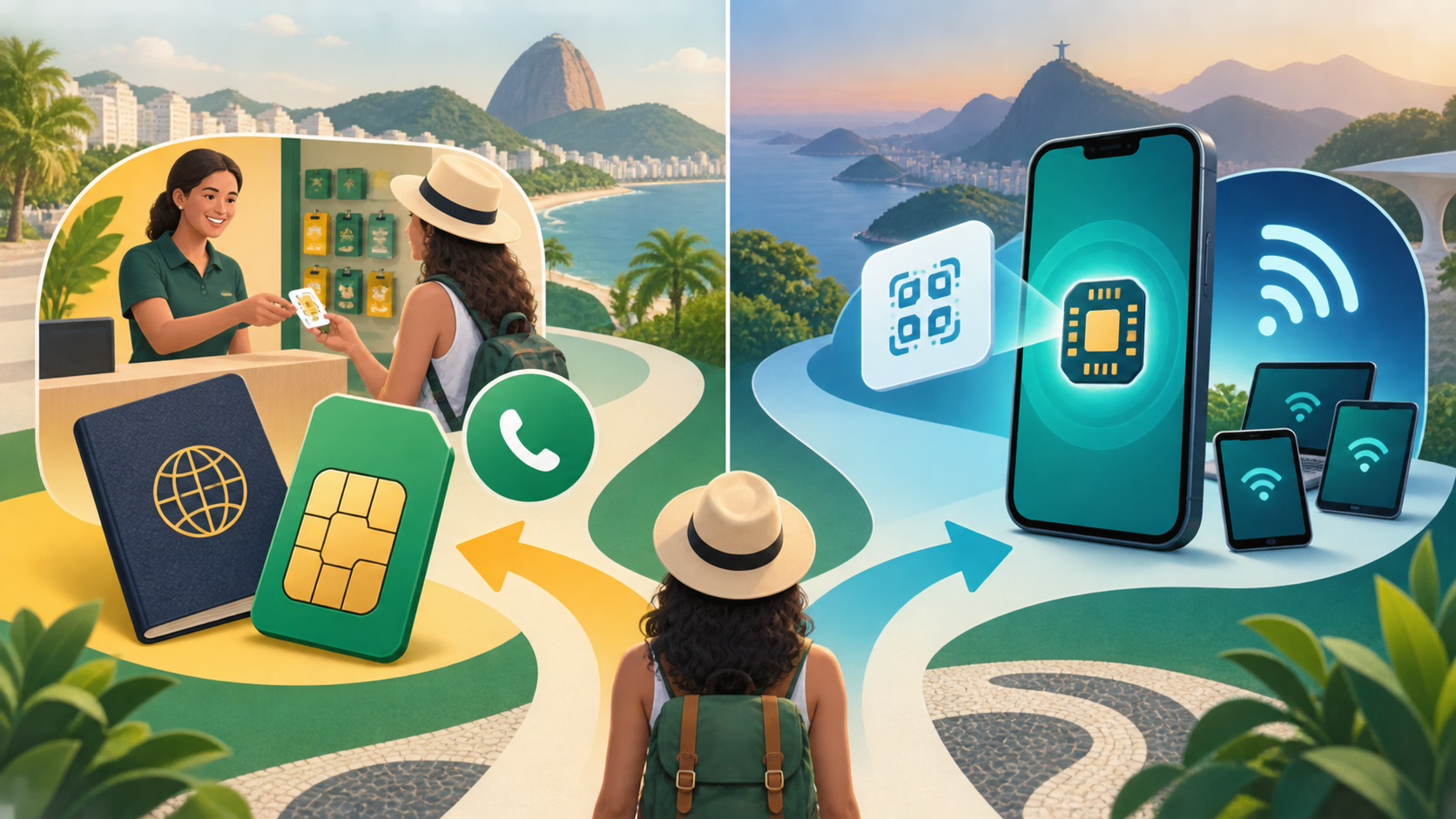
The better option depends on the job your phone needs to do during the trip.
| Travel situation | Usually the better starting point | Why |
|---|---|---|
| Short city break or late arrival | Travel eSIM | Data can be installed before departure without a store visit |
| Longer stay that requires a Brazilian number | Local prepaid SIM | Local calls, SMS and a Brazilian number are available after registration |
| Unlocked phone without eSIM support | Local prepaid SIM | A physical SIM is the practical compatible option |
| Multi-city trip or remote itinerary | Check carrier coverage first; keep a backup | Convenience does not replace route-specific coverage planning |
Choose an eSIM when you want data immediately
An eSIM is usually the lower-friction choice for a one- or two-week holiday. You can install it on Wi-Fi, keep your home number active for incoming messages, and have data available for maps and rideshare after landing. It is particularly useful for late arrivals and tight connections, when finding an open carrier store would be inconvenient.
Before buying, verify that the phone supports eSIM and is carrier-unlocked. Install the plan before departure, but follow the provider’s activation instructions so the validity period does not begin earlier than intended.
Choose a local SIM when you need a Brazilian number
A physical prepaid SIM is more suitable when local voice calls, ordinary SMS or a Brazilian number are important. This can matter for longer stays, local work or services that do not accept a foreign number. It is also the practical option for an unlocked phone that lacks eSIM support.
The trade-off is setup. Budget time for a carrier-store visit, identity registration and testing.
Use dual SIM when you need both roles
Many recent phones can keep a home SIM active while using an eSIM for Brazilian data. This lets you receive bank or account messages on your usual number while avoiding roaming data. Disable data switching and set the Brazil eSIM as the default data line to reduce the risk of accidental roaming charges.
If the selected plan allows hotspot sharing, a compatible phone can provide data to a laptop or another device. Tethering can consume a fixed allowance quickly, especially during video calls, cloud backups or software downloads.
If you choose an eSIM: fixed, daily or unlimited data?
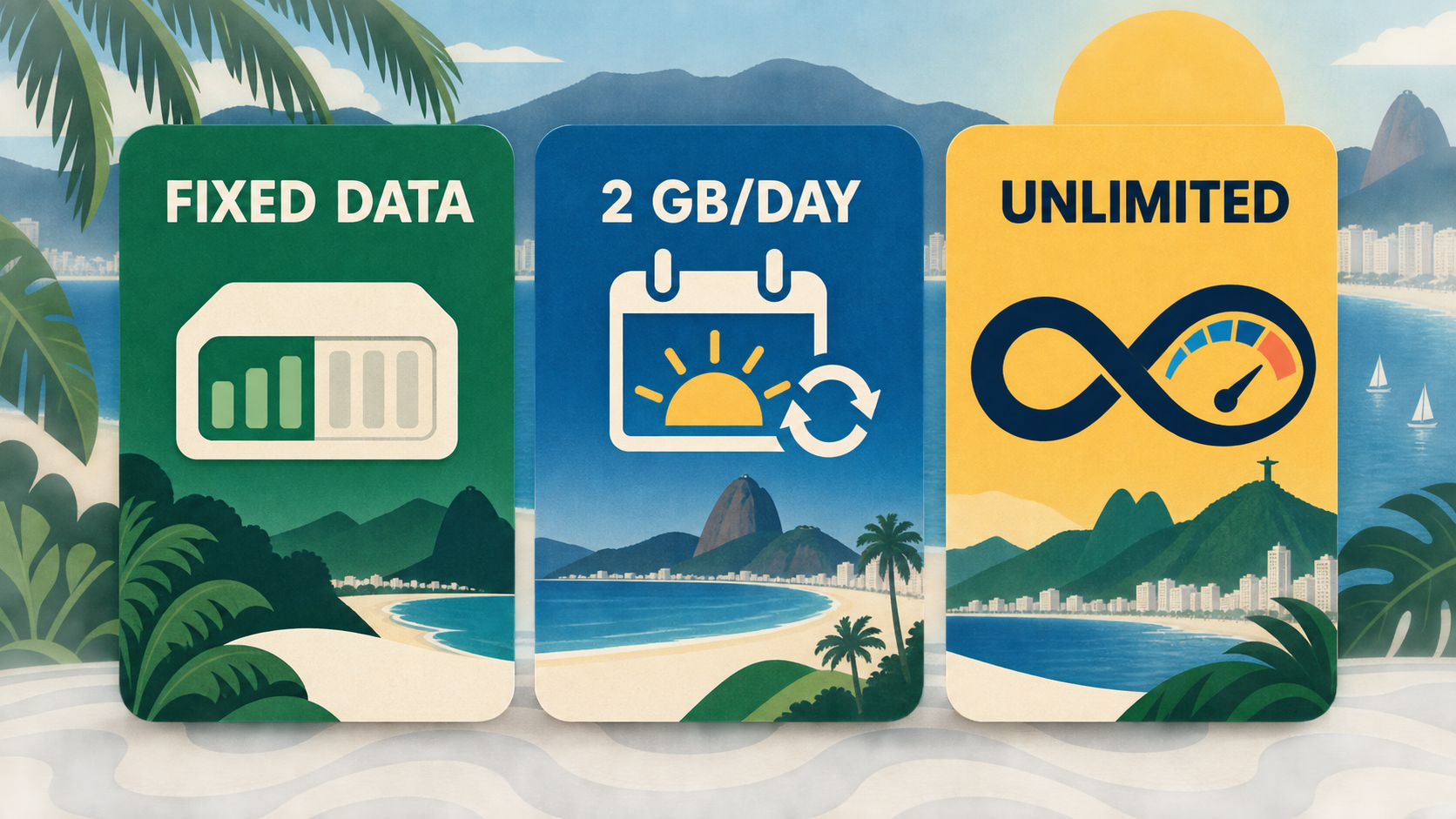
Once an eSIM is the right delivery method, review the current Brazil eSIM data plans and match the plan structure to your usage rather than buying the largest number on the page. The examples below describe the supplied Brazil travel plans; prices and availability should be rechecked before purchase.
- Light backup use: A small fixed-data plan can cover occasional messages or provide emergency connectivity, but 100 MB or 500 MB disappears quickly if maps, photo sync or app updates run in the background.
- Predictable daily use: A 2 GB/day plan suits travelers who want a fresh high-speed allowance each day. After the daily allowance, the connection continues at 384 Kbps, which is more appropriate for messaging than media-heavy use.
- Frequent hotspot or heavier use: An Unlimited plan provides 1 GB of high-speed data per day and then continues at up to 5 Mbps. That reduced speed remains more usable for everyday browsing and many standard-definition tasks, although performance still depends on local network conditions.
- Longer trip with controlled usage: A 30-day fixed-data allowance may be easier to budget if you know roughly how much data you need and prefer not to manage a daily threshold.
If you need a full comparison of travel eSIM choices rather than a local-SIM decision, read the best eSIM options for Brazil. For installation and activation steps, use the Brazil eSIM setup guide.
Frequently asked questions
Can a US phone use a Brazil SIM card?
Usually, if it is unlocked and the exact model supports the selected network. For an eSIM, the device must also have eSIM enabled. Check the model number rather than relying only on the marketing name.
Can foreigners buy a SIM card in Brazil without a CPF?
Carrier-supported passport registration exists, but it generally requires assisted service. Claro directs foreigners without a CPF to a Claro store with a passport or RNE. TIM accepts passport-based registration information, and Vivo directs foreign prepaid customers to a store with a passport. Do not assume every reseller can complete the process.
Is it better to buy a SIM card at São Paulo or Rio airport?
Airport purchase can work, but availability, registration capability, price and opening hours vary. If you need data immediately, an eSIM installed before travel is more predictable. A city-center carrier store is usually the better place to arrange a local number.
Does a Brazil travel eSIM include a phone number?
Many travel eSIMs are data-only. They work with internet-based calling and messaging apps but do not include a Brazilian phone number, traditional calls or SMS.
Can I use my phone as a hotspot in Brazil?
Some Brazil eSIM plans support hotspot sharing, while others restrict it. Check the plan description before purchase, and remember that tethering laptops or multiple devices can use data much faster than phone-only use.
Does 5G work everywhere in Brazil?
No. A 5G-capable plan and phone can connect only where compatible 5G coverage is available. Signal and speed also change with location, buildings, terrain, congestion and indoor conditions.
Conclusion
A Brazil SIM card is still useful for travelers who need a local number, have a phone without eSIM support or plan to stay long enough to justify an in-store registration. For most short visits, a data-only eSIM removes the CPF and store-visit uncertainty and gives you a more predictable way to get online after landing.
Compare your trip length, daily data use and need for a local number first. If an eSIM fits that decision, you can compare the current Brazil data options by allowance, validity and reduced-speed policy before departure.
Sources and verification
- Anatel: prepaid registration and digital identity validation
- Anatel: guidance for foreign mobile phones in Brazil
- Anatel: mobile coverage and signal limitations
- Claro: prepaid SIM activation for foreigners
- Claro: current prepaid plans and Chip Prezão+
- TIM: International Visitors prepaid offer
- TIM: prepaid service for foreign visitors
- Vivo: Tourist Plan for international visitors
- Vivo: current Vivo Pré offers
- Vivo: prepaid registration notice
- Anatel: competition monitoring report and mobile-market shares

High-speed data, wherever your journey leads
Enjoy instant, secure mobile data with Ezigo eSIM in 200+ destinations. No physical SIM needed.