首次巴西规划
第一次去巴西旅行,最好的选择并不在于游览的景点最多。 It is the one with a realistic route, current entry information, practical transport choices, and a simple plan for staying connected after you land.
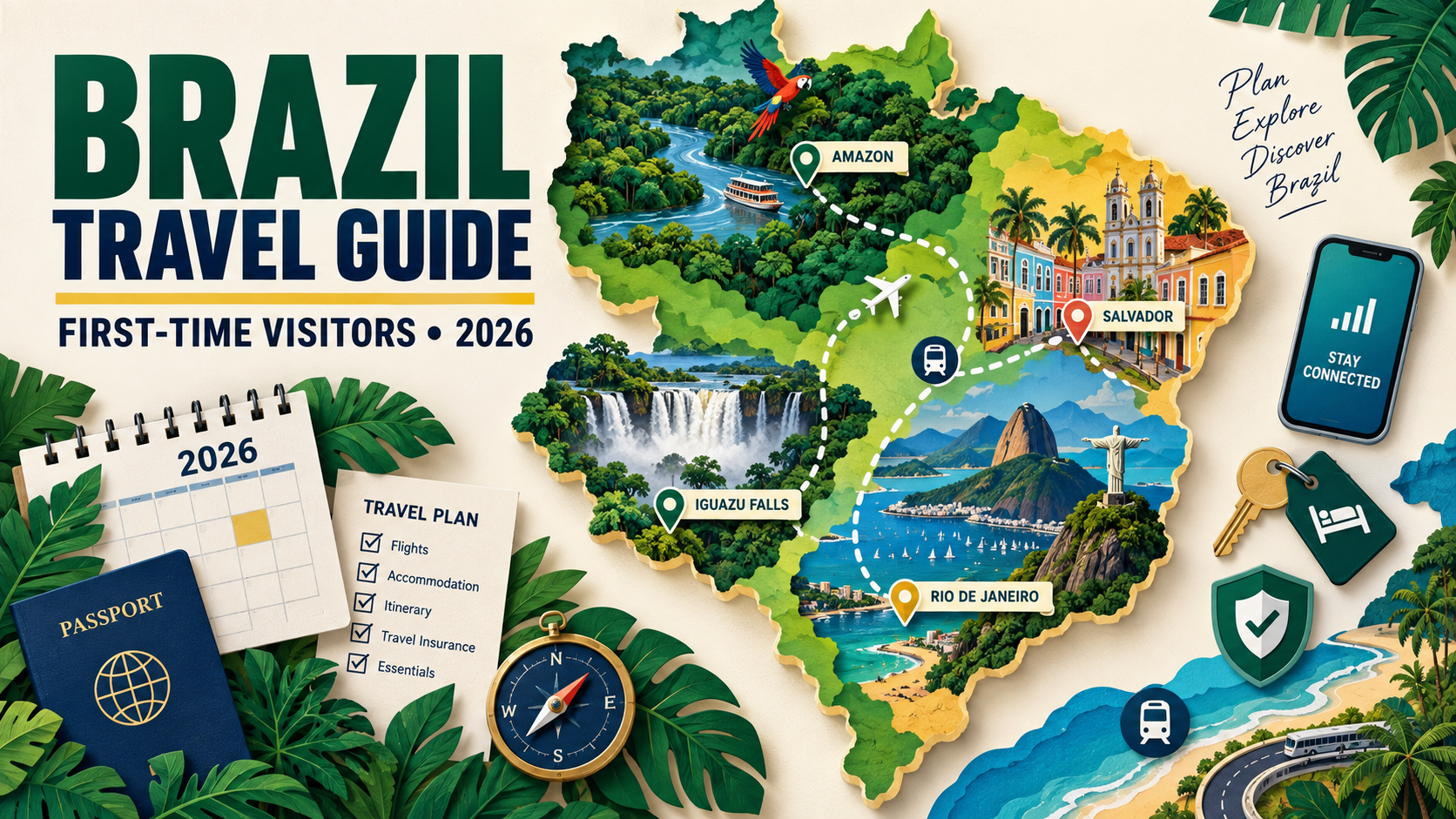
这种实用性 巴西旅游指南 explains how to plan a first trip: the best time to visit by region, how many days to allow, how to build a workable itinerary, what to arrange before departure, how to get around, where to stay, and which everyday habits make travel easier.
Brazil is the largest country in South America and covers several climate zones. The right plan depends less on seeing every famous place and more on choosing destinations that make sense together.
巴西旅游指南:快速规划概览
Use these as starting points, then adjust them for your nationality, travel dates, and the regions you actually want to visit.
| 决定 | 實際出發點 | Why it may change |
|---|---|---|
| 行程長度 | 10–14 days for a multi-stop first trip | Seven days works better for one city plus one nearby destination |
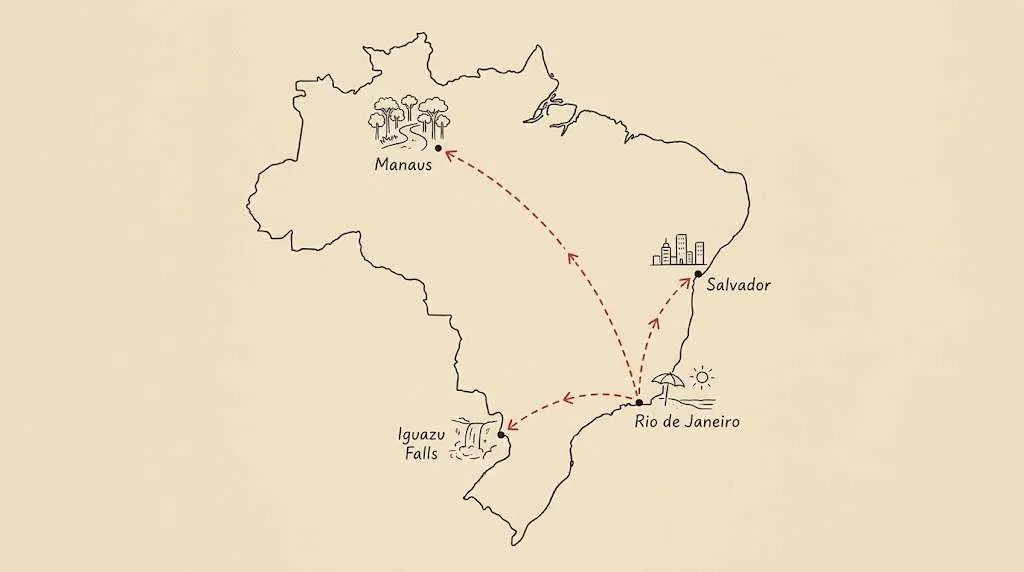
| 路线 | Choose one regional cluster, such as Rio + Iguazu or Salvador + the Northeast | Add a distant region only when you have enough time for the transfer |
| Best time | Choose by region and travel goal, not by one nationwide answer | Carnival, beach weather, wildlife and rainfall follow different patterns |
| 文书工作 | Check entry, passport and health requirements before booking | Rules depend on nationality, origin, route and current policy |
| 运输 | Domestic flights for distant regions; buses and metro for suitable local legs | Compare the total door-to-door time, not just the map distance |
| 连接性 | Prepare a compatible, unlocked phone and a data option before departure | Plan-specific network access and activation instructions can differ |
前往巴西旅遊的最佳時間是什麼時候?
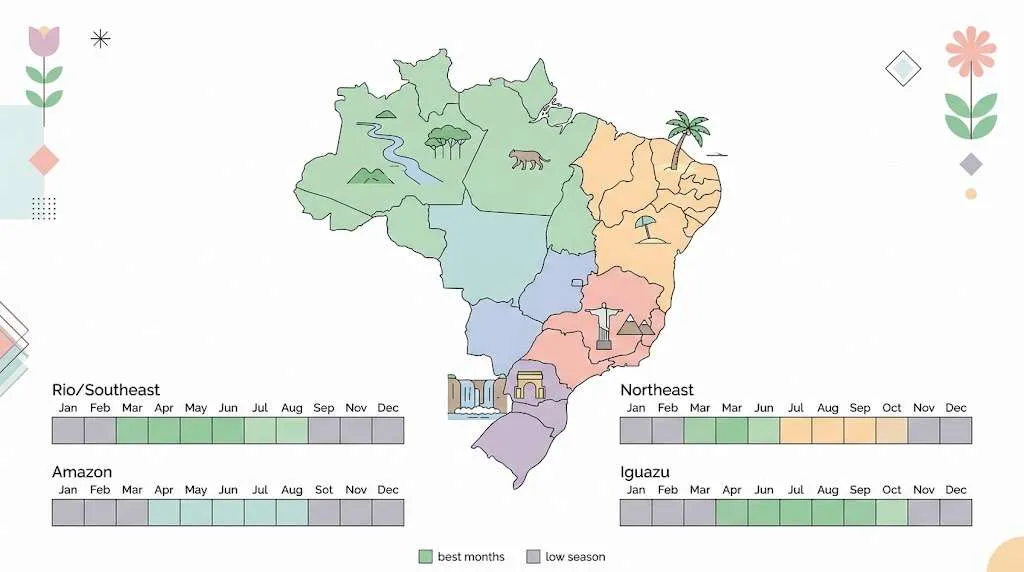
There is no single best month for the whole country. Brazil’s size means that beach weather, Carnival, rainforest conditions and cooler southern weather can point to different travel windows.
A useful shoulder-season option for many first-time city and coastal trips. Check local rainfall and event calendars for your route.
夏季、重大庆典和繁忙的海滩时期。
A quieter transition period for some routes. Conditions vary significantly between the Southeast, Northeast and interior.
Often considered for rainforest or wetland trips, but confirm the exact conditions for the area and activities you plan to visit.
| Region or experience | Planning approach | Check before booking |
|---|---|---|
| Rio and the Southeast | Choose between festival energy, beach time and a quieter city trip | Humidity, rainfall, events and accommodation demand |
| Northeast beaches | Prioritize water conditions and the coast you want to explore | Local rainfall patterns and peak-season prices |
| Amazon or wetlands | Choose the season that fits your wildlife, river and hiking priorities | Operator schedules, water levels, heat, rain and health guidance |
| 伊瓜苏瀑布 | Works across much of the year and fits several city routes | Water levels, forecast and whether you will visit both sides |
Use a regional climate guide and a forecast for your exact dates before finalizing flights. A month that is excellent for one part of Brazil may be inconvenient for another.
Brazil itinerary: how many days do you need?
Plan around transfer time, not just sightseeing time. Brazil is large, and every hotel change or airport transfer takes part of a day.
| 长度 | A realistic route shape | 最適合 | Avoid |
|---|---|---|---|
| 7天 | Rio plus Iguazu, or one focused regional route | A first introduction without constant packing | Adding Salvador, the Amazon and several beach towns |
| 10 天 | Rio + Iguazu + Salvador, with transfer days protected | A balanced first-time route | Treating a long flight or bus journey as a sightseeing day |
| 14 天 | Rio + Iguazu + Salvador plus one additional region | A broader trip with a slower pace | Crisscrossing the country because destinations look close on a map |
Where should you go in Brazil?
Choose destinations according to the experience you want, then check how they fit together geographically.
- 里约热内卢 — beaches, viewpoints, culture and a strong first-city introduction.
- 圣保罗 — museums, restaurants, neighborhoods and a major transport hub.
- 萨尔瓦多 — Afro-Brazilian history, music, food, colonial streets and coastal scenery.
- 伊瓜苏瀑布 — a nature-focused stop that can fit several Southeast routes.
- The Amazon or wetlands — guided nature and wildlife experiences that need extra planning time.
- Florianópolis or Northeast beaches — options for travelers who want more time on the coast.
Do not treat this as a checklist. Two or three well-connected bases are usually more useful than trying to collect every major destination.
What should you arrange before travelling to Brazil?
Time-sensitive travel requirements should be checked for your own nationality and itinerary. Use official sources rather than relying on an old blog post or a third-party summary.
Before booking flights
- Confirm passport validity, visa or e-Visa requirements, permitted stay and entry conditions through the 巴西外交部 or the relevant official visa portal.
- Check whether your route, nationality or recent travel history affects health documentation.
- Choose arrival and departure airports that match your route instead of assuming every city is a short transfer away.
- Arrange travel insurance with appropriate medical and cancellation coverage.
出發前
- Book accommodation with a clear address, reliable reviews and a staffed or secure entrance.
- Save booking confirmations, passport details, insurance contacts and your first hotel address offline.
- Install your transport, translation, banking and accommodation apps.
- Confirm that your phone is carrier-unlocked and compatible with the connectivity option you choose.
How do you get around Brazil?
Transport should shape the itinerary from the beginning. Domestic flights are often the practical choice between distant regions; long-distance buses work well on some corridors, while metro, walking and app-based rides are useful within major cities.
Useful for long distances and for routes that would consume a full day by road. Include airport transfers and baggage time when comparing options.
Can suit regional routes and travelers with more time. Check the total journey time and arrival location before booking.
Use metro, walking and official or app-booked rides according to the city, time of day and your luggage.
Keep day trips close to your base. A destination that looks nearby on a map may still require a long transfer.
对于机场乘车,请使用签名的接送区域或官方预付费服务。
上车前请在应用程序中确认司机和车辆,并以葡萄牙语和英语显示目的地。
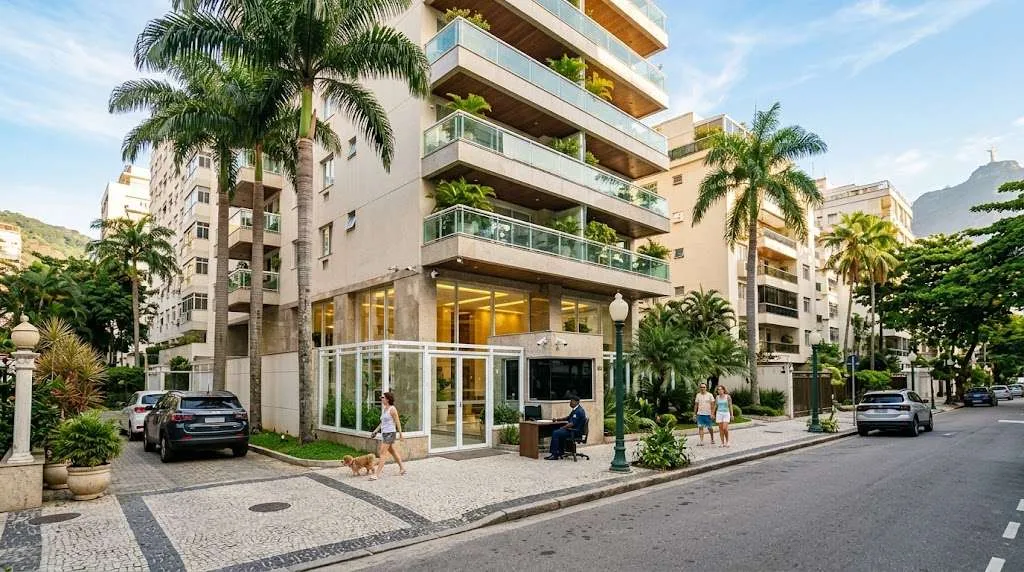
Choose the neighborhood before choosing the property. A convenient address near restaurants, transit and a staffed entrance is often more useful than a cheaper property that requires late-night street navigation.
| 城市 | Examples to research | Property features to prefer |
|---|---|---|
| 里约热内卢 | Ipanema, Leblon, Copacabana, Botafogo or another well-reviewed base that fits your route | Staffed entrance, clear pickup instructions and recent reviews |
| 圣保罗 | Jardins, Pinheiros, Itaim Bibi or a well-connected alternative | Secure access, easy transport and a street that remains active |
| 萨尔瓦多 | Barra, Ondina, Rio Vermelho or another area verified for your plans | Reliable front desk, clear arrival instructions and recent local reviews |
What practical habits help in Brazil?
Try local dishes such as feijoada, moqueca, pão de queijo, churrasco and açaí. If you are unsure about tap water or ice, choose bottled or filtered water.
Carry a small backup amount of Brazilian real, keep cards secure, and check the amount on the terminal before confirming a payment.
Portuguese phrases such as “obrigado/a”, “por favor” and “quanto custa?” are useful. Keep an offline translation option available.
Beachwear belongs on the beach. For restaurants, churches and everyday errands, neat casual clothing is the safer default.
What should tourists know about safety?
Brazil is a rewarding destination, but city safety requires attention to surroundings. Advice can vary by city and neighborhood, so check current official guidance and recent local information before you go.
- Keep phones and cameras away from the curb, busy crossings and crowded transport areas.
- Use a lobby, café or shop when you need to check maps, messages or a ride.
- Use official or app-booked transport and confirm the driver and vehicle.
- Avoid displaying expensive watches, jewelry or large amounts of cash.
- Do not enter unfamiliar areas just because they appear close on a map; ask your accommodation for current local advice.
- Keep a backup payment method and copies of important documents separately from the originals.
How can you stay connected in Brazil?
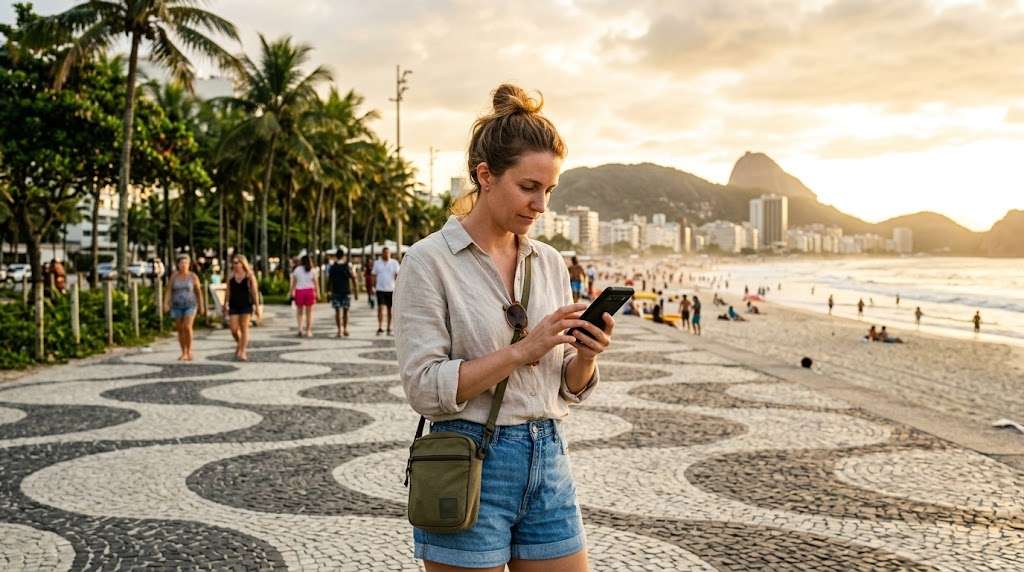
Mobile data helps with maps, translation, ride-hailing, booking changes, card alerts and contacting your accommodation. Treat it as part of arrival planning rather than something to solve after landing.
Local SIM or travel eSIM?
A local SIM can work well for visitors who want a Brazilian number and are comfortable buying and registering a physical SIM. A travel eSIM is useful when you want to prepare before departure and keep your physical SIM installed. The best choice depends on your phone, trip length and whether you need calls or mainly data.
What should you check before using an eSIM?
- 确认您的手机支持 eSIM 并且已解锁运营商。
- Install the eSIM over stable Wi-Fi before the flight, but follow the plan-specific activation instructions.
- 抵达后,选择移动数据的旅行线路,并根据说明要求启用该线路的数据漫游。
- Network access depends on the selected plan and local availability; partner networks may include Vivo, TIM or Claro.
在机场高峰期到来之前,请提前做好网络连接准备。
Check compatibility, install over Wi-Fi, and keep the QR code and setup instructions available offline. See the current Brazil eSIM plans 出發前。.
For more detail, read the 巴西最佳 eSIM 指南制定的分階段實施路線圖, Brazil SIM card guide for tourists, or the step-by-step Brazil eSIM installation guide.
巴西出发前检查清单
- Entry and passport requirements checked for your nationality
- Travel insurance arranged
- Route and transfer days confirmed
- Accommodation address and arrival instructions saved offline
- Phone carrier-unlocked and eSIM-compatible
- Connectivity plan installed or local SIM plan understood
- Maps, translation and ride-hailing apps ready
- Backup payment method and small cash prepared
- Important documents and emergency contacts saved offline
- Current health guidance checked for the regions on your route
Keep the route focused, confirm time-sensitive requirements close to departure, and leave enough flexibility for weather and transfer delays. That is usually more useful than trying to fit every Brazilian highlight into one trip.
常見問題解答
前往巴西旅遊的最佳時間是什麼時候?
It depends on the region and your plans. Many first-time city trips can work well in the shoulder seasons, while Carnival, beaches, the Amazon and wetlands each require more specific timing. Check the regional guidance above.
我在巴西需要待几天?
七天的時間對於里約加上伊瓜蘇這樣重點式的行程已經足夠。十到十四天的行程則能讓您有更多空間前往薩爾瓦多或其他地區,而不需要每天都在趕路換點。
遊客在巴西如何往來各地?
遠距離地區請利用國內航班,適合的廊道請搭乘長途巴士,市區內則建議使用地鐵、步行或預約叫車。選擇前請先比較門到門的總通勤時間。
巴西對遊客來說安全嗎?
許多人都能順利造訪巴西,但大城市的預防措施至關重要。請將手機和貴重物品妥善收好,使用經認證的交通工具,審慎選擇住宿地點,並遵循當前當地及官方的建議。
我去巴西旅行需要签证吗?
具體要求取決於您的國籍、護照、路線及現行政策。請在預訂前及出發前再次查詢巴西外交部官網或簽證入口網站。
在巴西保持連線最簡單的方式是什麼?
A compatible, unlocked phone with a travel eSIM can provide data as soon as the plan connects to a supported local network. A local SIM is another option, especially if you need a Brazilian number. Compare both before you travel.
审核人: Ezigo eSIM 内容团队 上次審核時間: September 2026
Visa rules, health requirements, network availability and safety conditions can change. Confirm time-sensitive details with official providers before departure.
Planning references: 巴西外交部 · US State Department Brazil advisory · 美国疾病控制与预防中心旅行健康