Last reviewed: September 29, 2026
You land in Sydney, spend a week driving along the east coast, then fly to Auckland. If you are looking for a SIM card for Australia and New Zealand, the real question is not which provider has the flashiest deal. It is whether you need one regional data connection, two local numbers, or the convenience of your home plan.
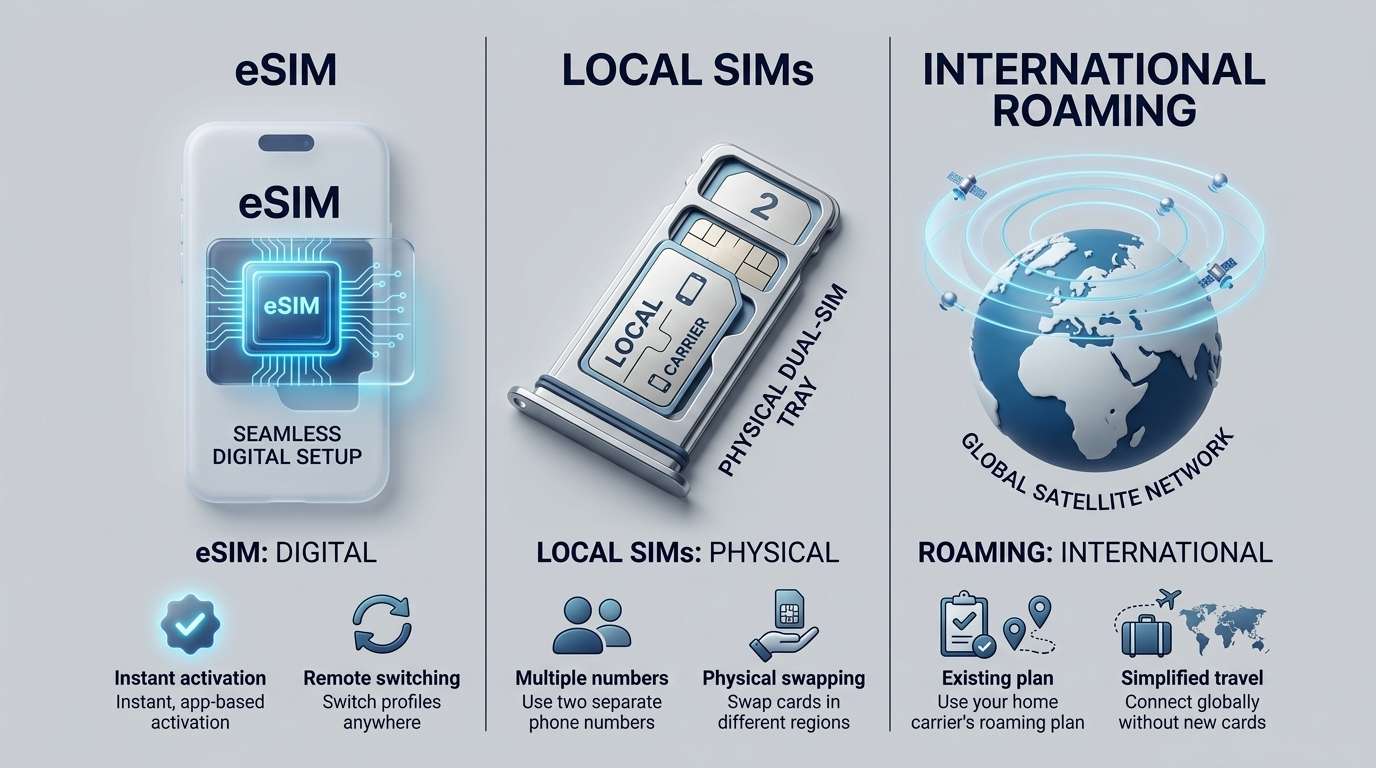
In this guide, “SIM card” is used in the broad travel-search sense: it includes both physical SIM cards and eSIMs. The practical choice depends on whether you need a local number, how long you will stay, where you will travel and how much setup you are willing to manage.
For many short holidays focused on maps, messaging and bookings, one regional data eSIM is the simplest option. Two local services make more sense when you need local calling or a longer stay in each country. Home-carrier roaming is convenient for a short stop, but its value depends on the current terms of your own plan.
Quick Answer: Which Option Fits Your Trip?
| Your priority | Usually the best starting point | なぜ |
|---|---|---|
| One setup for both countries | Regional Australia and New Zealand eSIM | Install once and use the same profile in both destinations |
| Local Australian and New Zealand numbers | Two local SIMs or local eSIMs | Local operator plans are more likely to include domestic calls, texts and a local number |
| Keeping your usual number with no new profile | ホームキャリアのローミング | Your existing line stays in use, subject to your carrier’s roaming terms |
| オーストラリアまたはニュージーランドのみ | A single-country plan | Avoid paying for coverage you do not need |
| Three or more Oceania destinations | A broader Oceania plan | A wider regional footprint may fit the itinerary better |
When choosing a SIM card for Australia and New Zealand, remember that a regional eSIM is commonly data-only, two local services add setup, and roaming terms vary by home carrier.
Can One SIM Card for Australia and New Zealand Work in Both Countries?
Yes—but only if the plan explicitly includes both countries.
An Australian prepaid SIM does not automatically become a New Zealand plan after you fly across the Tasman Sea. It may stop working or continue through paid international roaming. The reverse is also true for a New Zealand local service. Never assume that geographic proximity means domestic coverage in both places.
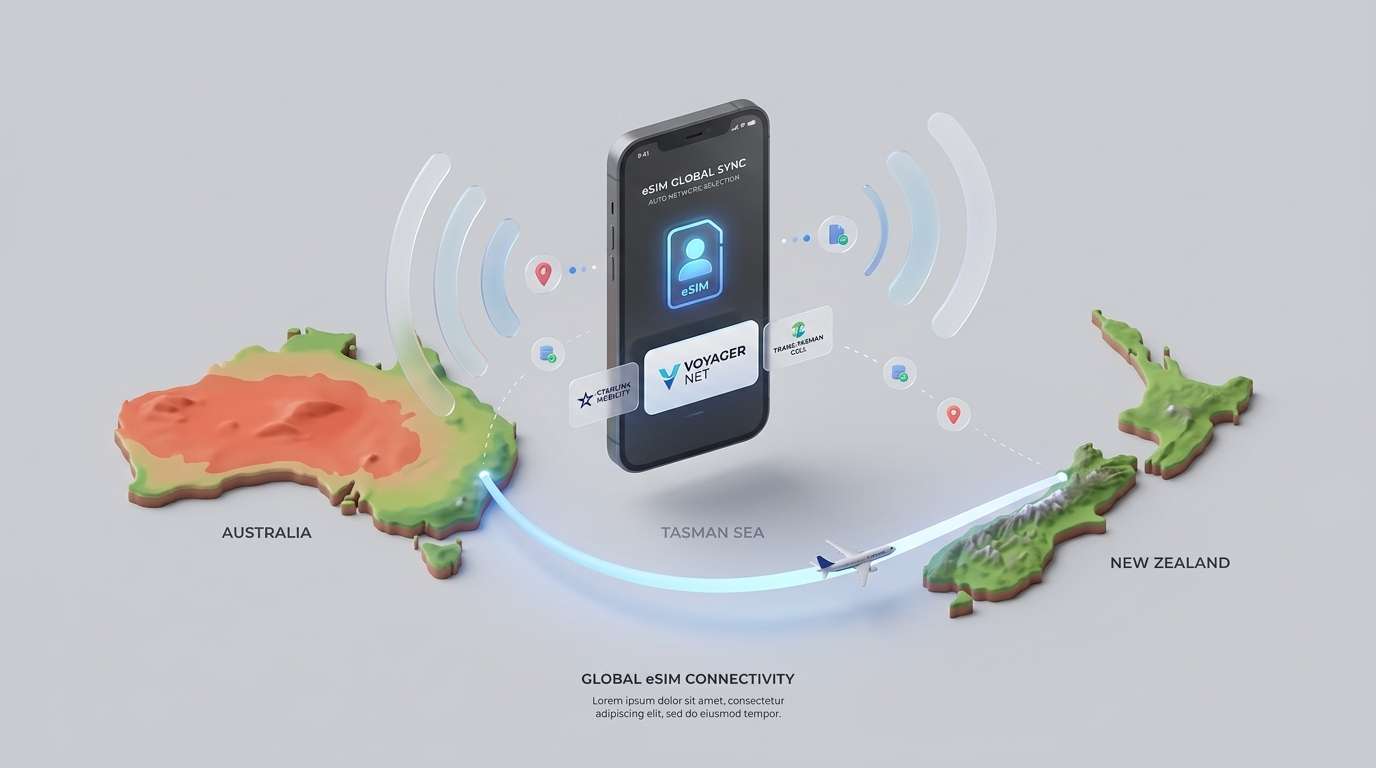
A regional eSIM designed for Australia and New Zealand works differently. The same digital profile can connect to a supported partner network in each country. You keep the eSIM installed and the network changes after arrival. With Ezigo’s dual-country product, the Australian network depends on the allowance model: Daily plans use Telstra and Vodafone, while Total Data plans use Optus and Telstra. New Zealand access is through Spark; the available network generation depends on the selected plan.
“Australia eSIM,” “New Zealand SIM card” and “Oceania eSIM” describe different coverage footprints. Check the destinations on the actual plan rather than relying on a broad label.
One Regional eSIM vs Two Local SIMs vs Roaming
Compare the three options by the job you need the phone to do, not only by headline data volume.
One regional eSIM for both countries
A regional eSIM is usually the cleanest fit for a one- to four-week holiday covering both Australia and New Zealand. You purchase one plan, install one profile and use it for mobile data in both countries. There is no physical card to collect after landing and no second profile to buy before the next flight.
This option is strongest when you mainly use:
- maps, ride-hailing and public-transport apps;
- WhatsApp, iMessage, FaceTime or other internet-based communication;
- booking confirmations and airline apps;
- social media, browsing and email; or
- hotspot sharing where the selected plan allows it.
The trade-off is that many travel eSIMs are data-only. They do not supply an Australian +61 or New Zealand +64 number, and ordinary calls or SMS are not included. You can often keep your primary SIM active for incoming messages, but your home carrier may charge for roaming activity on that line.
Two local SIMs or local eSIMs
Buying one service in Australia and another in New Zealand can suit a long stay, a working holiday or anyone who needs a local number in both countries. You will manage two activation processes and balances, and your phone needs enough physical or digital SIM capacity. Australia also adds an identity step: the Australian Communications and Media Authority says prepaid providers must collect customer details and check identity when a prepaid service is activated.
Choose local service because you need the number, local calling or a particular operator arrangement—not simply because “local SIM” sounds more authentic.
ホームキャリアのローミング
Roaming is the lowest-effort option when your normal plan already includes both countries on acceptable terms. Check the daily charge, high-speed allowance, reduced-speed policy, hotspot use, calls, texts and whether both destinations share a roaming zone. It is convenient, but its value depends on the current home-carrier plan.
Choose by Number Needs, Trip Length and Phone Setup
Three questions usually decide the answer faster than a long provider list.
Do you need a local phone number?
ホテル、ツアーオペレーター、雇用主、または現地の連絡先がオーストラリアまたはニュージーランドの番号に電話する必要がある場合は、追加の設定を行って現地サービスを利用する価値があるかもしれません。
データベースのアプリを通じて通信が行われる場合、通常はデータ専用の地域 eSIM で十分です。
How long will you spend in each country?
A ten-day Australia trip followed by seven days in New Zealand is a classic regional-plan itinerary. A six-month working holiday split between the two countries creates different needs: local numbers, recurring allowances and domestic service may matter more than a one-time setup.
Before buying, check when validity starts and whether the allowance resets. Ezigo’s plans begin when the eSIM first connects successfully to a supported network in either country; installation before departure does not start validity.
Can your phone manage the option you chose?
For any second SIM or eSIM, the phone must be carrier-unlocked. For a travel eSIM, it must also support eSIM in the exact regional model. If you are unsure, use the デバイス互換性ガイド 購入前に。
Travelers using an older or imported device should also review network compatibility. Australia’s completed 3G shutdown created additional voice and emergency-calling considerations. The separate guide, Will My Phone Work in Australia?, covers model checks, VoLTE and route planning without repeating them here.
Coverage in Australia and New Zealand: Check the Route, Not the Flag
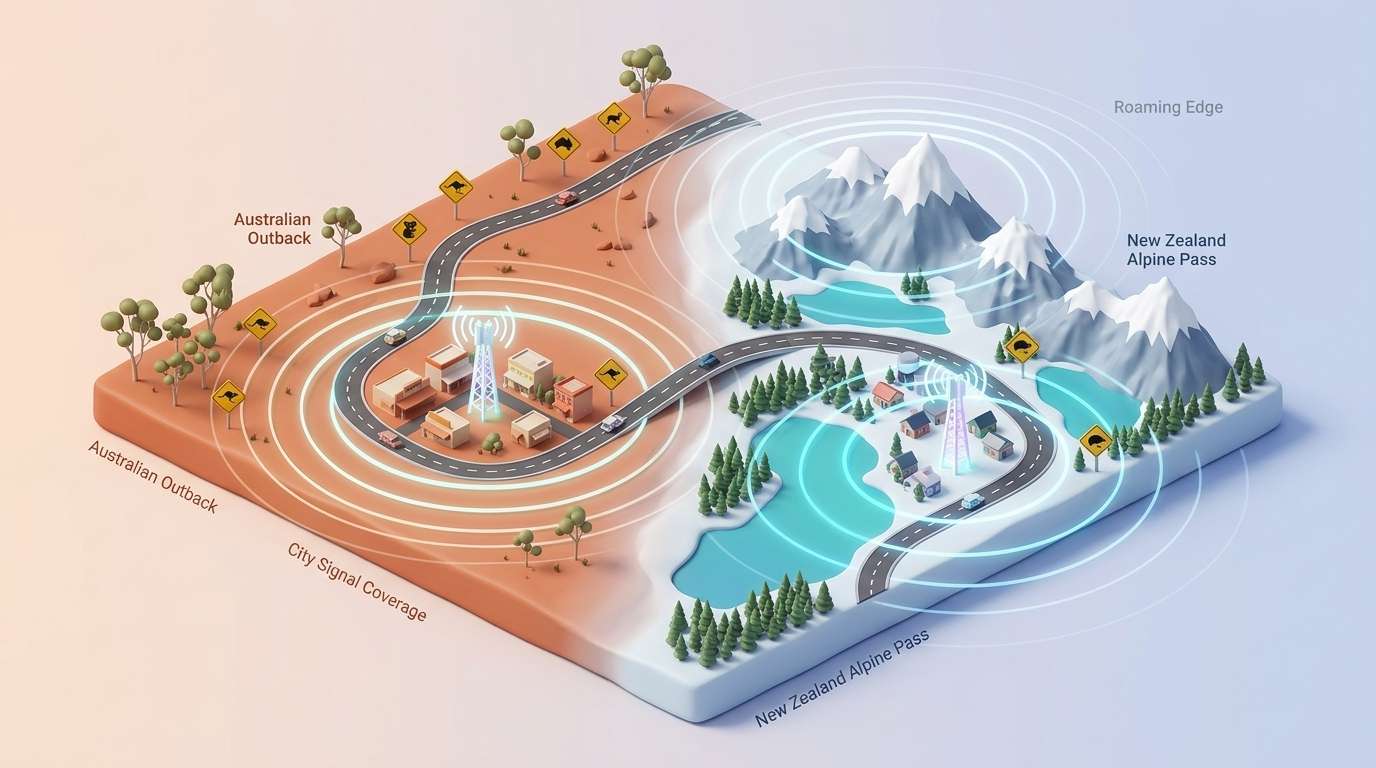
No SIM format creates coverage where the underlying network has none. The important question is which network carries the selected plan and whether that network covers your actual route.
Australia’s three national mobile operators are Telstra, Optus and Vodafone. New Zealand’s three mobile network providers are Spark, One NZ and 2degrees, according to the New Zealand Commerce Commission.
City itineraries are generally easier to assess. Road trips require more care:
- check the highway between towns, not only the accommodation postcode;
- check national parks, ferry terminals, trailheads and overnight stops;
- download offline maps before remote drives or hikes; and
- keep a separate emergency plan where mobile coverage is uncertain.
Coverage maps are predictions, not guarantees. Telstra’s official coverage map describes predicted outdoor coverage and notes that real experience can vary. Device choice, terrain, buildings and network demand all affect reception. New Zealand providers use standardized “good,” “moderate” and “limited” descriptions, but travelers should still check their specific stops.
With a dual-country plan, network access depends on the plan type. Daily options use Telstra and Vodafone in Australia and Spark in New Zealand. Total Data options use Optus and Telstra in Australia and Spark in New Zealand. These are network-access details, not a promise of uninterrupted service across every rural or remote route.
Daily Data or a Shared Total Allowance?
After choosing the connection method, choose the allowance model. The useful question is not “Which plan has the biggest number?” but “How predictably will I use data?”
| Usage pattern | より良い出発点 | What to watch |
|---|---|---|
| Navigation and messaging with occasional browsing | 合計データ | The shared pool stops when exhausted, so monitor usage |
| Similar use every day with regular uploads or hotspot sessions | 日次データ | The high-speed amount resets at local midnight, not 24 hours after activation |
| Uneven trip with several light days and one heavy day | 合計データ | One pool gives flexibility across the whole validity period |
| Heavy daily use where reduced speed is preferable to a hard stop | 日次データ | After the daily high-speed allowance, reduced speed may limit streaming and large uploads |
Ezigo の現在の Daily オプションでは、1 暦日あたり 3GB の高速データが提供され、その後は現地深夜のリセットまで最大 384Kbps のデータが提供されます。
1 日の有効期間は現地の暦日に従うため、夜遅くにアクティブ化すると初日が短くなります。
That shared-pool rule is useful for a Trans-Tasman itinerary. If you use less data in Australia, the unused amount remains available in New Zealand, subject to the plan’s overall validity.
What Happens When You Fly Between the Two Countries?
With one regional eSIM, crossing the Tasman should be a network-registration event—not a second installation.
以下の手順を使用してください。
- Install the eSIM over stable Wi-Fi before departure. Installation alone does not start the Ezigo plan.
- Label the line clearly, such as “AU NZ Travel.”
- On arrival in the first country, select that eSIM for mobile data and enable Data Roaming on the travel line.
- Keep data roaming off on your home line unless you deliberately want home-carrier data.
- When you land in the second country, leave the regional eSIM installed and enabled. It should register with the supported local network automatically.
- If it does not connect, toggle airplane mode, restart the phone and confirm the supplied APN or network-selection instructions.
Do not delete the profile during the trip. An eSIM QR code may not be reusable, and reinstallation can require support.
After the flight, the same allowance rules still apply: Total Data remains one shared pool, while Daily follows the local-midnight rule. Crossing the border does not create an extra allowance.
When a Single-Country or Oceania Plan Is Better
A two-country product should match a two-country itinerary. Use the narrowest coverage that fits the actual trip:
- Australia only: compare Australia eSIM plans and the existing オーストラリア観光客向けSIMカードガイド.
- New Zealand only: compare New Zealand eSIM plans rather than paying for Australia coverage you will not use.
- Australia and New Zealand: a dual-country plan avoids managing two separate data products.
- Australia, New Zealand and another Oceania destination: compare a broader オセアニアeSIM and check every included country.
This route-based split also prevents a common buying mistake: choosing the broadest-sounding regional plan without checking whether its destinations, networks and validity actually suit the itinerary.
Need One Plan for Both Countries?
If your trip includes both countries, your phone is unlocked and you mainly need mobile data, a regional SIM card for Australia and New Zealand can remove the second purchase and setup from the itinerary.
Explore Australia & New Zealand eSIM Plans to compare current Daily and Total Data options, supported networks, validity periods and plan details. The plans are data-only, support hotspot use and switch between supported partner networks across Australia and New Zealand without installing a second profile.
Choose a local service instead if a local number or domestic voice and SMS are essential. Choose roaming if your home plan already provides acceptable terms and keeping the usual line is your top priority.
よくある質問
Can I use an Australian SIM card in New Zealand?
Only if that Australian plan includes New Zealand roaming. Otherwise, it may stop working or create roaming charges. A plan that explicitly covers both countries is different from an Australia-only SIM.
Do I need two SIM cards for Australia and New Zealand?
Not if you use a regional eSIM that lists both countries. Two local services are mainly useful when you need local numbers, domestic calling or long-term local plans in each destination.
Does an Australia and New Zealand eSIM include a phone number?
Not necessarily. Ezigo’s Australia and New Zealand eSIM is data-only and does not include a local number, ordinary calls or SMS. Internet-based calling and messaging apps can use the data connection.
Does the data allowance reset when I fly to New Zealand?
いいえ。Ezigo Total Data プランは、両国で 1 つの共有固定プールを使用します。
When does the Ezigo plan validity start?
国境を越えても残高や有効性はリセットされません。
What happens after I use 3GB on a Daily plan?
日次プランは現地の深夜手当のルールに従い、国が変わったからといって 2 回目の手当を与えることはありません。
Can I share data with a laptop or another phone?
Yes. Hotspot sharing is supported on the current Ezigo Australia and New Zealand plans, subject to device compatibility, local network conditions and the selected allowance.
The Best Choice Is the One That Matches the Whole Itinerary
Choosing a SIM card for Australia and New Zealand is simpler when you separate convenience, local-number needs and coverage. One regional eSIM is usually the practical choice for a short two-country holiday focused on mobile data. Two local services suit travelers who genuinely need local numbers or longer domestic arrangements. Roaming suits people whose existing carrier already offers fair terms in both destinations.
Whichever option you choose, verify the included countries, underlying networks, activation rule and route coverage before buying. The right plan is not the one with the largest headline—it is the one that still makes sense after the flight between Australia and New Zealand.
編集者注: Network access, coverage, roaming terms and plan availability can change. Confirm the current product details and official coverage maps shortly before travel.
どこへ行っても、高速データ通信で快適に
Ezigo eSIMなら、物理SIMカードなしで、200以上の国や地域ですぐに安全なモバイルデータ通信をご利用いただけます。