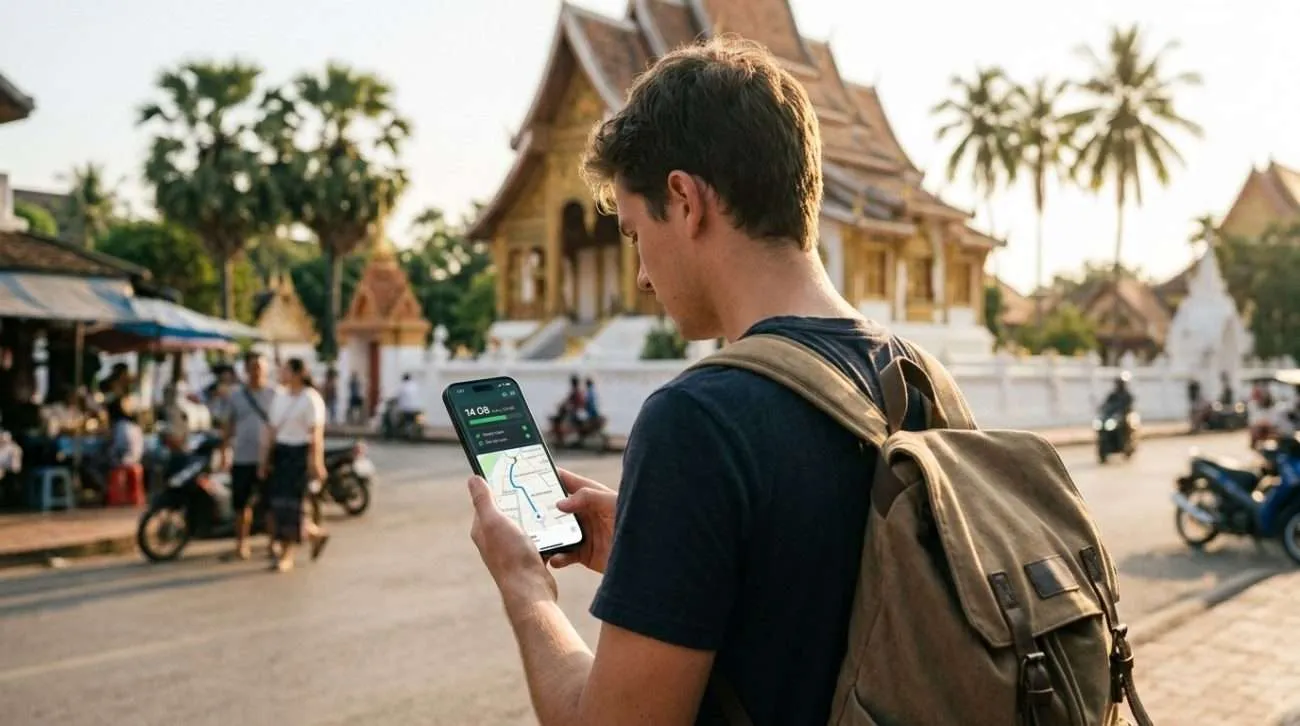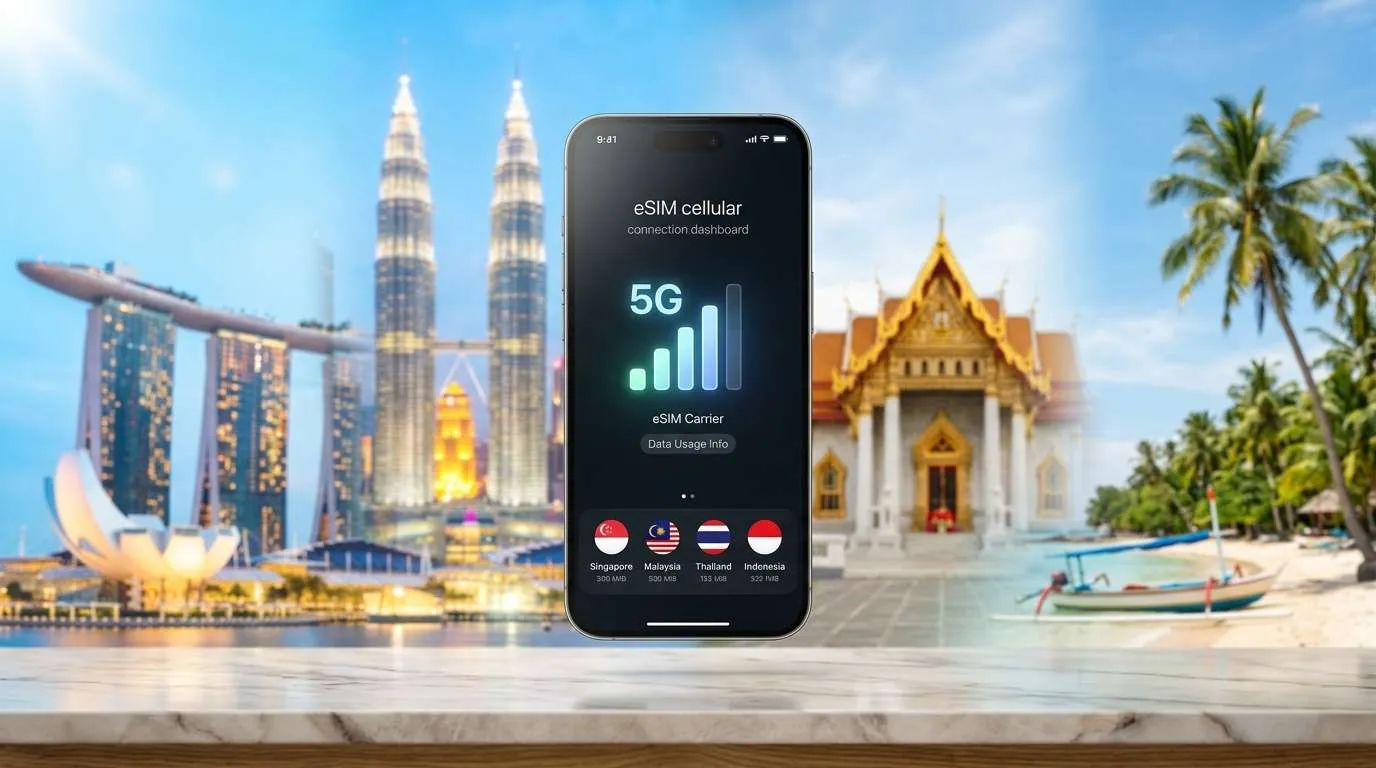
Editorial disclosure: Ezigo publishes this comparison and provides the 4-country Southeast Asia travel eSIM featured below. Network infrastructure, pricing tiers, and regulatory customs policies were verified against official records in September 2026 and can change over time.
✓ Fact-Checked against Singapore IMDA, Thai NBTC, and Indonesian Bea Cukai customs regulations.
Quick answer: which Southeast Asia SIM option should you choose?
- Multi-country route: Finding the best eSIM for Southeast Asia means selecting a unified 4-in-1 plan when visiting Singapore, Malaysia, Thailand, or Bali. It avoids multiple airport queues, cuts connectivity costs by up to 70%, and bypasses Indonesia’s complex IMEI registration.
- Single-country extended stay: Buy a standalone local physical SIM or destination-specific eSIM if you spend over 30 days in one country and genuinely need an assigned local phone number for incoming carrier voice calls.
- Home provider roaming: Select your domestic carrier’s daily roaming pass only when your carrier confirmed a fixed rate below $5/day and your overall itinerary is under 48 hours.
- Choosing the Best eSIM for Southeast Asia vs. 4 Local SIMs
- The Real Friction of Buying Multiple Local Tourist SIMs
- The Indonesia IMEI Trap: Advice for Bali Arrivals
- Network Quality & Local Tier-1 Carrier Alliances
- Choosing Your Data Allowance: Daily Limit vs. Total Data
- A Simple Pre-Departure Checklist
- Frequently Asked Questions
Southeast Asia is one of the world’s most accessible and rewarding travel corridors. Backpackers and vacationers frequently link cosmopolitan Singapore, heritage routes in Malaysia, tropical beaches in Southern Thailand, and cultural retreats in Bali on a single multi-week itinerary.
However, staying connected across national borders has traditionally meant navigating confusing telco booths. With digital embedded SIM profiles standardized globally by the GSMA, choosing the best eSIM for Southeast Asia ensures you no longer need to physically swap chips, risk losing your primary SIM card, or register your passport four separate times.
Choosing the Best eSIM for Southeast Asia vs. 4 Local SIMs
When weighing a regional digital package against local physical tourist cards, the cost, convenience, and regulatory benefits quickly become apparent:
| Criteria | Ezigo 4-in-1 Regional eSIM | 4 Local Physical Tourist SIMs |
|---|---|---|
| Pricing baseline | From $3.42 USD | $30.00 – $55.00 USD combined |
| Airport arrival setup | Instant (Auto-latches on touchdown) | 25–45 minutes in lines per airport |
| ID / eKYC requirements | Zero passport uploads needed | Mandatory passport scanning at all 4 |
| Indonesia IMEI rules | 100% Exempt (No Bea Cukai queue) | Must register at customs / tax risk |
| Primary SIM 2FA status | Active (Dual-SIM mode enabled) | Inactive (Ejected from phone tray) |
| Personal Hotspot | Supported on all options | Varies by tourist plan tier |
The Real Friction of Buying Multiple Local Tourist SIMs
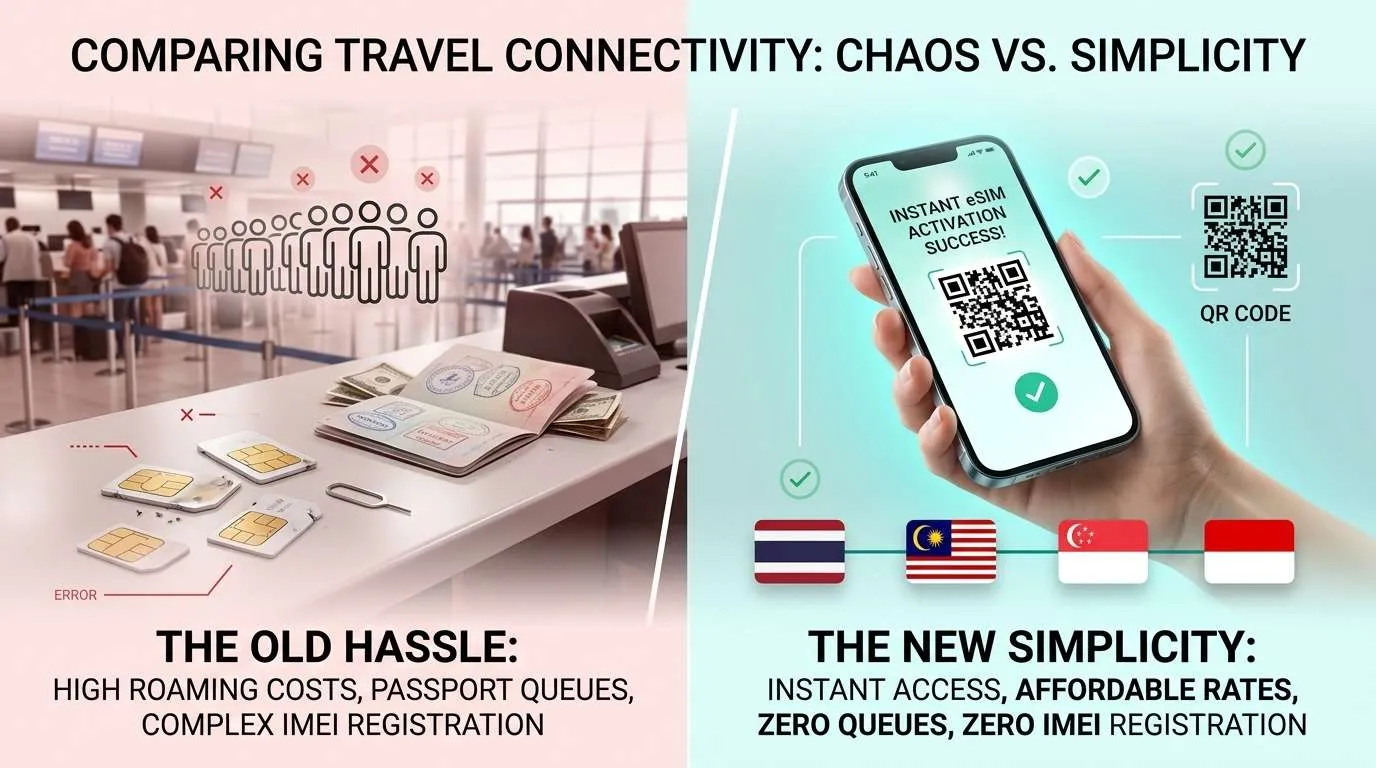
Purchasing standalone tourist SIMs locally sounds straightforward, but managing 4 separate transactions across four different regulatory environments introduces real travel friction:
1. Repeated Passport Verification & Privacy Exposure
Telecommunication laws enforced by agencies like the Infocomm Media Development Authority (IMDA) in Singapore and the NBTC in Thailand require strict in-person registration (eKYC). Tourists must physically hand their passports over at every counter, pose for facial scans, and wait for third-party booth attendants to process their profiles.
2. Bank Two-Factor Authentication (2FA) Failure
If your smartphone only has one physical SIM tray, ejecting your domestic SIM card prevents your device from receiving vital SMS security tokens. When attempting to verify a credit card transaction for high-speed train tickets or lodging reservations, you risk getting locked out of online accounts.
The Indonesia IMEI Trap: Advice for Bali Arrivals
Travelers heading to Bali (Denpasar) or Jakarta must understand Indonesia’s national telecommunications database policies, managed jointly by the Ministry of Communication and Bea Cukai (Customs).
Under national regulations, if you purchase and insert a domestic Indonesian physical SIM card into a foreign smartphone, the handset’s International Mobile Equipment Identity (IMEI) number must be officially declared with customs. For smartphones valued over $500 USD, travelers are subject to customs clearance lines, electronic declaration forms, and potential import taxes. Unregistered phones are blacklisted from local cellular towers within 48 to 90 days.
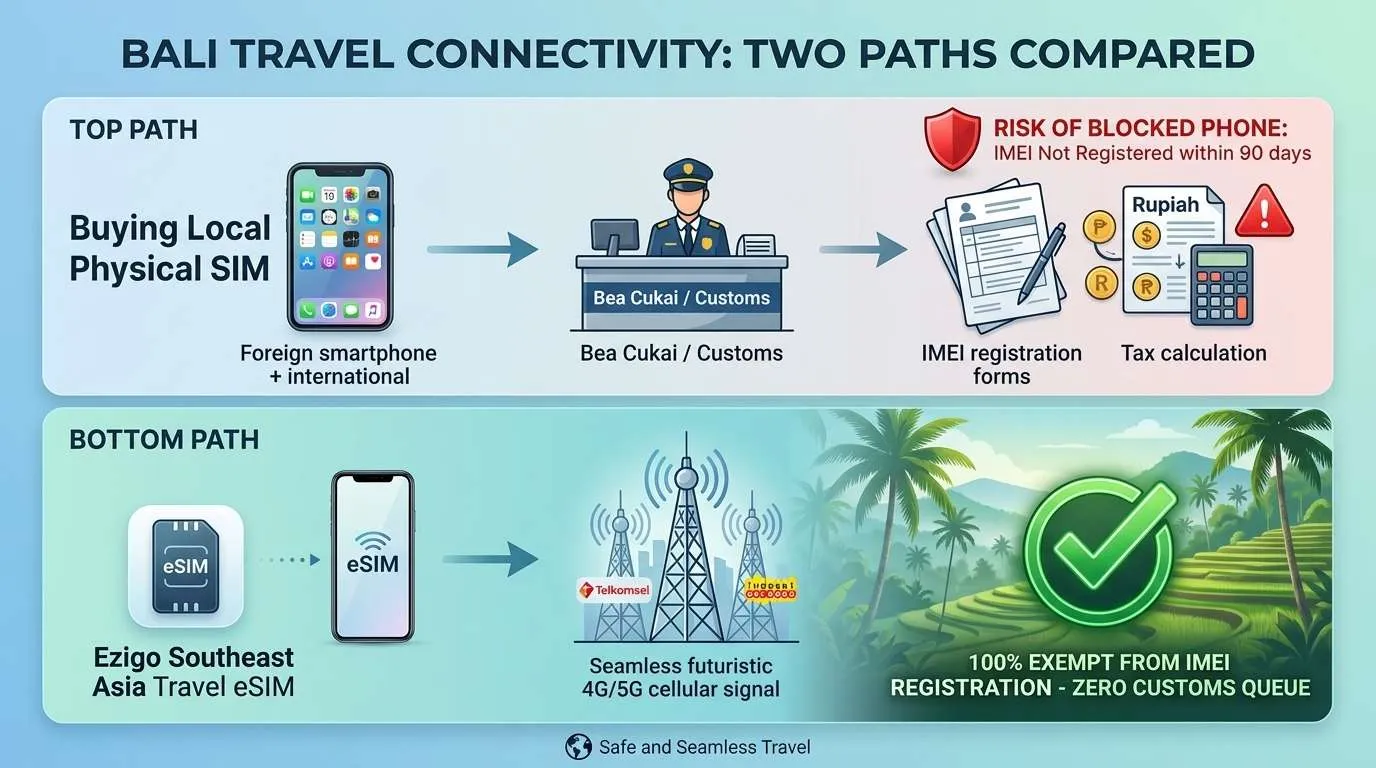
The Travel eSIM Exemption: When you connect through a regional travel eSIM profile, data traffic operates via international roaming carrier agreements with premier Indonesian telcos like Telkomsel and Indosat. As a result, tourist eSIM users are legally exempt from IMEI registration, avoiding customs declaration queues entirely.
Network Quality & Local Tier-1 Carrier Alliances
Some budget global roaming plans achieve cheap rates by routing data through unprioritized third-party virtual operators (MVNOs). The Ezigo 4-in-1 Southeast Asia eSIM partners directly with the leading Tier-1 cellular networks in each destination:
- Singapore: Primary connectivity via Singtel & StarHub (Sub-6GHz 5G and high-speed LTE).
- Malaysia: Dual-carrier fallback on Celcom & Maxis (Robust coverage from Kuala Lumpur to George Town and Borneo).
- Thailand: Nationwide access via AIS & TrueMove H (Superior coverage across Bangkok, Chiang Mai, and the southern islands).
- Indonesia: Verified access via Telkomsel & Indosat Ooredoo (The archipelago’s most resilient infrastructure across Bali, Lombok, and Java).
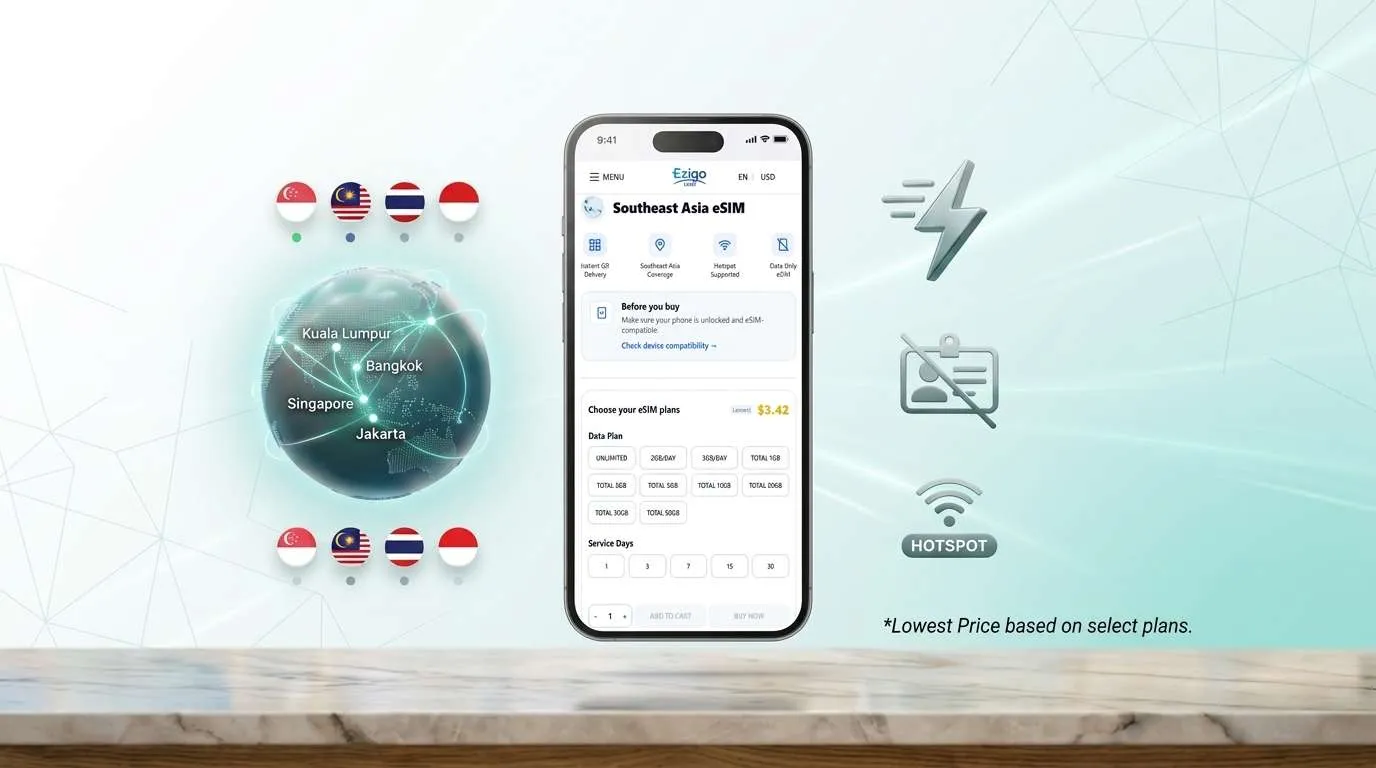
Choosing Your Data Allowance: Daily Limit vs. Total Data
Configuring your eSIM data profile depends on your itinerary length and digital habits:
- Total Data Packages (1GB to 50GB): Best for standard vacations where your primary needs involve Google Maps navigation, messaging, Grab ride bookings, and translation. You use your total data bucket freely over the entire validity period. (For a step-by-step calculation, check our guide on How Much Data You Need for Southeast Asia Travel).
- Daily Allowance / Unlimited Plans (1GB/day, 2GB/day, Unlimited): Ideal for digital nomads, vloggers, or business travelers who require regular hotspot tethering for laptops or video conferencing. Your high-speed allowance resets every 24 hours.
A simple pre-departure checklist
Check before departure
- Ensure your smartphone is carrier-unlocked and supports eSIM technology.
- Install your Southeast Asia eSIM on Wi-Fi before boarding; do not delete the profile once installed.
- Keep your primary domestic SIM active for incoming bank 2FA texts, but toggle its “Data Roaming” to OFF.
- Enable Data Roaming specifically on your newly installed Ezigo travel eSIM line.
- If crossing by land from Singapore to Malaysia (Woodlands/Tuas), allow 60–90 seconds for automatic tower handoff.
- For Bali arrivals: skip the Bea Cukai customs IMEI registration queues—your travel eSIM roams exempt from local device taxes.
- If using a Total Data plan, bookmark your top-up link to add gigabytes on the go if needed.
Frequently asked questions
Can I use one eSIM across Singapore, Malaysia, Thailand, and Indonesia? +
Yes. Choosing the best eSIM for Southeast Asia allows you to operate across Singapore, Malaysia, Thailand, and Indonesia on a single profile. When landing or crossing borders, your phone connects automatically to top-tier partners (Singtel, Celcom, AIS, or Telkomsel) without changing settings.
Is it cheaper to buy local SIM cards in Southeast Asia? +
For a single country visit exceeding 30 days, a local shop SIM can occasionally save small amounts. However, across a multi-nation trip, buying 4 separate physical cards means paying tourist markups and activation fees four times over. From $3.42 USD, a unified travel eSIM offers far better value, zero queue time, and no passport verification friction.
Do tourists need to register IMEI in Indonesia when using a travel eSIM? +
No. IMEI registration with Indonesian Customs (Bea Cukai) only applies to foreign smartphones using locally issued Indonesian physical SIM cards. Regional travel eSIM profiles connect via authorized international roaming agreements, keeping foreign tourists legally exempt from customs declaration queues, handset lockouts, and import taxes.
Can I use mobile hotspot/tethering with the Ezigo Southeast Asia eSIM? +
Yes. Personal hotspot and internet tethering are fully supported across all 4 countries on both Total Data and Daily data plans. You can share your connection freely with laptops, tablets, or travel companions.
When does the Southeast Asia eSIM validity start? +
Validity begins only when the eSIM connects to a supported cellular network in Singapore, Malaysia, Thailand, or Indonesia for the first time. Installing the eSIM at home ahead of departure does not trigger the validity timer.
Final planning advice
A multi-country trip across Southeast Asia is easiest to enjoy when you don’t overcomplicate logistics. Pick your core destinations, keep transportation flexible between hubs, and ensure your phone is ready to navigate immediately upon arrival with an offline map backup and a verified regional eSIM profile.
The region’s best moments—from catching a night train through southern Thailand to hailing a sunrise scooter in Canggu—rely on smooth digital access. Avoiding airport SIM queues and bypassing registration headaches means your journey starts the moment your wheels touch down.
Get Connected in Southeast Asia with Ezigo
Prepare your mobile data before traveling to Singapore, Malaysia, Thailand, and Bali. Enjoy flexible high-speed plans with hotspot support across major Tier-1 networks from just $3.42 USD.
View Southeast Asia PlansSources and methodology
- Infocomm Media Development Authority (IMDA) Singapore: SIM registration requirements
- Directorate General of Customs and Excise (Bea Cukai) Indonesia: Passenger IMEI registration guidelines
- GSMA Official eSIM Specifications and Architecture
- Ezigo 4-in-1 Southeast Asia eSIM technical plan terms
- Ezigo Thailand destination connectivity guide
- Ezigo Indonesia and Bali network specifications
This article is an editorial pre-travel guide based on current regional telecommunication regulations, verified network peering agreements, and public regulatory sources. Local carrier roaming terms, customs thresholds, and registration procedures are periodically reviewed and updated.
High-speed data, wherever your journey leads
Enjoy instant, secure mobile data with Ezigo eSIM in 200+ destinations. No physical SIM needed.